Resuming our journey Apologies for quite a lengthy absence, we had a significant family health issue to deal with, which is now fully resolved and not expected to cause any further problem. However the account of our journey to Liverpool is now very behind schedule as we actually reached the big city a month ago now. (You’ll have to wait for photos) When I last wrote, we were in East Marton with its double bridge,
East Marton, double bridge
and it had started to rain. To be honest, it’s felt like it’s rained most of the past six weeks and as we were leaving the intense beauty of the Dales a grey drabness enveloped us.
Rain. Rain. Rain.
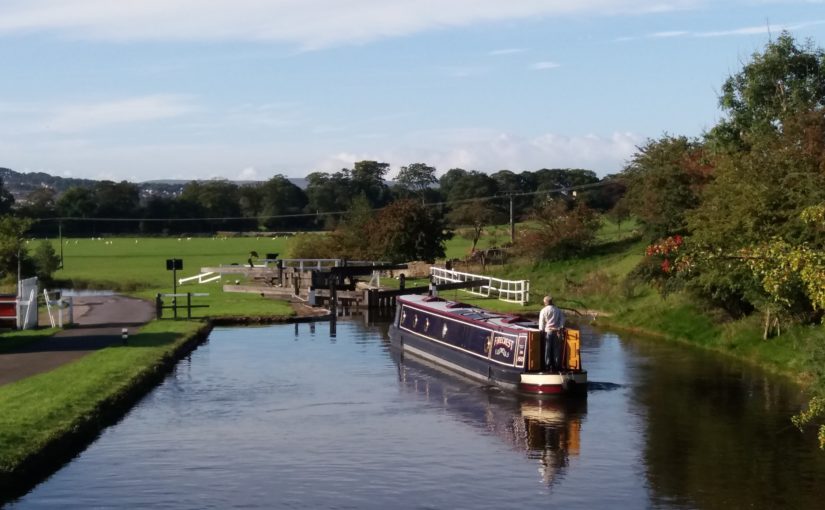
Being true codiwomplers we do have the luxury of time and are able to stay put inside if it rains. But undeterred we dodged the showers and continued up the last few locks at Greenberfield.
Arriving at the summit of Leeds and Liverpool canal
And shortly after crossed the border from Yorkshire into Lancashire at bridge 149.
Passports please, crossing the border.
Then came the one way Fouldridge tunnel with its traffic lights. Because of number of widebeams using this canal it’s inappropriate for CRT to ask them to restrict passage to 8am as they do for other one way tunnels. So each direction has an allocated 10 minute time slot per hour in which to enter the tunnel and make it’s minute journey into the darkness. Can you imagine car drivers waiting 50 minutes for the lights to change.
Waiting for the lights at Fouldridge tunnel
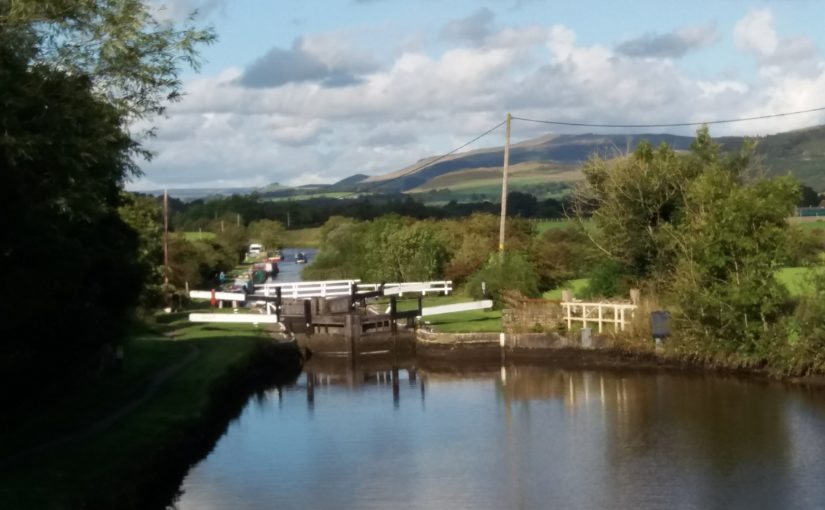
We were now descending the Pennines and our first series of locks at Barrowford didn’t disappoint.
Looking down over Barrowford locks at Barnoldswick
In one sense going down is easier because I can open the paddles fully to empty the lock but on the shorter locks it’s harder to open the gates without the helm getting soaked under the deluge from leaky gates.
This is true Yorkshire Dales country. We’re high up and it feels like the canal is still climbing although this is an optical illusion as we haven’t seen a lock since Bingley. It’s because we’re reaching the top of the valleys.
Heading towards Gargrave
But we still had a few hundred feet to climb before we reached the summit of the canal and locking up began again at Gargrave.
Super highway super slow way
We were a bit disappointed that the footpath closures meant the mooring in Gargrave was restricted and limited, which is a pity because it’s a pretty village, one that we have driven through many times. But the generous side of my nature says it’ll be a fantastic asset to the walkers and cyclists once it’s finished.
Overnight mooring just before
We moored one night but then took advantage of a fellow traveller to share the locks
Proof that it’s not just the women who like to chat
People aren’t wrong when they say this is the prettiest section of the canal, and I think the Gargrave flight definatelty makes it into my top 10 for views. We were lucky that our dramatic cloudy backdrop held onto the rain until after we had cruised.
Just another beautiful bridge
We were able to stretch our legs with some bracing walks
Bridge over the river Aire
Thankful that we didn’t have too strenuous a climb to reach the top.
Around Bank Newton
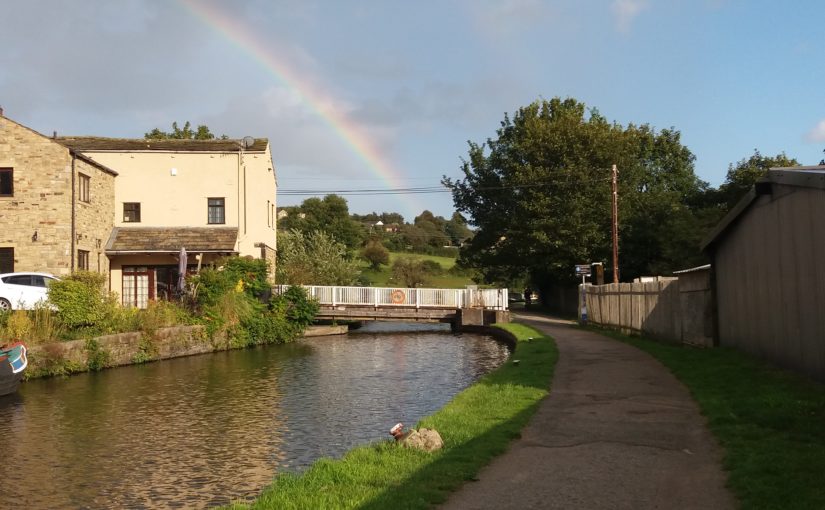
Sadly the weather didn’t play fair and we had to dodge some heavy downpours before reaching East Marton, though without rain you dont get rainbows and I was able to take advantage of a sunny break to show off my Towpath spinning.
100g Jacob wool
It would have been easy to slip through the tiny village of East Marton if we hadn’t been on the lookout for the water point. And the lock keeper had told us that the Cross Keys pub did a good Sunday carvery.
Looking down from the Cross Keys,
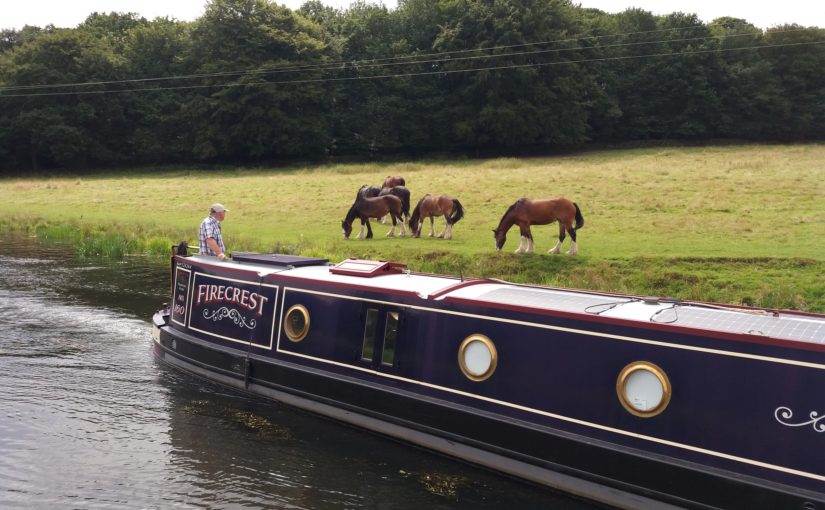
We could just about see Firecrest nestled below us, in the far left, as we ate the best roast beef and Yorkshire pudding we’d had since I last cooked it in Boroughbridge.
There’s Roast Beef underneath that Yorkshire pudding
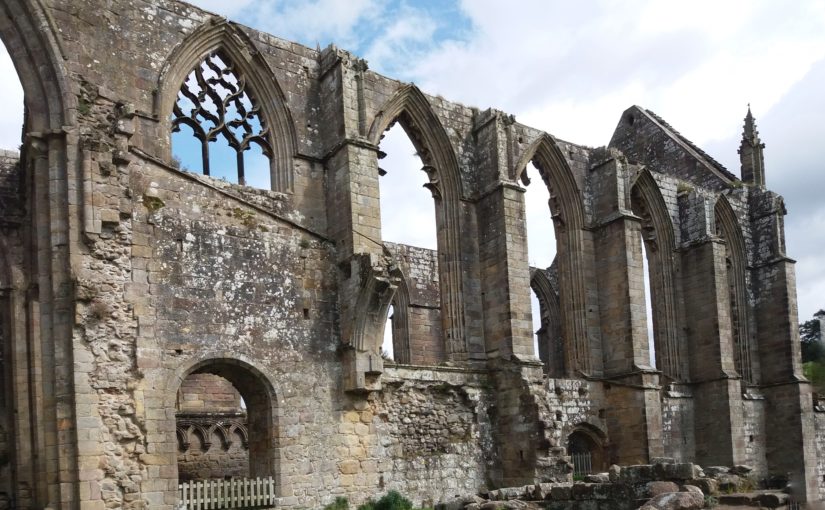
Mum decided to take advantage of the scenic drive over from the Lakes to visit us in Skipton. So we decided to take advantage of their wheels and asked for a trip out to visit Bolton Abbey. I’d not been before and thought it was just the ruins of an old monastery .
Bolton Abbey
Well I guess to some extent it is, but there’s oh so much more. Bolton Abbey is really the whole estate village, owned, run, and cashed in on, by the Duke of Devonshire and his family.
Bolton Hall
There is an active church known as the priory still attached to the ruins which is a place of beauty in its own right, with stunning stained glass
Pugin’s Victorian stained glass
And the most unusual painted alter wall, depicting Madonna Lilies and other symbolic plants.
We could have sat and absorbed the peace that flowed through this building despite its turbulent past, being partially destroyed during Henry VIII’s dissolution of the monasteries, but the outside was calling us
And as we sat to enjoy the view
We had to have a family photo
Those grey clouds were getting ominously closer so we decided to take a drive through the estate where we were able to stand in the ancient oak woodland and look down onto the River Wharfe and over to the Priests house in the distance
The River Wharfe towards the Priests house
The whole area of Wharfdale is stunning, and I was so lucky to be taken for a drive through it. Even though its so close, its quite different from the views we get from the canal.
Oh good, I thought as we left Bingley, “No more locks for a while.” What I hadn’t realised was that by following the contours through farm land, was just how many manual swing bridges I’d have to open and close. Some were pretty and pleasant but a lot were simply fiddly hard work, needing a CRT anti-vandal handcuff key and help from passers by to get the heavy compressed mechanisms shifting.
Milk Hall swing bridge
But leaving the awkwardness aside we were travelling through some of the prettiest countryside.
Another lovely place to live
And I don’t think I’ll ever get tired of stone bridges
Kildwick
Or houses that come straight down onto the canal
Kildwick Main Street
Even the mills across the fields were lovely
Cross lane Mill, Bradley.
We had to chuckle to ourselves that we used to drive this way to and from the Lake District not knowing there was a canal on the other side. Although we could say the same about our cruise, who’d have thought there was a main road just over that wall.
The super highway A65
We were looking forward to coming into Silsden because it’s one of the places we visited, if only because it was on our Lakeland route, when we were designing Firecrest.
Looking East from Silsden Bridge
But we’d never explored beyond the canal. So it was a pleasant afternoon walking around this lovely little town, watching the dogs watching the river ducks
And finding out about the nail trade that arrived in 1776 in Silsden from the Midlands.
We also found out that in the 1830s 3 Silsden men were some of the first to be transported to Austrailia rather than being hung for burglary. So we thought it was time to move swiftly on.
After a few more nights in the countryside
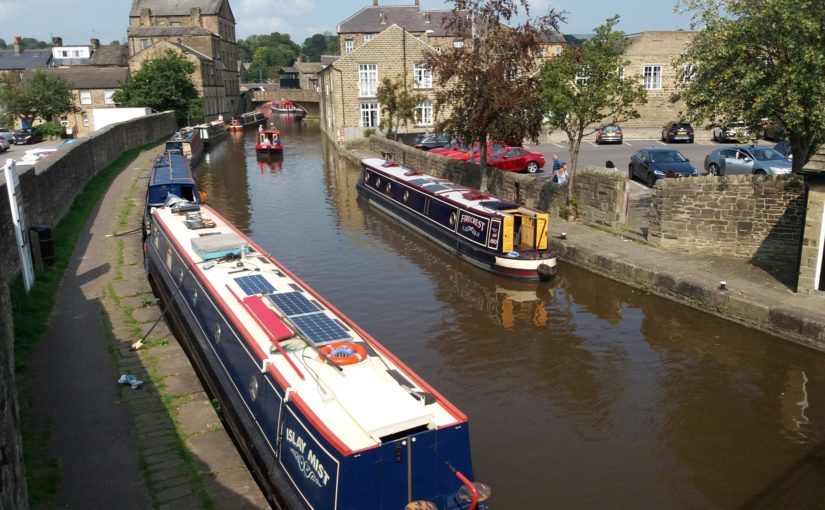
We moored up underneath the Victoria mill chimney in Skipton
Skipton visitor moorings
We rushed off to have fish and chips from Bizzie Lizzies, another tradition from our 4 wheeled travels. Skipton is overflowing with fine foods, and is the home of several award winning pie shops.
Champion pork pies
We sampled as many as our bellies would allow. So we burnt off a few of the extra calories doing a bit of walking, and discovered the Skipton woods by the castle, guarded by the Huntress of Skipton.
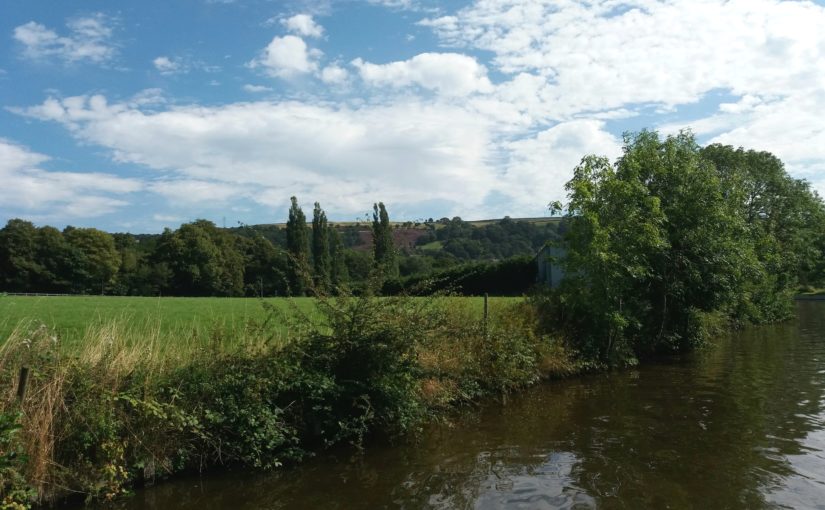
Our journey westwards continued through some of the loveliest countryside, with the canal following the contours of the land. Land which rolled into hills, farms and valleys with woodland and views in abundance.
Milking time on the farm
And on the whole, we were lucky enough to be traversing this section in good weather. We took advantage of some shady towpath mooring.
Low wood woods
We found ourselves next to Low Wood Nature Reserve, which although next to a beautifully manicured golf course to the south,
Keighley golf course
took us ruggedly upwards through scrambling rocks just begging to be climbed.
Exploring Low Wood Nature reserve
Forget the golf course, this was our sort of playground.
Who’s the king of the castle
And we found plenty of nature around the reserve.
The common shrew, parasol mushrooms Pygmy goat, Speckled Wood Butterfly
Of course being surrounded by ancient oaks, is an ideal place to build a business if you love wood. Eric was beyond excited when he realised one of the companies he buys furniture grade wood from was within walking distance of our mooring.
The British Hardwoods candy store
And while he oohed and arred throughout the vast selection, okay admittedly I was also very impressed, he was very restrained and only bought a small piece to do some tweaks to Firecrest.
One very happy customer
When we downsized to move onto Firecrest, it was Eric’s woodworkshop that was the hardest to leave behind. Fortunately for me, wool is much more squashable and I was able to sneak a lot more into the hidden corners of Firecrest. So when the weather is as good as it was this week I was able to indulge my hobby and sit on the bank spinning.
100g freshly spun Jacob wool
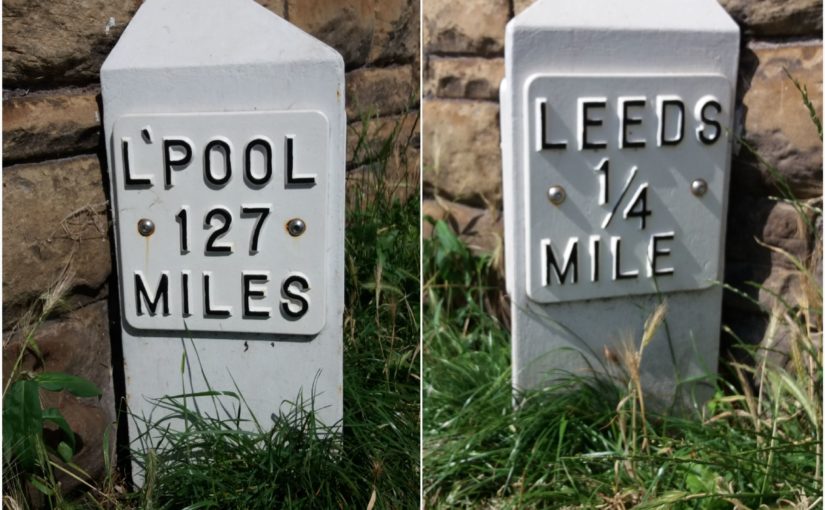
While we were relaxing and enjoying the world go by we realised every now and then a sweaty runner with a number shuffled past. I just had to ask about their race as they were so spaced out. It turns out they were competing a mega marathon, one of three CanalSlams, which entailed running from Liverpool along the towpath, all the way to Leeds. Oh my goodness that’s 117 miles. Not only is the distance mega, they were doing it non stop. After I’d picked myself up off the floor, I had a look at the website. 59 runners started the race, 36 completed it. There were checkpoints every 10-15 miles and they were allowed buddy runners for encouragement, although the buddies were not permitted to run ahead In case that made them pacers. They were allowed to sit in a support vehicle for up to 40 minutes break provided it didn’t move. They left Liverpool at 6am and the winner arrived 22 hours later. The last – I refuse to say looser- took 39 hours. According to AC canal planner it takes 66 hours for a narrowboat to do the same journey, I guess the runners didn’t have any locks or swing bridges to negotiate. I could have taken photos but I decided I would stand up and cheer as each one went past, I even topped up a couple of water bottles for them. I forgot to ask how they were getting back to the car park in Liverpool.
Nice place for a run
While we were in this area, we were lucky to meet fellow Braidbar Boaters on Mr Blue Sky. We took it as a great complement that they had designed their boat with a similar style bow as ours and had followed the continuing innovations in using an electric motor.
The mooring at the top of Bingley five rise is tricky. It’s either too shallow or there is a concrete shelf running just under the waterline. It’s frustrating because you don’t know you can’t get in until you try and fail, but this time it worked in our favour because we were forced to cruise on another 10 minutes to Micklethwaite. Close enough to walk back into Bingley and with a number of good country walks.
Micklethwaite mooring
My trusty OS map showed me that we were right on the edge of Ilkey Moor, so off we went, humming that famous Yorkshire anthem to ourselves
Running up that hill
The heather was stunning, and we could see for miles. That’s Keighley (pronounced keithly) on the hill on the far right. The canal meanders along the valley contours below Keighley towards Skipton.
Looking towards Keighley
And when we got to the top we realised just how vast and bleak the moor was. Can you imagine what it would be like in winter. Or how easy it would be to get lost. It was less than 4 miles to Ilkey but we decided we weren’t dressed for a proper hike.
On Ilkla moor
It was blowing a gale up here, so yes even if we’d brought our hats we wouldn’t still be wearing them.
Baht’at
It was a bracing and invigorating walk. And as we descended back to the canal we found a nice pub for Sunday Lunch . And enjoyed looking back up the hill, which was a lot higher than the photo suggests.
Looking up towards Ilkey Moor
The next day Eric needed to catch up on a few things so I took myself off to visit Riddlesden Hall, a NT property on outskirts of Keighley
Riddlesden Hall
A small but interesting manorial farm house, one of its outstanding features is the 400 year old Great Barn.
The Great Barn at Riddlesden hall
It’s collosal and virtually unchanged since it was built. It was used as a threshing barn and also house 42 animals in stalls around the edge. Inside the house is a collection of ornate needlework and some spinning equipment.
Lots to interest me.
Micklethwaite was another lovely base to spend a few days exploring away from the canal. If we had moored at the top of the five rise, we would only have stayed one night and missed all of this.
And for those of you that don’t know the full Ballard of Ilkley moor here are the words and a translation
And the climb continues. Leaving Saltaire we headed off westwards to the Bingley staircases. Eric does most of the helming when we cruise, but as we’d got at least 11 locks and several swing bridges to do in today’s journey, I took us through Hirst and Downy
Hirst lock
We’re really enjoying the scenery contrasts, one moment it’s rural bridges
The next it’s those industrial landscapes and mills as we passed through Bingley. Wonder what’s made in that factory.
Keeping Bingley warm
There are experienced lock keepers assisting passage up and down the Bingley boat wash, I mean the Bingley 5.
Bottom lock Bingley five rise
And plenty of gongoozelers to watch and help, so it’s quite good fun, and really lovely.
Quite an audience
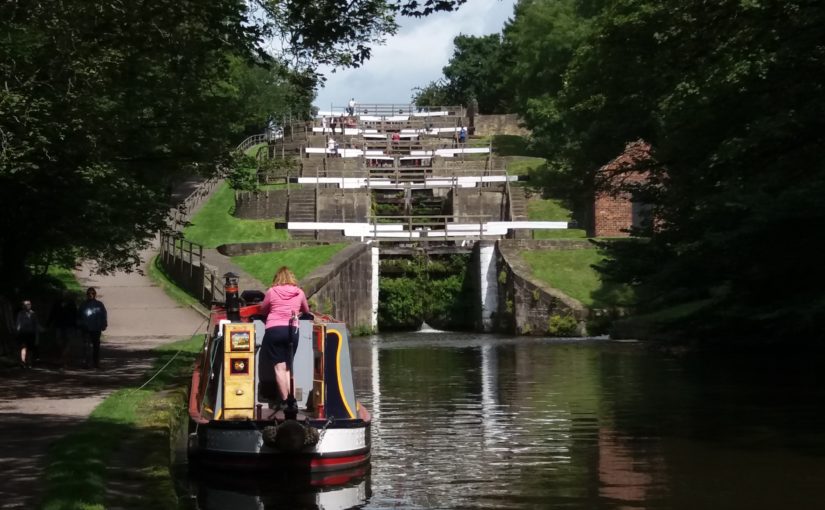
Bingley 5 rise is considered one of the 7 wonders of the inland waterways. It’s a stunning feat of engineering, at 60 foot its the steepest and deepest of all the staircases. It was completed in 1774 and is now classed as a grade 1 listed monument.
Lock keepers know how to draw the water down each lock so boaters don’t end up flooded or stranded. It’s easy to get muddled as each lock opens directly into the next. I’m not sure if that’s a look of satisfaction or relief as we reached the top.
I love a happy lockie
While I just stood and admired the view, before we popped into the top lock cafe for bite to eat.
Can’t believe we’ve only done 16 miles from Leeds. We thing they should add the number of locks and swing bridges as well as miles.
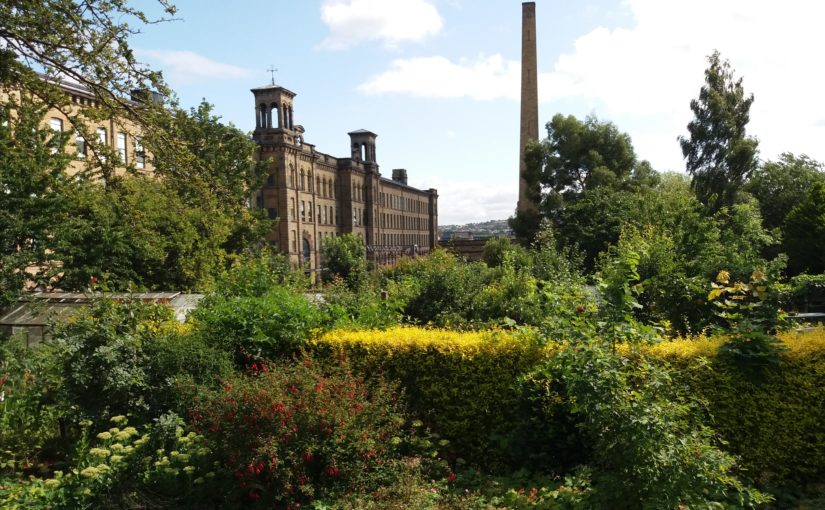
Our next stop, shortly after Shipley, was Saltaire. We’d heard about this “model village” that was now a world heritage site, but we weren’t prepared to be as awestruck as this. The canal cuts right through the middle of the site and were were graciously permitted the grand total of 6 hour mooring along side the famous mill.
Saltaire canal passage
Frustratingly there’s loads of mooring with rings immediately before this little section but there’s a concrete shelf just below the water level which means you can’t get close enough to step off safely. But gripe over, we took our 6 hours then found an idyllic spot about 1/4 mile beyond which meant we could stay up to 14 days and really absorb the atmosphere of the place.
Mooring below Hirst lock
Saltaire grew out of the vision of Titus Salt, entrepreneur and philanthropist. A very sucessful local business man, manufacturing cloth in Bradford, he naturally wanted to expand his empire. Being an upright Christian man with a strong social conscience, he was concerned by the squalid living conditions of his workforce. Seeing the ecconomic potential of both canal and railway, he set about building a new mill along the banks of the River Aire. And so in the 1850s “Saltaire” was born.
Looking over the allotments on Victoria street
A purpose built town,”model village” where the whole production of cloth, from fleece to fabric, was done under one, albeit very large one, roof. And the 4000 employees rented well built houses with amenities for their health and wellbeing. I suspect it was still a very hard life. There were strict rules about moral conduct, but Sir Titus recognised the financial benefit of caring for his community, and it was undoubtedly a better life than living in the slums.
One of the back streets
The town was meticulously planned, generally speaking the higher up the ladder you climbed, the more space you got. There were libraries, schools parkland and playing fields, even a hospital and alms houses for those unable to continue working. Strangely though, the bath houses were never accepted, so they were converted into more living accomodation.
Victoria Street
Sir Titus demanded the very best and in true victorian style the buildings were ornately decorated. He managed to obtain the 4 lions that were originally intended to stand at the base of Nelsons column in London (The Trafalgar Square commission had been given to another sculptor after Milnes had made the Saltaire lions, hence the reason they were looking for a home.)
The Saltaire Lions
But perhaps one of the most impressive buildings is the congregational church, which is still an active place of worship. And very beautiful inside.
The congregational church
Nowadays Saltaire has expanded and is home to more tourists than residents. As the British cloth industry was taken over by cheaper forgein imports, the grand mill fell into decline and disrepair. In the 1980s Johnathon Silver bought the mill and created a thriving environment for artists, visitors and small businesses. The most famous collaboration was with the artist David Hockney, another local man, who’s works are showcased in the many galleries. Hockney’s work is contemporary and not to everyone’s taste, certain aspects of his work are quite simplistic at first glance. But I enjoyed the grandeur of seeing whole series of large pieces displayed together.
Hockney exhibition
It wasn’t all expensive gallery, there was some fascinsting historical information and artifacts on display, in fact with several eateries, something for everyone.
Some of the old machinery
Mum was able to come down by train to share some of my explorations. We discovered 2 craft shops just off the main street, Barley Crafts and the Craft house, insentive enough to return, especially as the ladies at Barley craft insisted I stopped and had a cup of tea with them. I was able to talk to people who had worked in mill before it closed production and had real living memories of how it was their grandparents day.
The Craft house pigs and Barley Crafts
Then we pretended to be promonading Victorian ladies and went to meet Sir Titus in Roberts Park.
Sir Titus Salt in roberts Park
And his alpacas, Sir Titus was instrumental in popularizing worsted cloth made with Alpaca.
And finished the day with a traditional “Yorkshire Rascal”, now where did Eric go…
Enjoying a Yorkshire Rascal
The town is now a recognised World Heritage site, recognising the concept and the architecture. We spent several days just wandering around and left knowing there was still more that we hadnt seen.
Looking eastwards between the mills
We might get to see more of Saltaire next year because a film crew was making a feature for Netflix charting the rise of the Football association.
More lovely place names, although I suspect there was a bit of reverse phsycology going on. I doubt that life working in a spinning mill was a particularly sunny experience. We moored at Rodley for a few days.
Rodley
And I made my first discovery of the old Yorkshire cloth industry. There are old mills all along the banks of the canals and rivers. Sadly the spinning and weaving industrial revolution in this country has been overtaken by the cheaper manufacturing processes in other countries but the legacy of the old buildings remain. Some have been demolished, others gentrified into desirable accommodation and some have survived to take advantage of the vast space inside. Sunnybank Mill is one such place, about 20 minutes walk from Rodley into Farsley, it’s full of creative people and artisan eateries. But the area that grabbed my attention was the scrap store.
Sunnybank Scrap store
It is a social enterprise scheme where local businesses donate their waste, to prevent it going into landfill. The team then sell it at very low prices. It’s like a glorified jumble sale and this huge cavern stretches for as far as the eye could see. And I was left to wander and wonder at such potential. But living on a narrowboat requires strict self control, no superfluous clutter…..so much to Eric’s relief I didn’t bring it all back to firecrest.
As a reward for good behaviour I was treated to a cream tea at the Tiny Tea room on the canal bank.
A Tiny Tearoom cream tea
It really is tiny. No inside seating, and just a sink and work surface in the tiny stone building.
The tiny tearoom
But the weather was good so we made the most of it, and enjoyed a bit of gongoozling ourselves as we watched to narrowboats cruise past. It really is very pretty around here, hard to believe were only 10 miles or so from Leeds.
Our cruising was to take us through Apperley Bridge, which is the home of Bear Boating. And this is where Eric and I did our helmsmans course before we moved onto Firecrest.
Bear Boating base at Apperly Bridge
They taught us how to do locks and swing bridges, which is probably a good job because there are a lot of both on this canal.
If only all were automated like this one, life would be so much easier.
You’d think we’d been in Leeds for weeks but it was only 5 days. We’d seen such a lot, but one of our personal highlights was visiting the house in which Eric was born over half a century ago. Eric’s father was a Methodist minister and we were able to worship at his church. Although the family moved when Eric was just a nipper there were still people who remembered his Dad.
Much to our amusement, I was born in Liverpool so this really is a journey going back to our roots.
Sadly not all boaters have such a positive experience of Leeds and the advice is to travel earlier in the day because the local troublemakers don’t get out of bed before midday.
We heeded this advice and had an enjoyable passage although those first locks were a bit of a shock to my system because I’d been spoilt by the automatated river locks.
Thankfully we had a lock buddy for the kirkstall and Newlay rises and as they were staircase there was also a lock keeper in attendance to make sure we didn’t mess it up.
We treated ourselves to a night in the Aire Valley marina so we could fully charge the batteries on shore power and our second night out in the country side.
Relishing the peace quiet and tranquillity after city life.