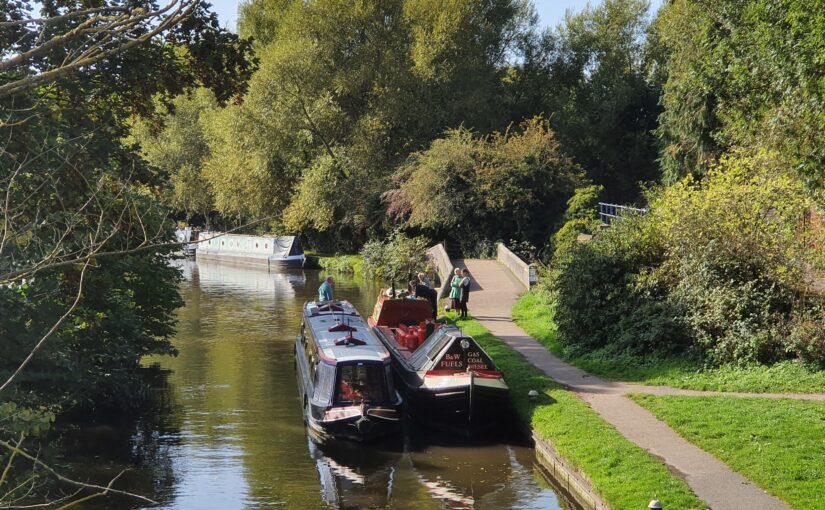
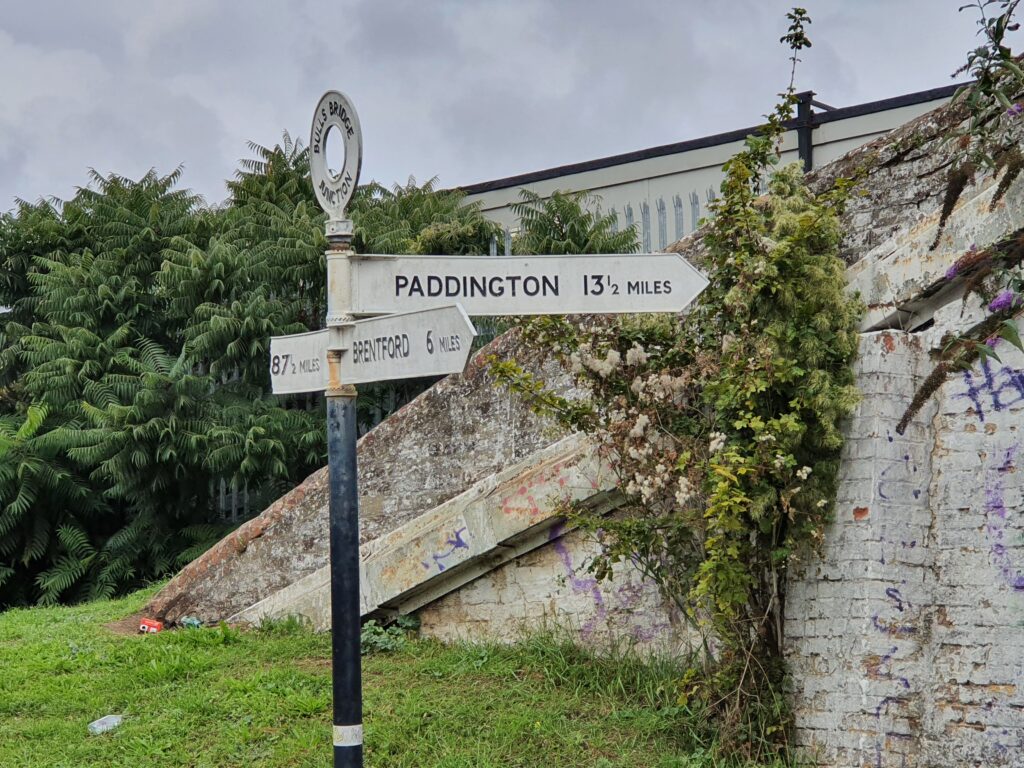
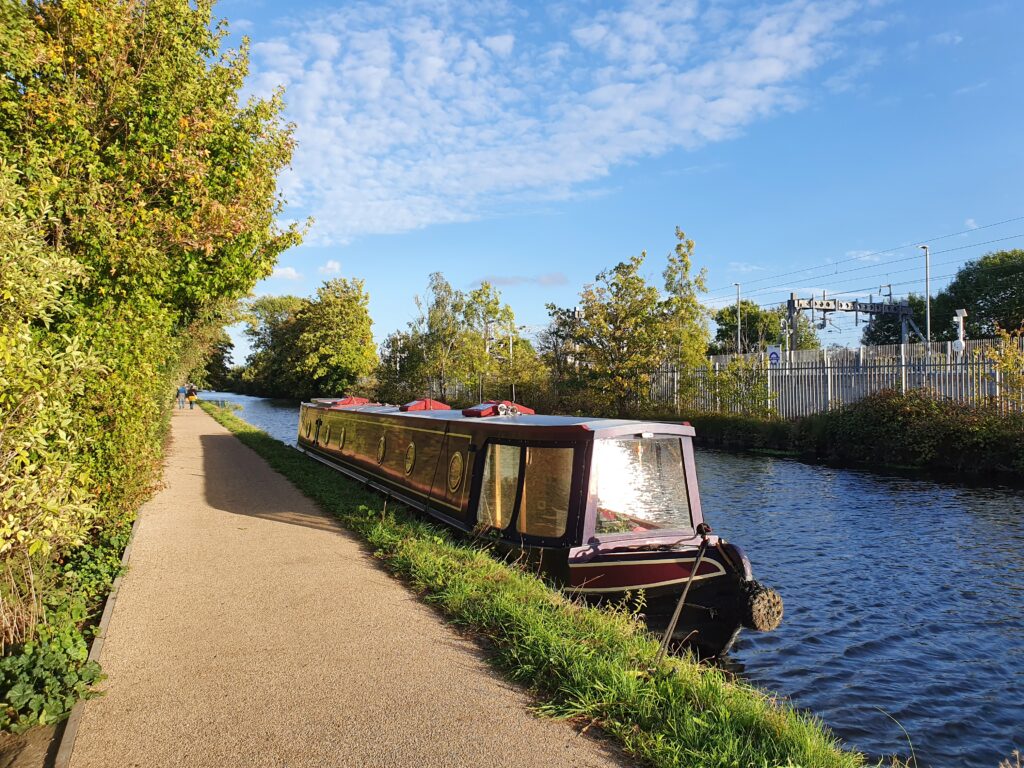
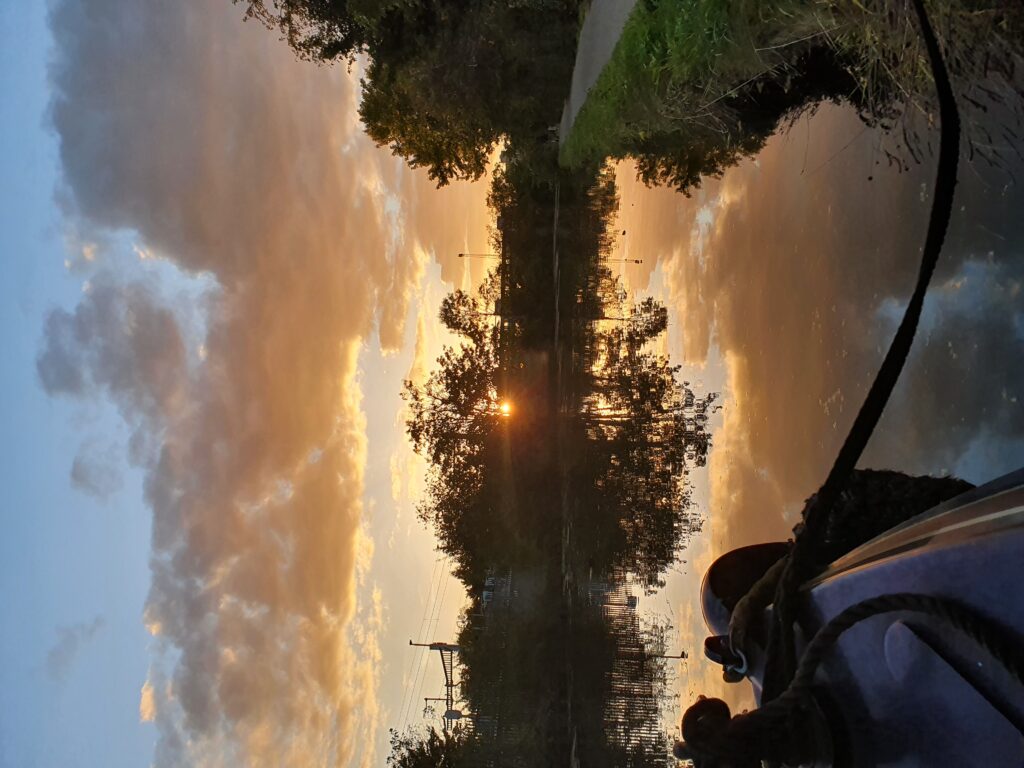
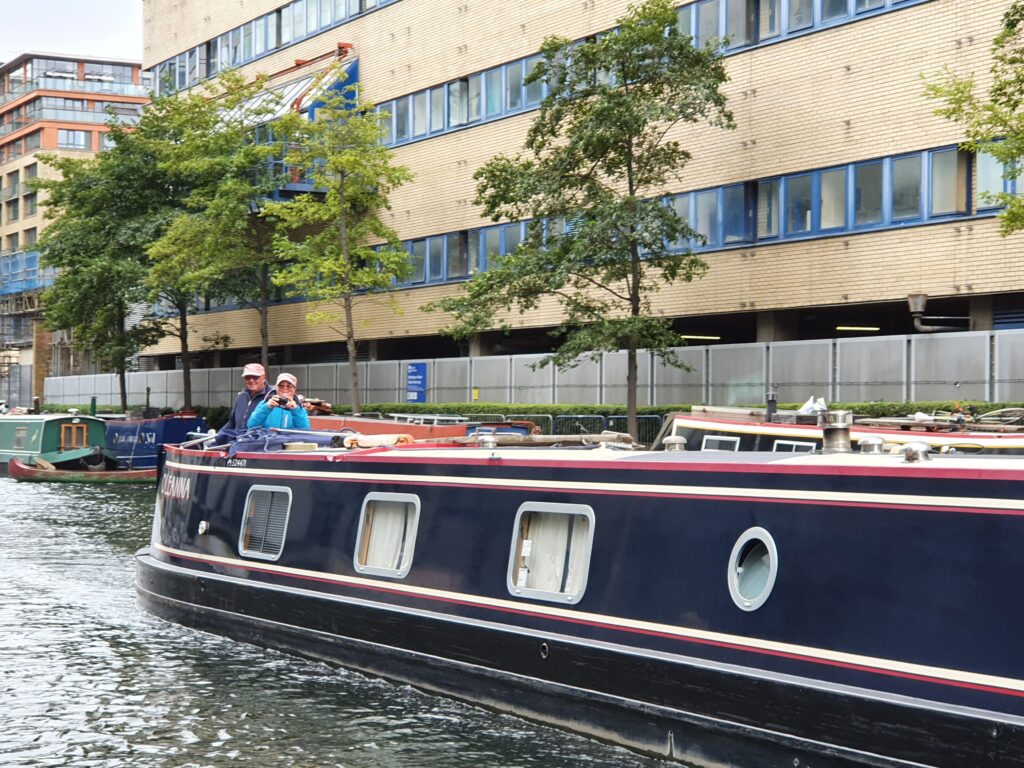
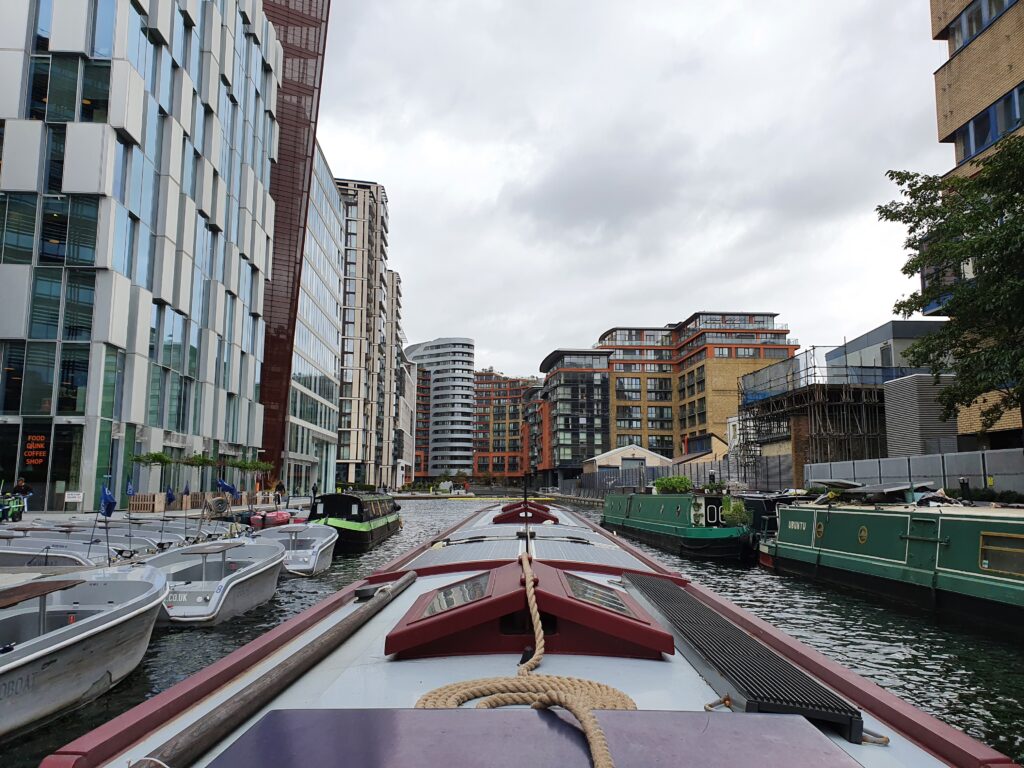
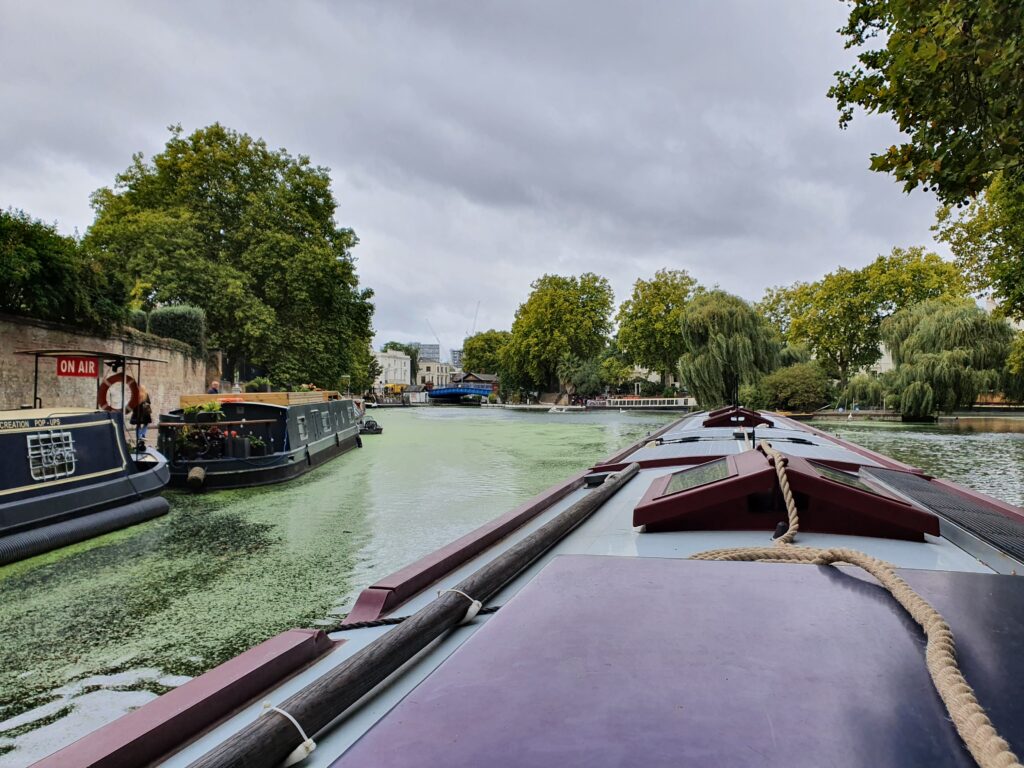
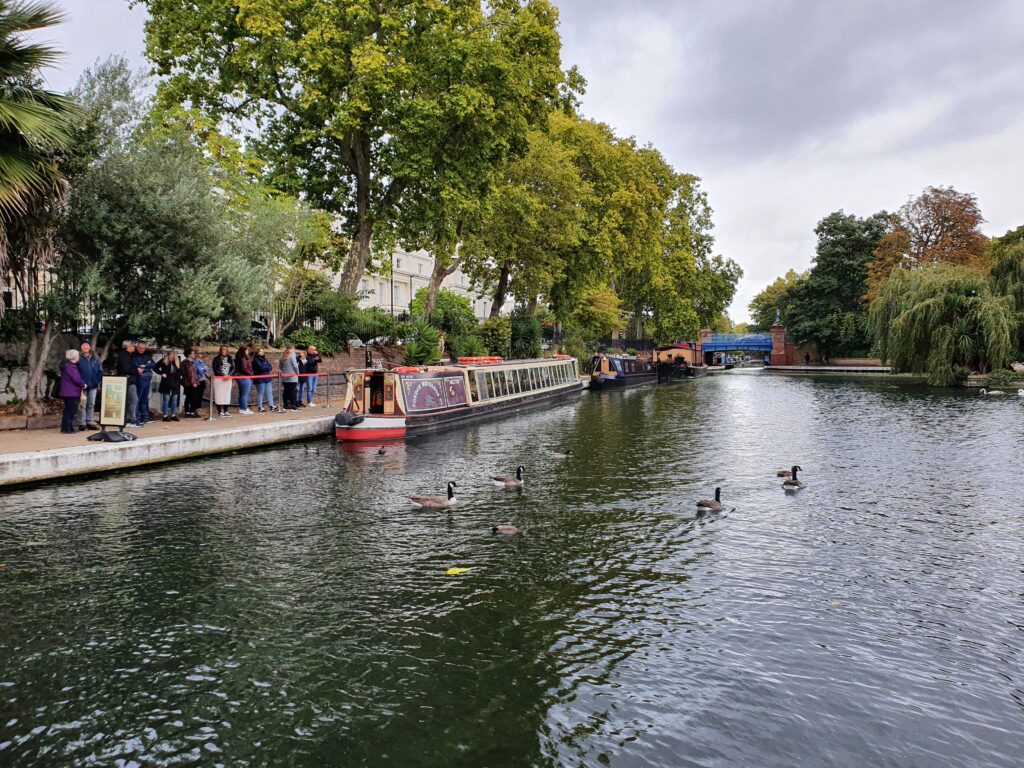
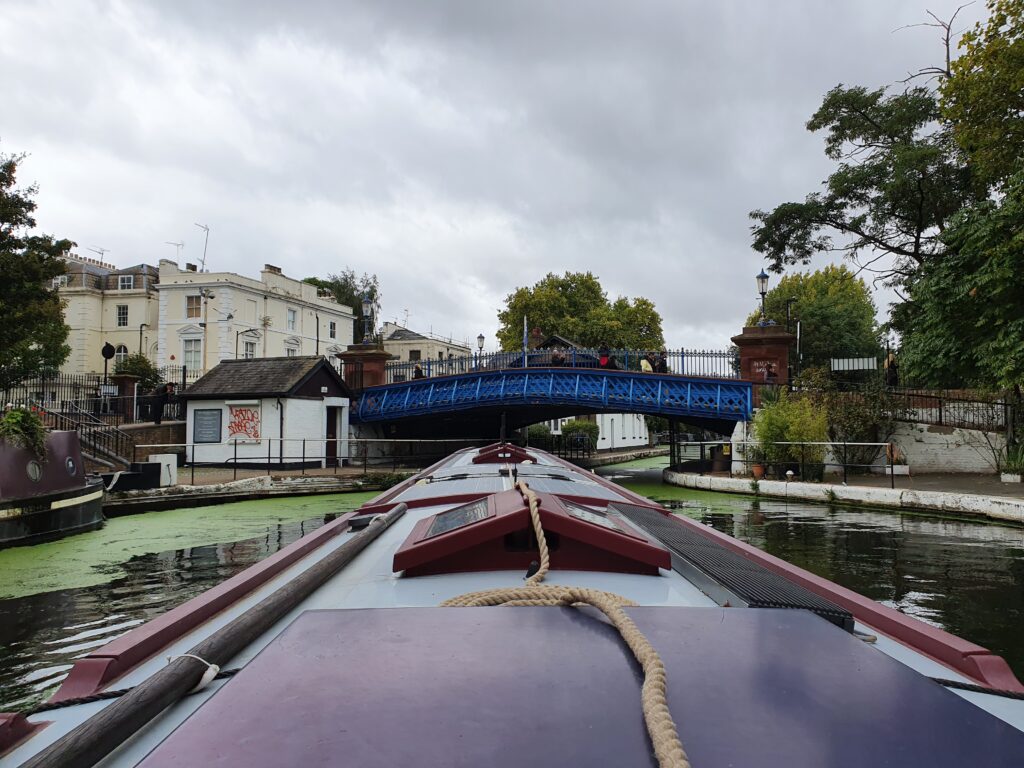
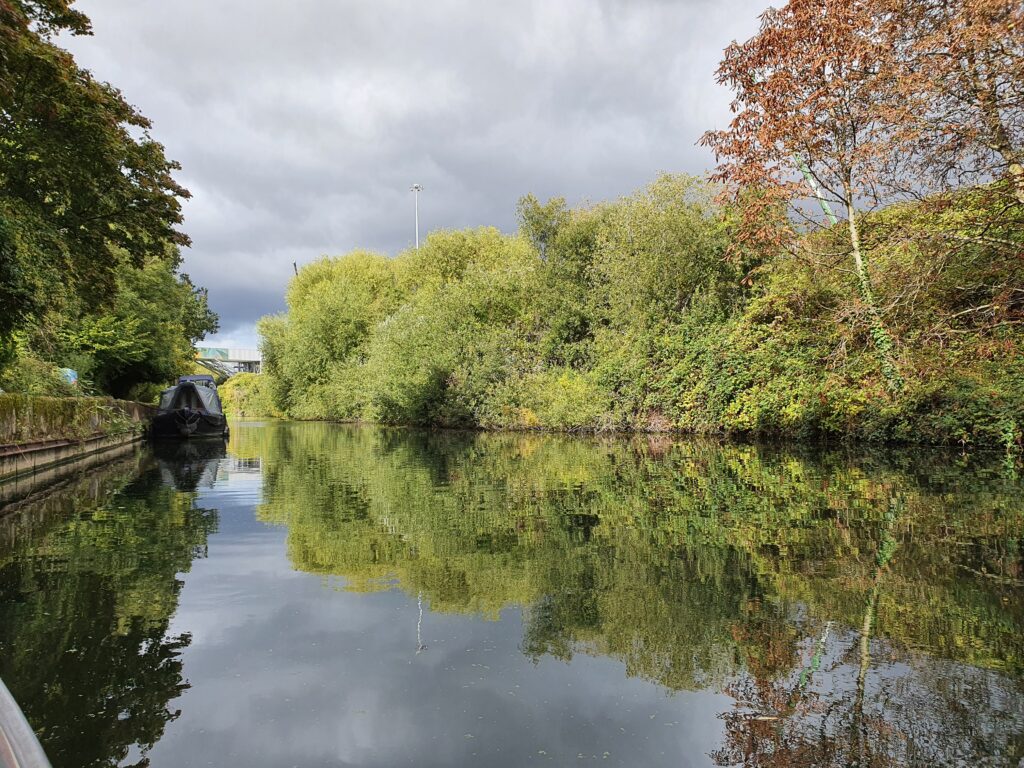
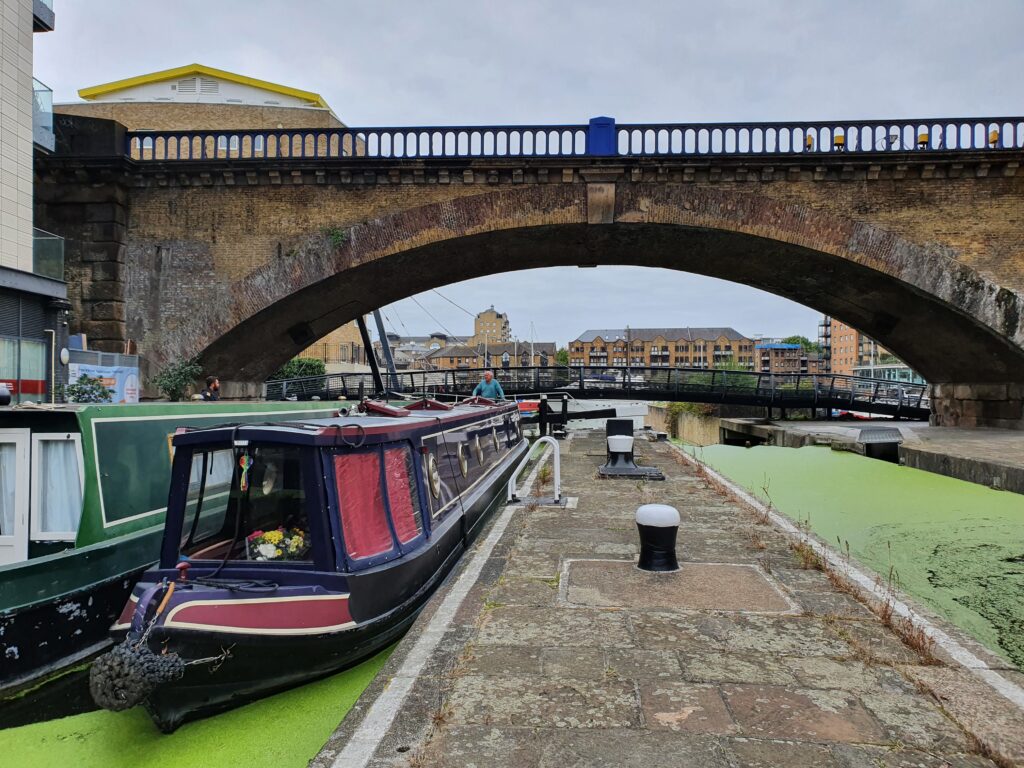
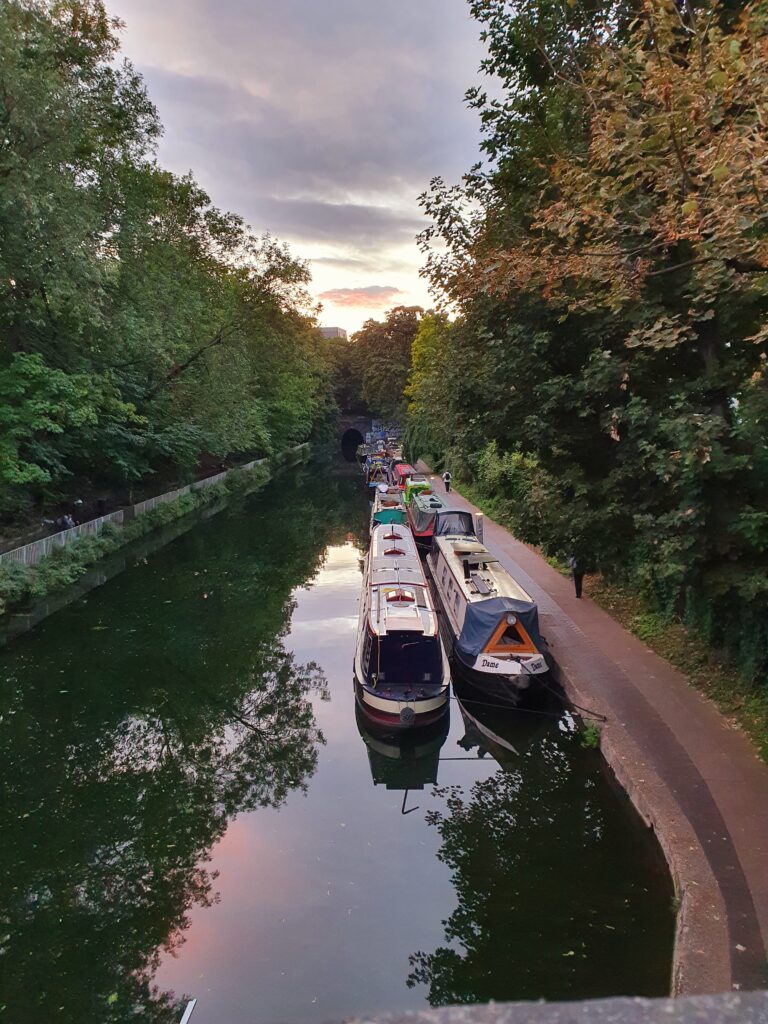
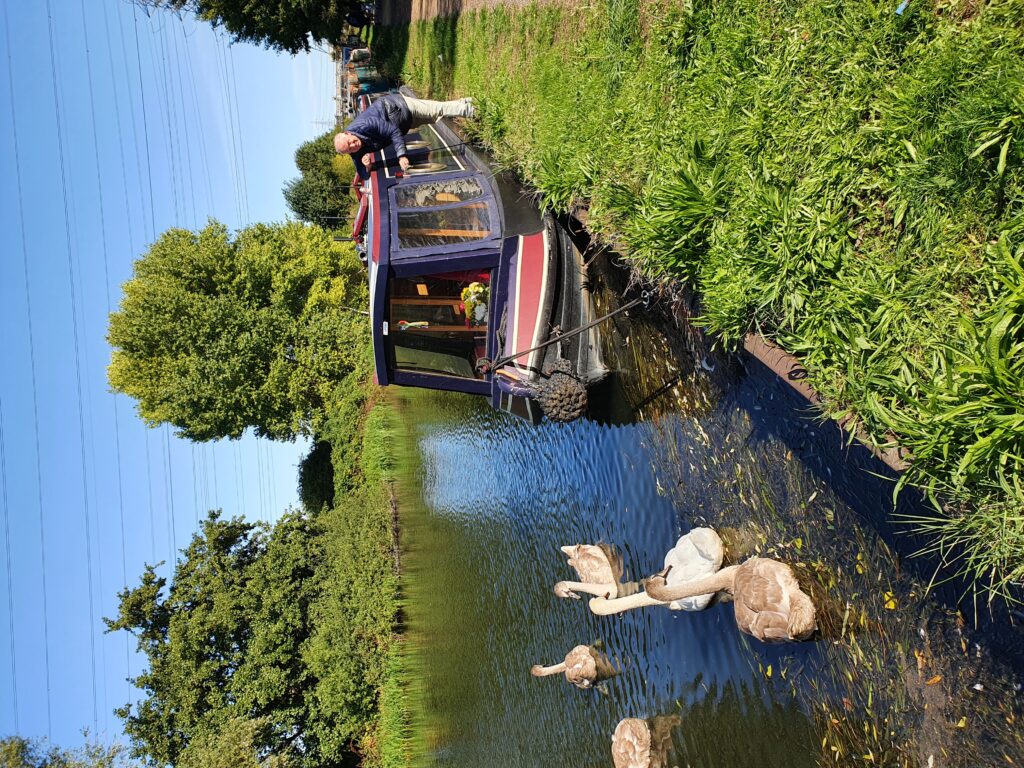
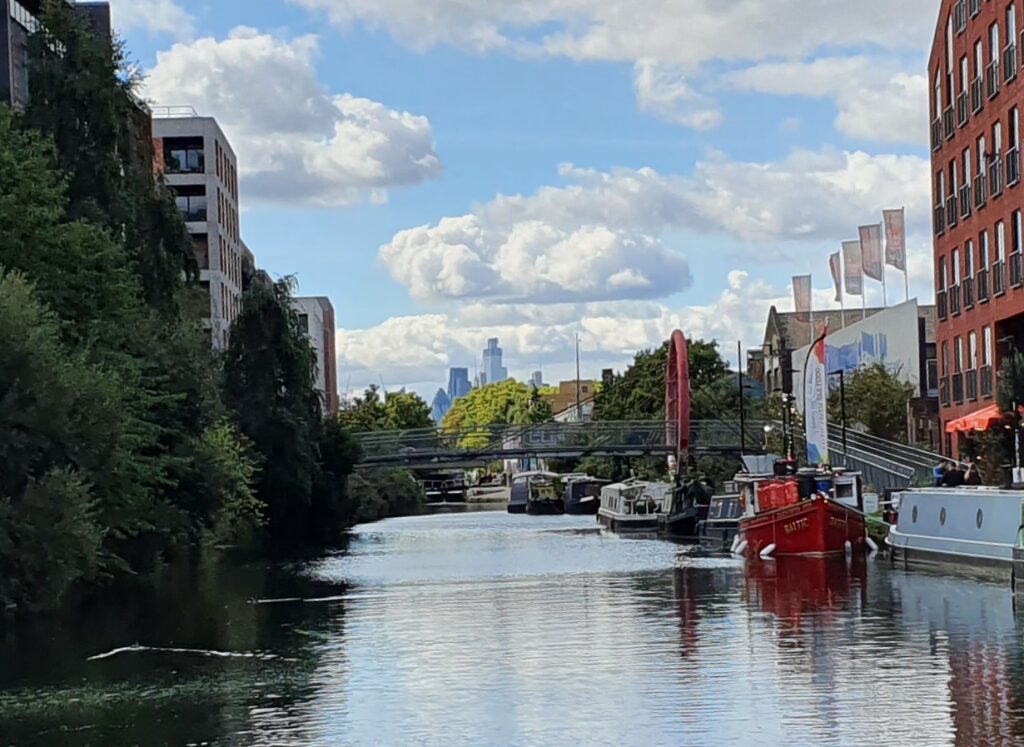
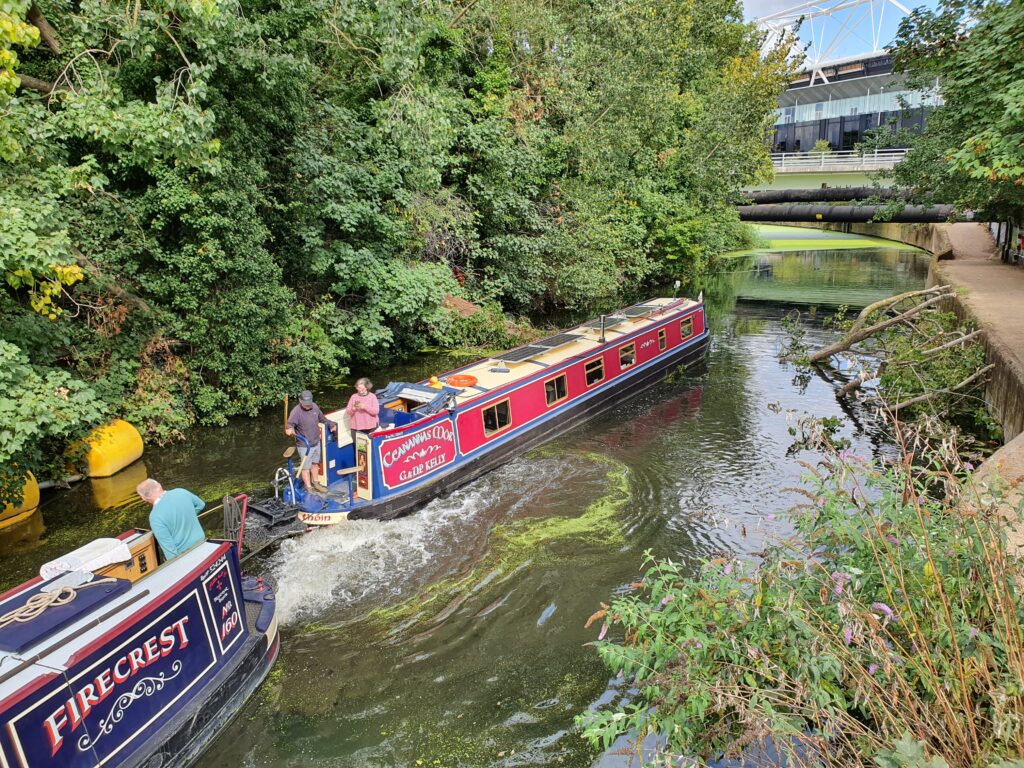
Not sure where we’d end up or if its 87.5 miles or 187.5 miles we turned right at Bulls Bridge to begin our journey back up north. We suspect it should say Braunston, but maybe Birmingham. We settled for a few days in West Drayton soaking up the sunshine,
Opposite the train station at West Drayton
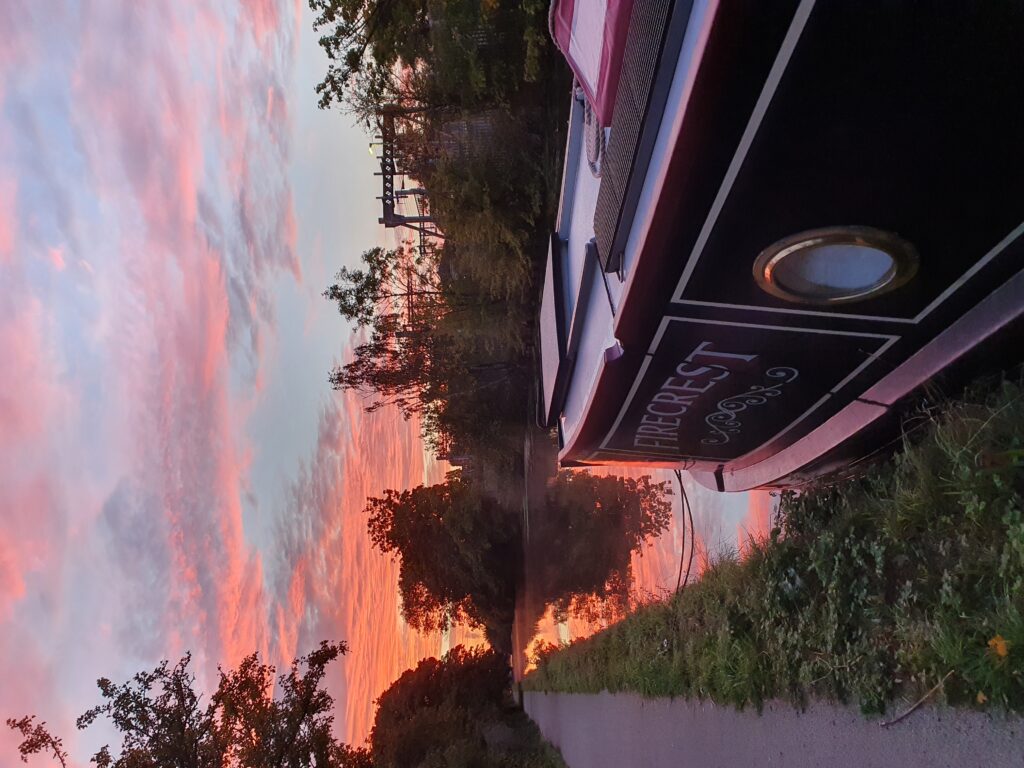
Enjoying the sunsets,
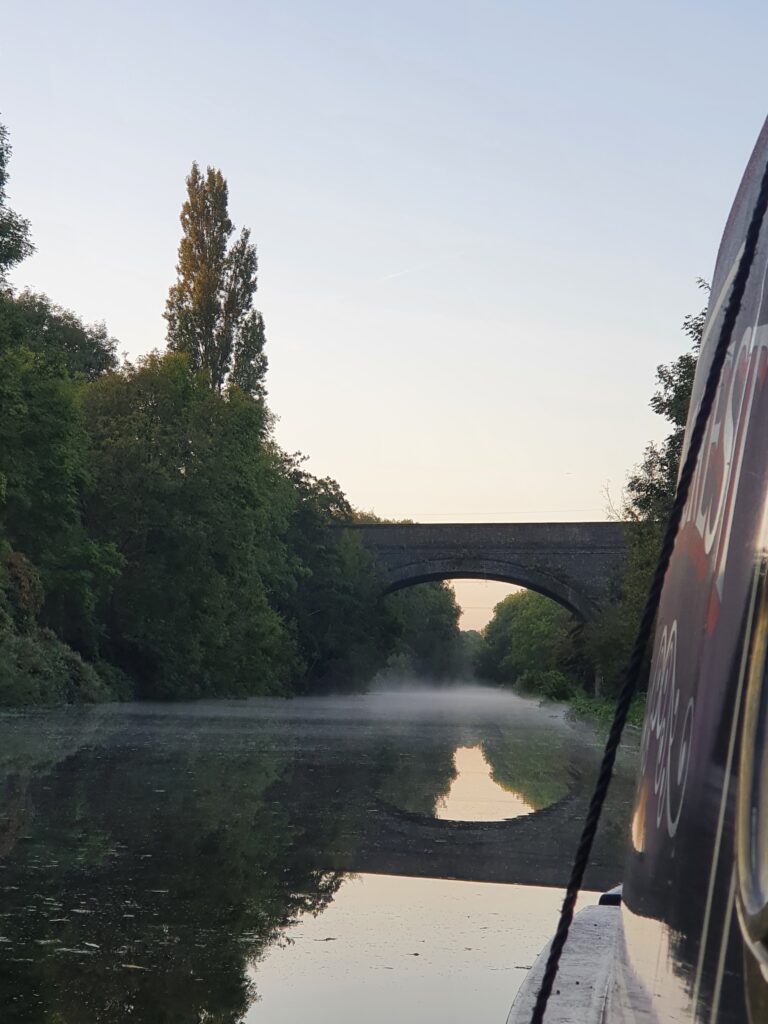
and the sunrises
All of which reminded us that we were still, infact, pointing west, not yet going north. And still just about within the Greater London confines inside the M25. Our autumnal cruising plan is to meander slowly up the Grand Union overwintering around the Milton Keynes area, roughly 50 miles and 67 locks. We decided not to venture down the 5 miles Slough arm, because although it is lock free, having chatted to the local boaters, we weren’t sure we could moor easily. Perhaps we missed an opportunity. Perhaps we’ll do it next time.
Cowley Peachy junction for the Slough Arm
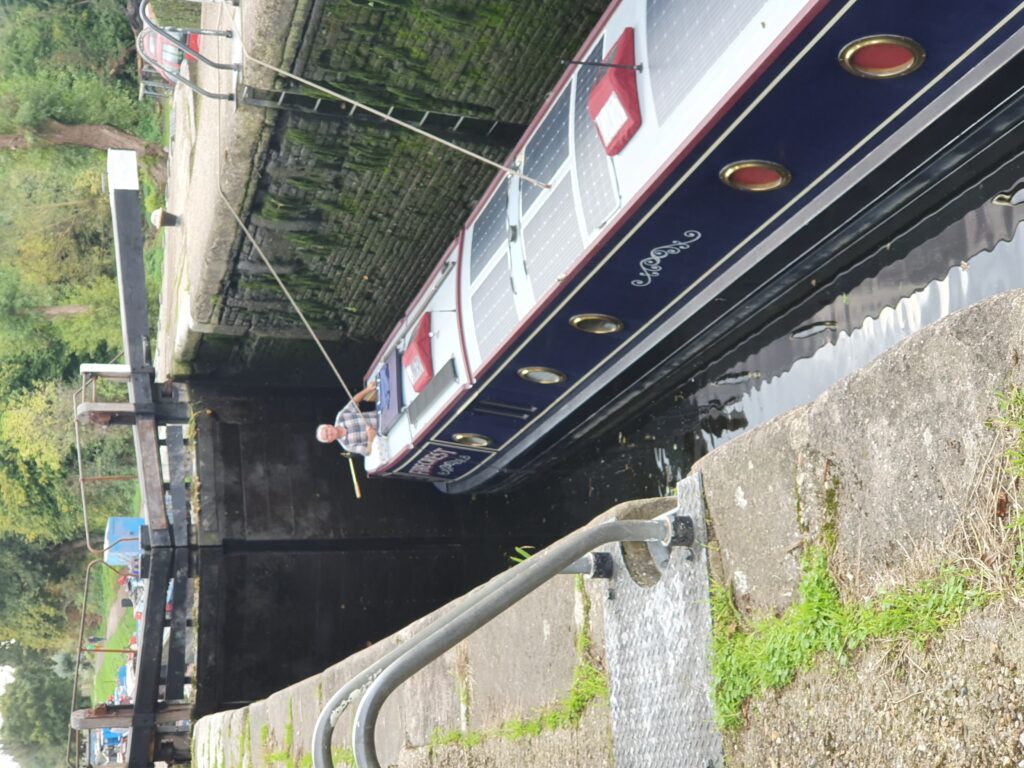
but immediately past the junction we were climbing uphill and the locks, thankfully not all 11 foot deep like Denham deep lock
Thats quite a deep lock
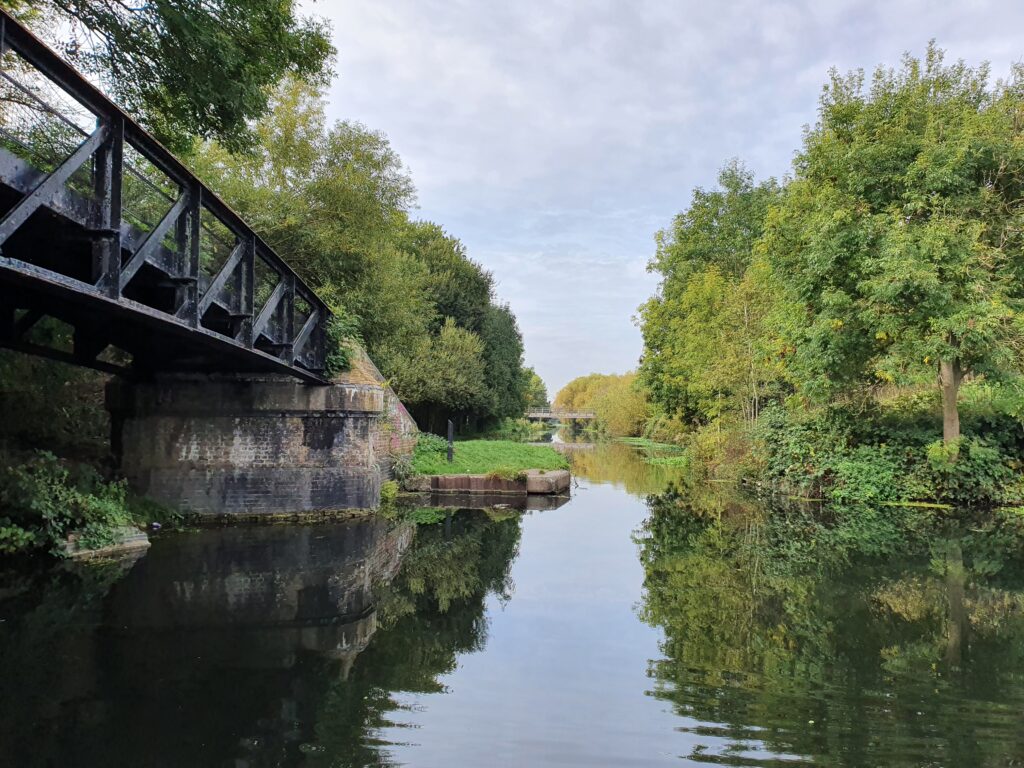
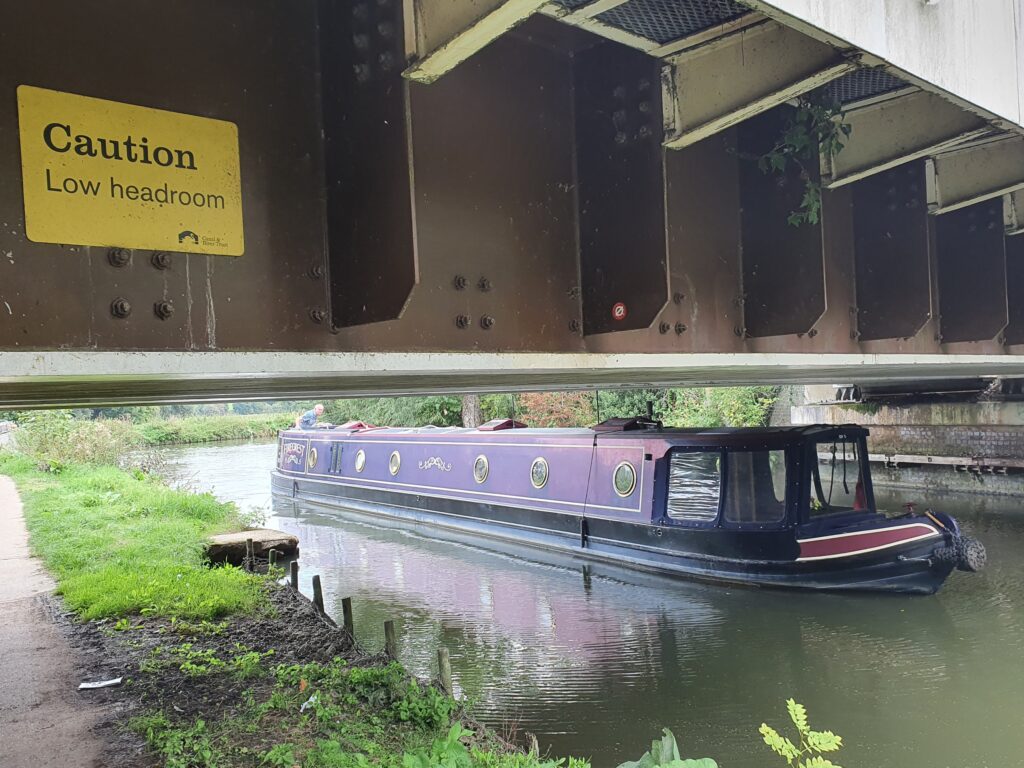
And under some high railway bridges
Denham rail bridge
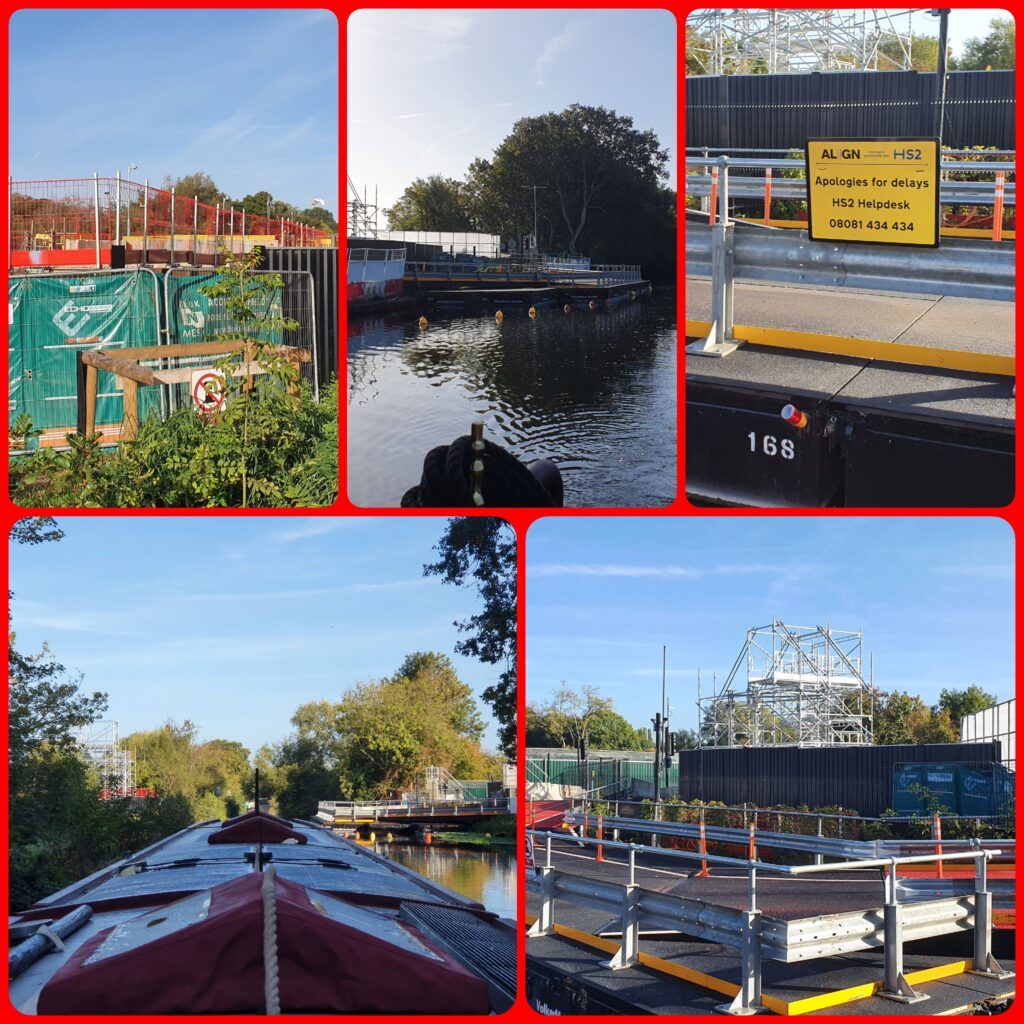
And past some railway bridges not yet built as HS2 passes over the canal around Harefield. We have to take a deep breath and remind ourselves what an eyesore building the canals must have been in the 18th century, but how glad we are to have them now.
HS2
In the late 1700’s William Capell, 4th Earl of Essex, was similarly concerned when sat of the board for the building of the Grand Junction canal, that would pass through his extensive estate, of Cassiobury and Watford. He insisted on the canal being aesthetically pleasing. And so it is.
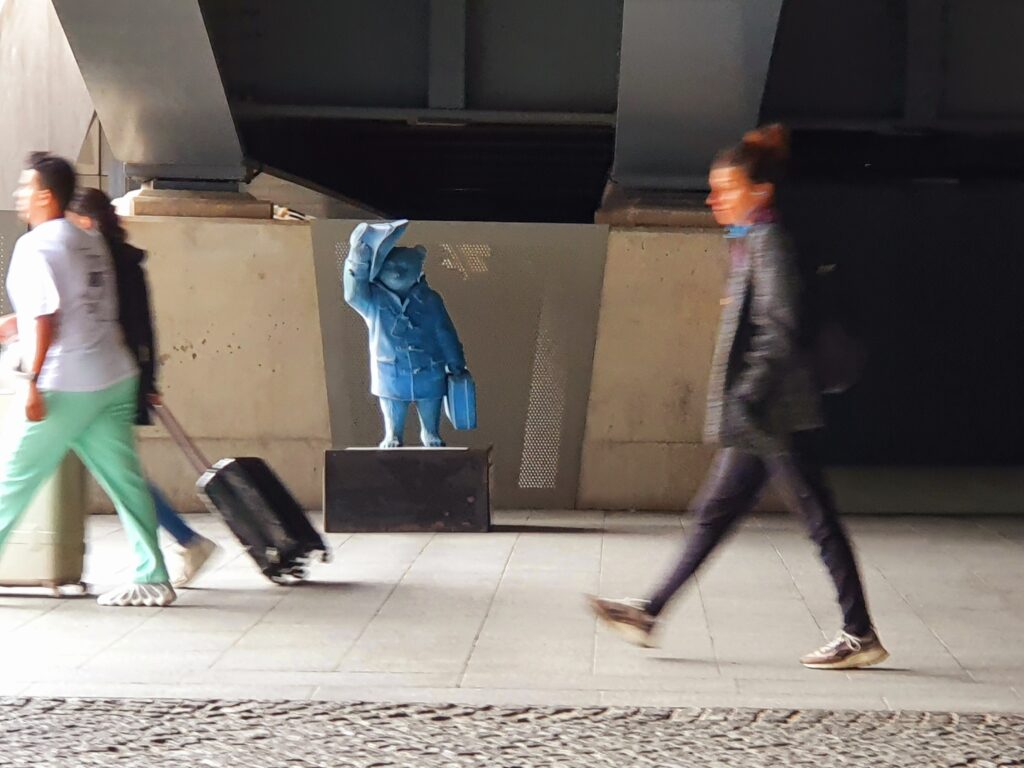
The Paddington Arm is a 13.5mile branch off the 137 mile long Grand Union Canal. It runs from Bulls Bridge in Hayes to the Paddington Basin in central London. When it was completed in 1801, it was mainly a rural route, and as one commentator wrote, in the 1700’s “ … next to the beautiful fields and quiet village, the gallows and the gibbet were the principal attractions….” but once the canal opened up the banks became the dumping ground for London’s ash and night soil and it became known as sticking Paddington. Paddington itself doesn’t derive its name from the marmalade eating bear from Peru, but most likely from the Anglo Saxon chieftain called Padda.
Paddington at paddington
Although we had a twitchy tiller, (our boaty equivalent to itchy feet) and we were ready to move on. But there’s always more hidden gems waiting to be explored in London and with hindsight we wished we had booked more than one night in Paddington Basin. Not least because the weather forecast was looking bleak with strong winds and heavy rain, but the crazy booking system, which would allow us a full 7 night stay, does not permit you to extend a single night despite there being spaces available. But as NB Oleanna, who were moored on the next pontoon, was risking the weather with an early get away….
Goodbye Mick and Pip, Im sure we’ll see you again soon
We decided to follow them out.
Looks like winding will be tricky
As all boaters know, to turn a boat through 180° is called winding, as in wind the weather phenomenon, not winding as in wine what you drink. This is because before the days of powerful motors, the old traditional boaters used to use the wind to help them rotate their boats. However despite all our modern advances, winding a 60′ boat in a wind tunnel on a windy day next to flimsy trip boats takes a fair bit of skill. But we did it and soon we were on our way, out into Little Venice and Rembrants garden.
Looking back towards the start of the Regent’s canal
And forward towards the Grand Union, Paddington arm, which would be our route out of the city.
Those clouds look a bit heavy
We managed about an hour before the rain started , and oh boy was it heavy, but thankfully the further west we travelled the more places we found to moor. And guess what, no sooner had we tied off the ropes, the sun came back out, but we’d gone far enough for one day and
Park Royal
… it gave Eric a chance to remove all the debris fouling our prop.
An all too familiar sight on the urban canals
Our journey continued over the North Circular, ah happy memories as this was the road Eric drove along, when he lived in the south and I lived in the north
Busy people on busy roads
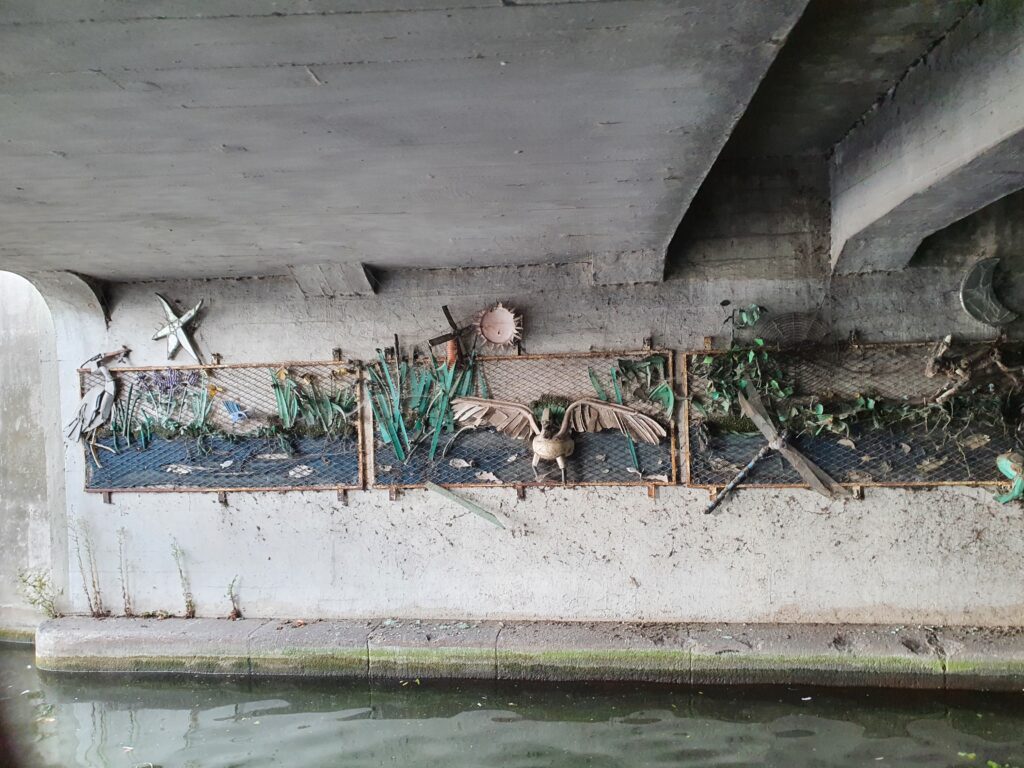
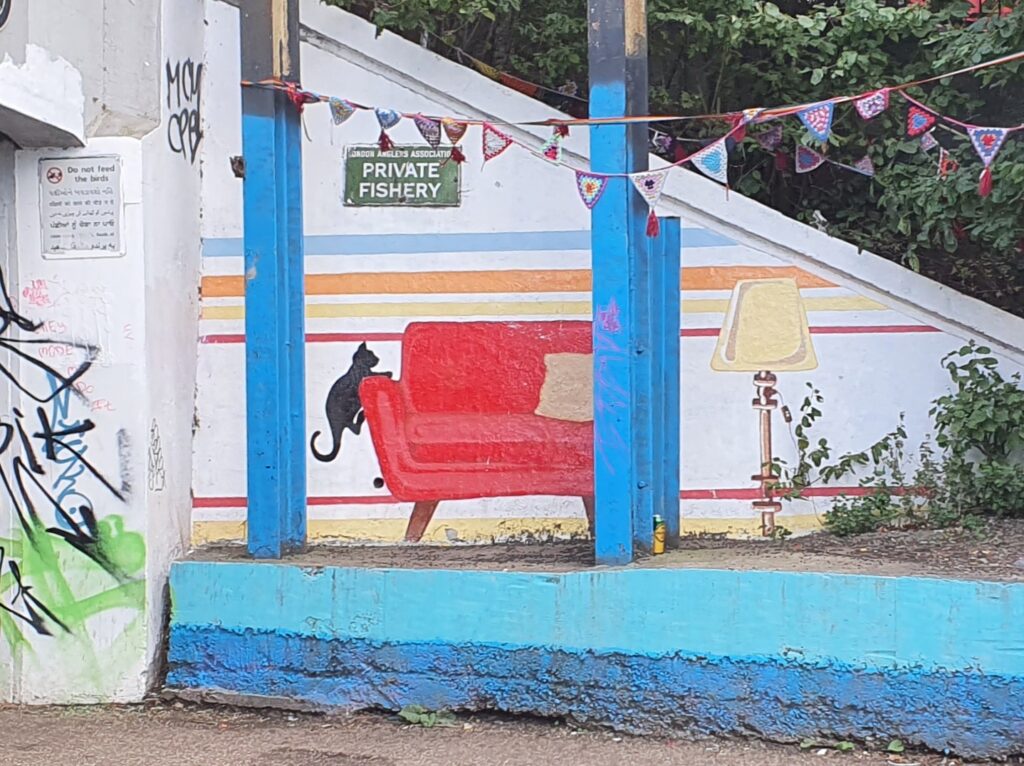
Past some interesting art work under a bridge
And a next to a bridge
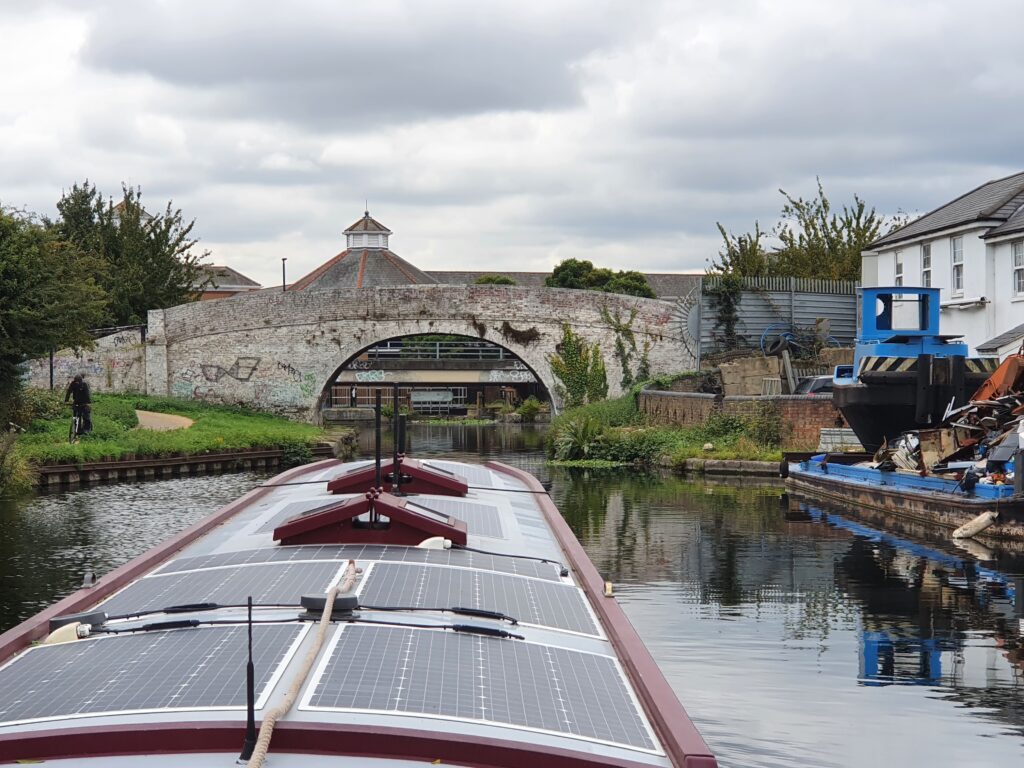
Stopping to buy diesel from Willowtree marina (£1.25 -29/09/22) and finally onto Bulls Bridge which is the junction of the Paddington Arm with the Grand Union Canal
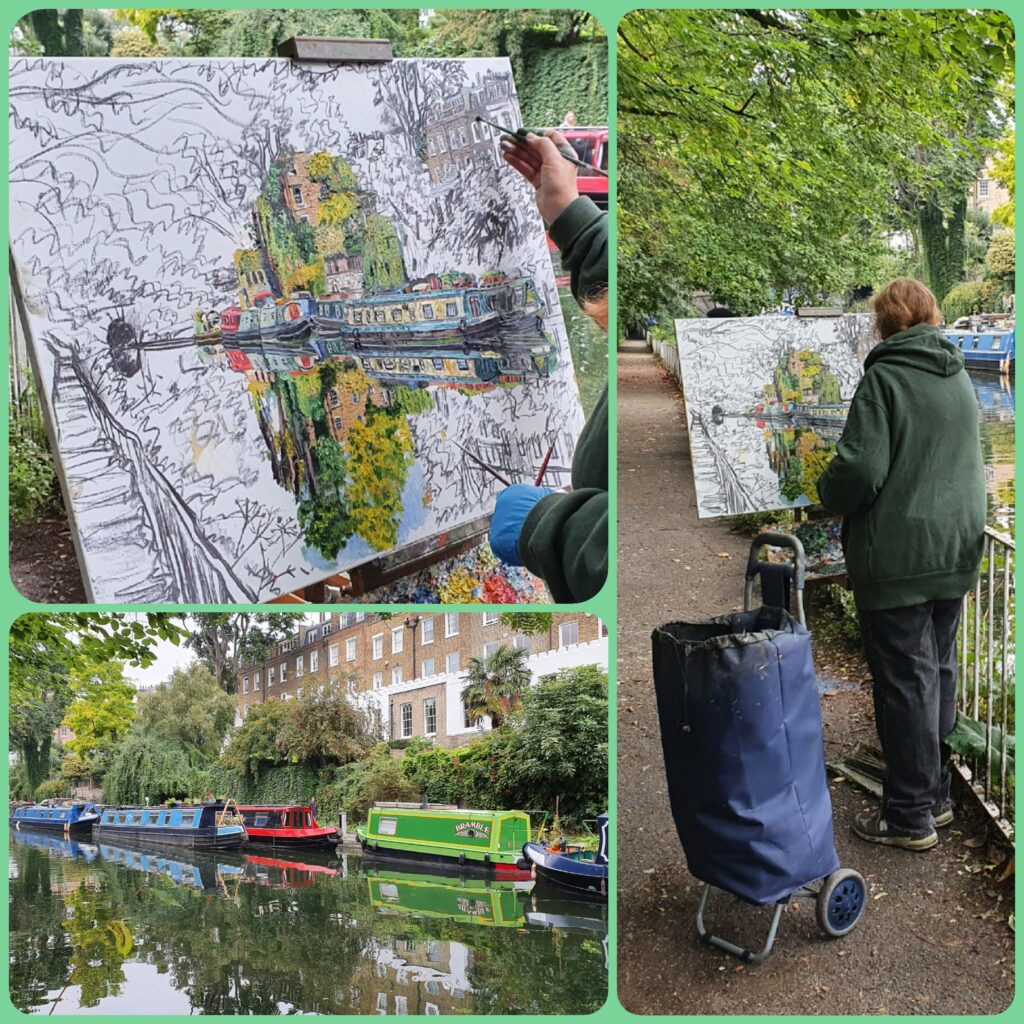
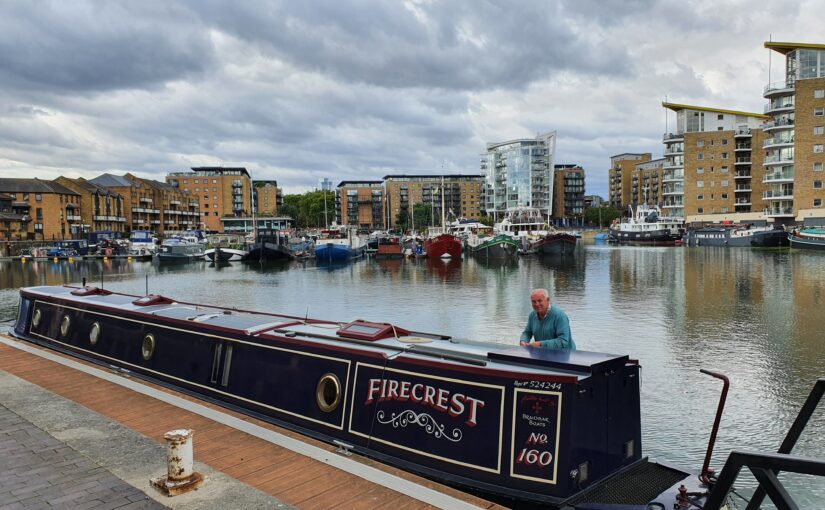
We really do love the colours of early autumn, and whilst we were enjoying a leisurely breakfast we noticed an artist had set up their easel to capture the scene. We walked over to say hello, and were so taken with the work, we were tempted to ask to buy it. Sadly Firecrest was just out of view and the artist, Melissa Scott-Miller said it was part of an exhibition for a gallery so not yet for sale.
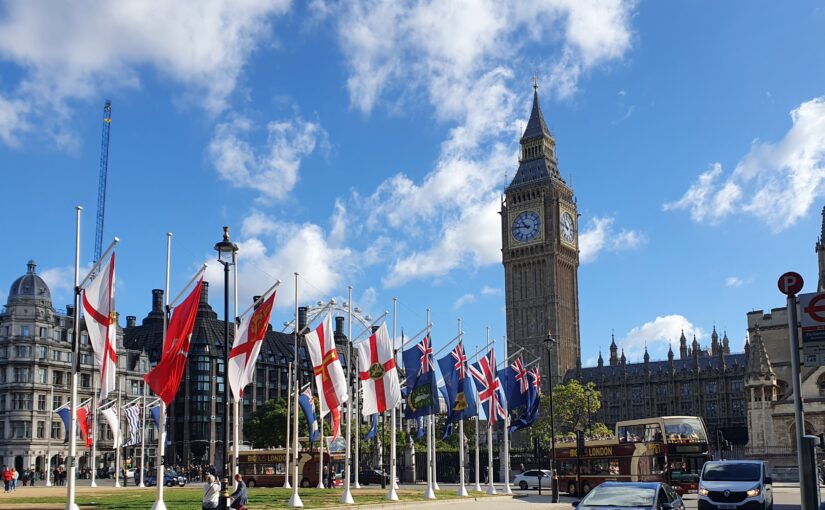
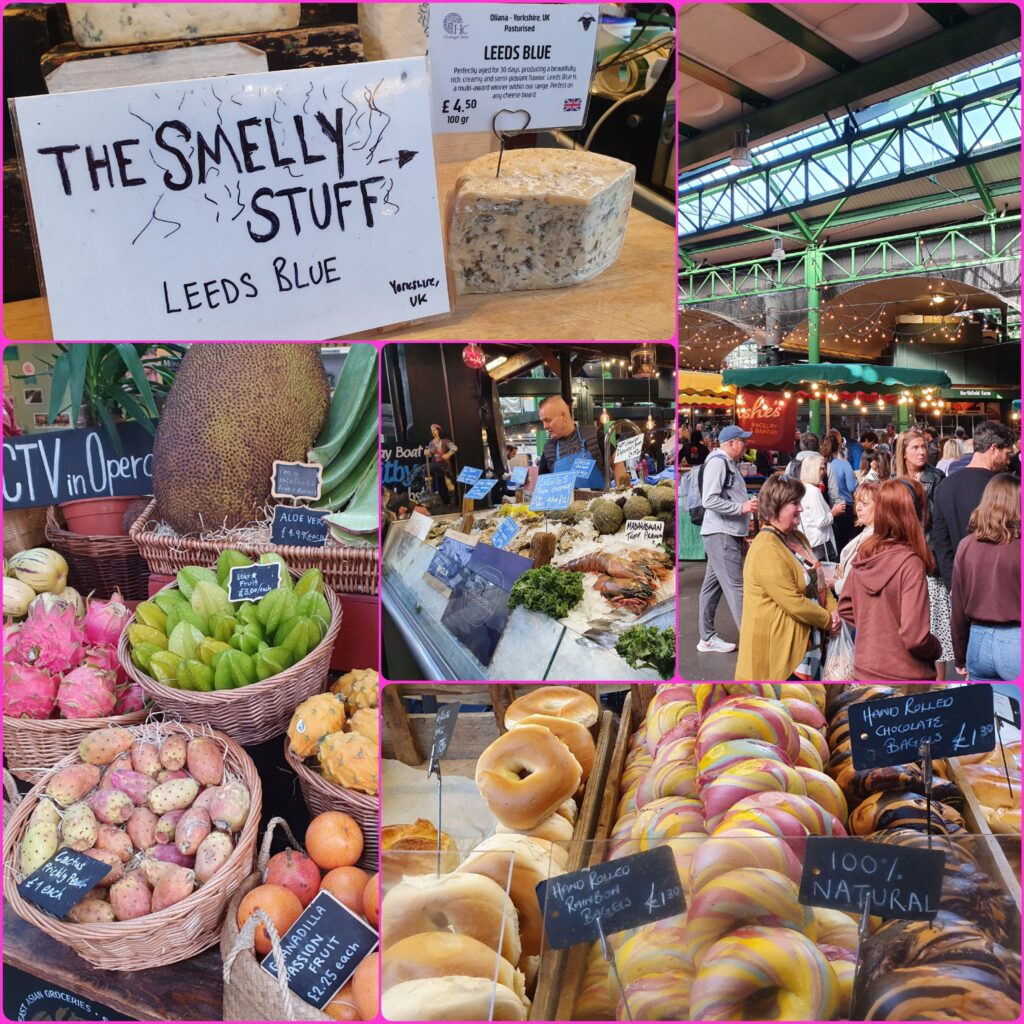
We were so lucky with the weather this week, Sunday morning was crisp and clear, so we decided to go to morning service at Westminster Abbey, which was heavenly, then on to explore Borough Market, which was food heavenly. A real treat for the senses.
Food Art
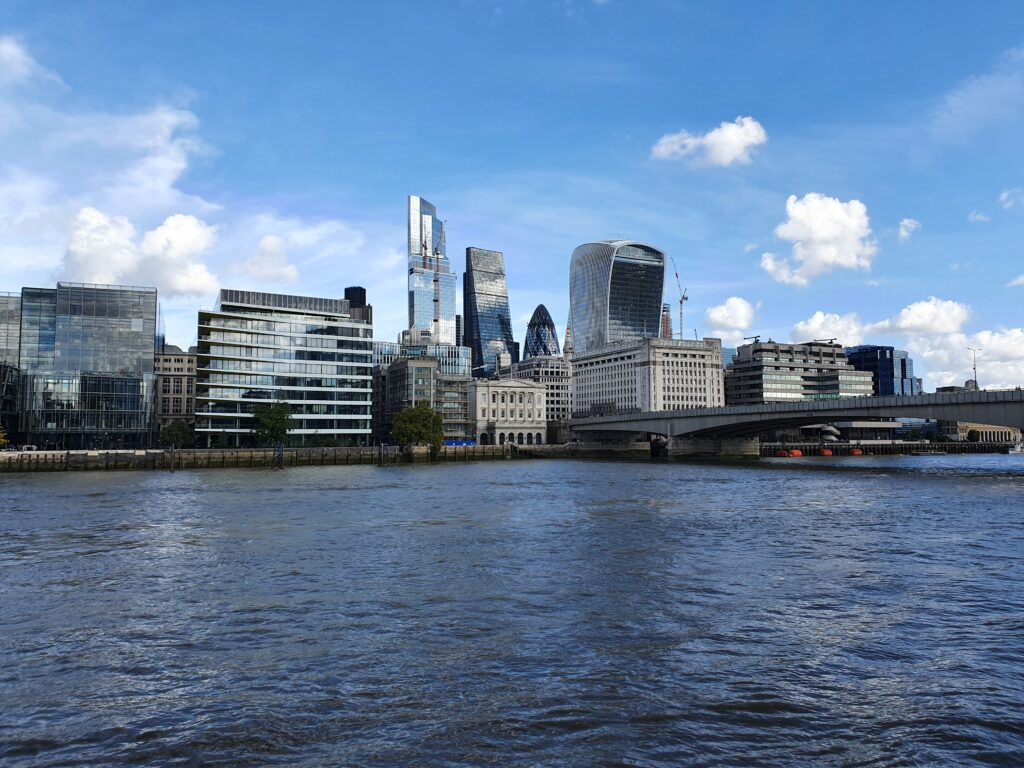
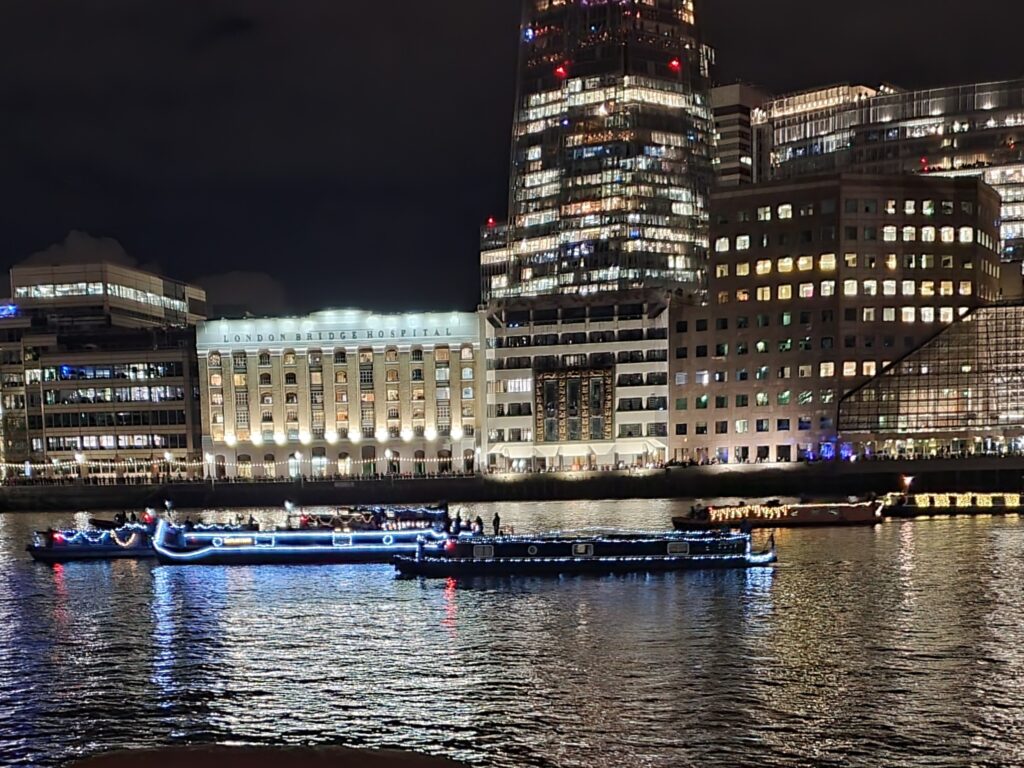
Borough Market in Southwark on the south bank of the Thames, which gave us an opportunity to see skyline from a different angle. (We had watched the reflections flotilla from where the orange barriers are)
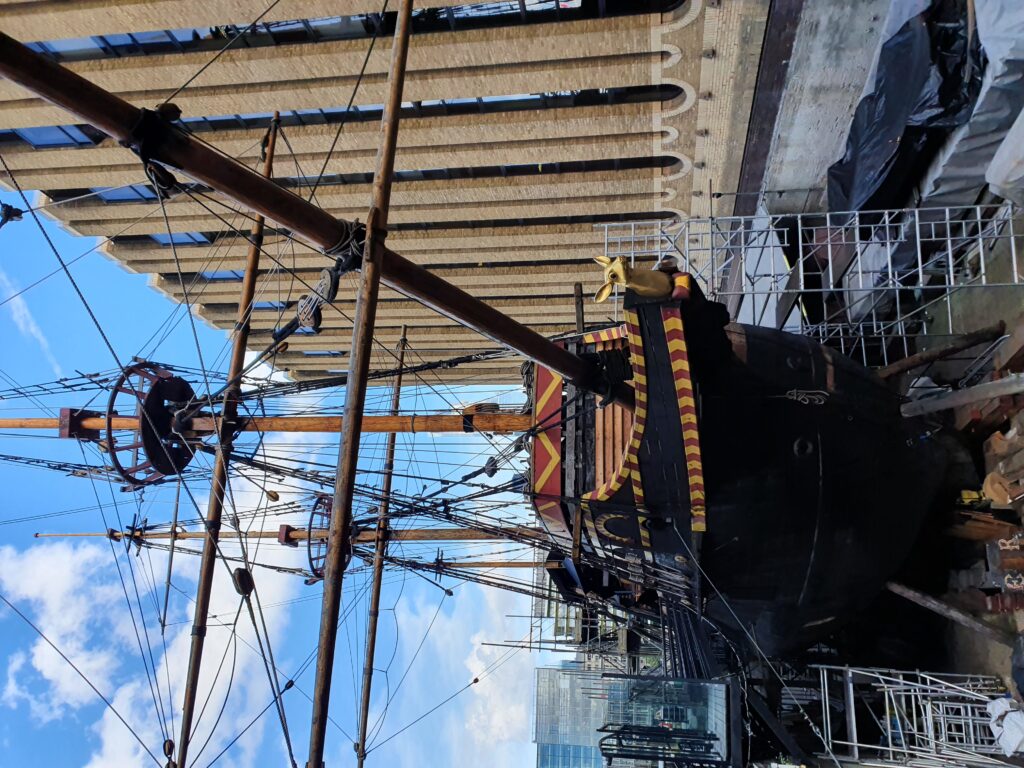
We also got the chance to see the seaworthy replica of Sir Francis Drake’s galleon, the Golden Hind. Although his mission was to explore and circumnavigate the globe, he turned “privateer”. “…..On 1 March 1579, now in the Pacific Ocean, off the coast of Ecuador, Golden Hind challenged and captured the Spanish galleon Nuestra Señora de la Concepción. This galleon had the largest treasure captured to that date: over 360,000 pesos (equivalent to around £480m in 2017).[7] The treasure took six days to transship and included 26 tons of silver, half a ton of gold, porcelain, jewellery, coins, and jewels.[8][9] On 26 September 1580, Francis Drake sailed his ship into Plymouth Harbour with 56 of the original crew of 80 left aboard. The ship was unloaded at Trematon Castle nearby, supervised by the Queen’s guards.[10] The final treasure also included six tons of cloves from the Spice Islands, at the time worth their weight in gold.[9] Elizabeth herself went aboard Golden Hind, which was then permanently at Deptford on the south bank of the Thames, where she had requested it be placed on permanent display as the first ‘museum ship’. There, she shrewdly asked the French ambassador to bestow a knighthood on Drake.[11] Over half of the proceeds went to the crown – her share of the treasure came to at least £160,000: “enough to pay off her entire government debt and still have £40,000 left over to invest in a new trading company for the Levant. Her return, and that of other investors, was more than £47 for every £1 invested, or 4,700%.”[8]…….” https://en.m.wikipedia.org/wiki/Golden_Hind
The Golden Hind
Not a bad investment, Firecrest contains quite a few tonnes of ballast, but its not silver or gold and unlike the Golden Hind, we doubled our crew for the last leg of our journey. Family, Diana and Chris came to join us for the day, as we sailed out of Islington, much laughing was done, despite the weather turning against us.
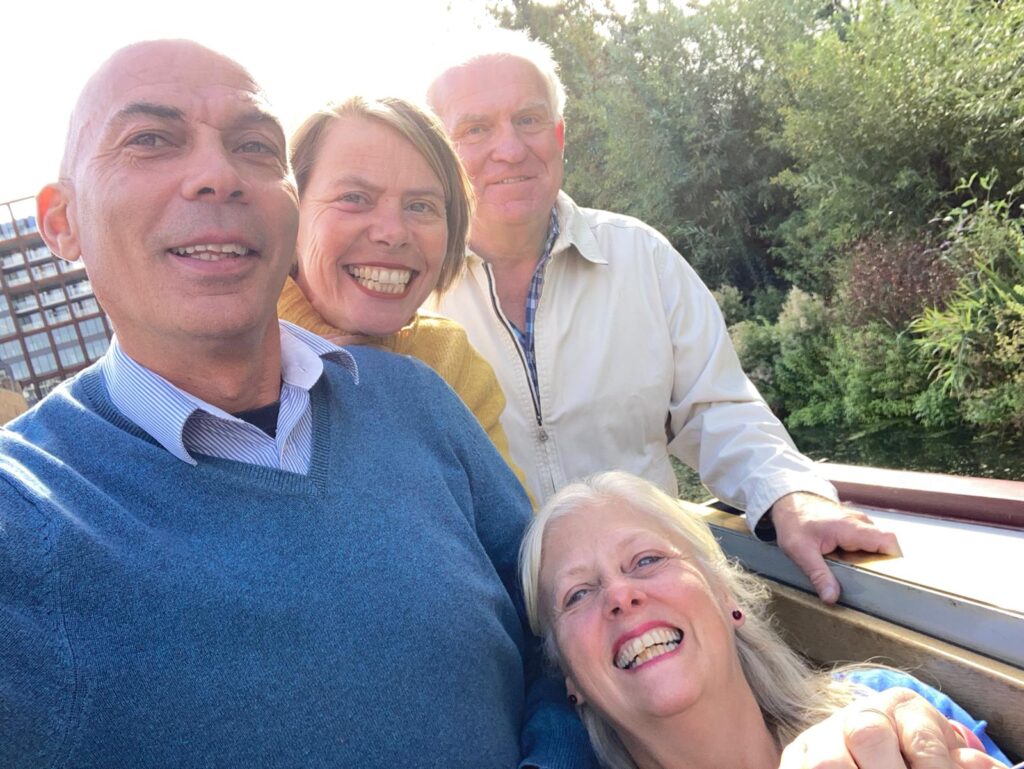
Chris Diana Eric and me on the bottom step
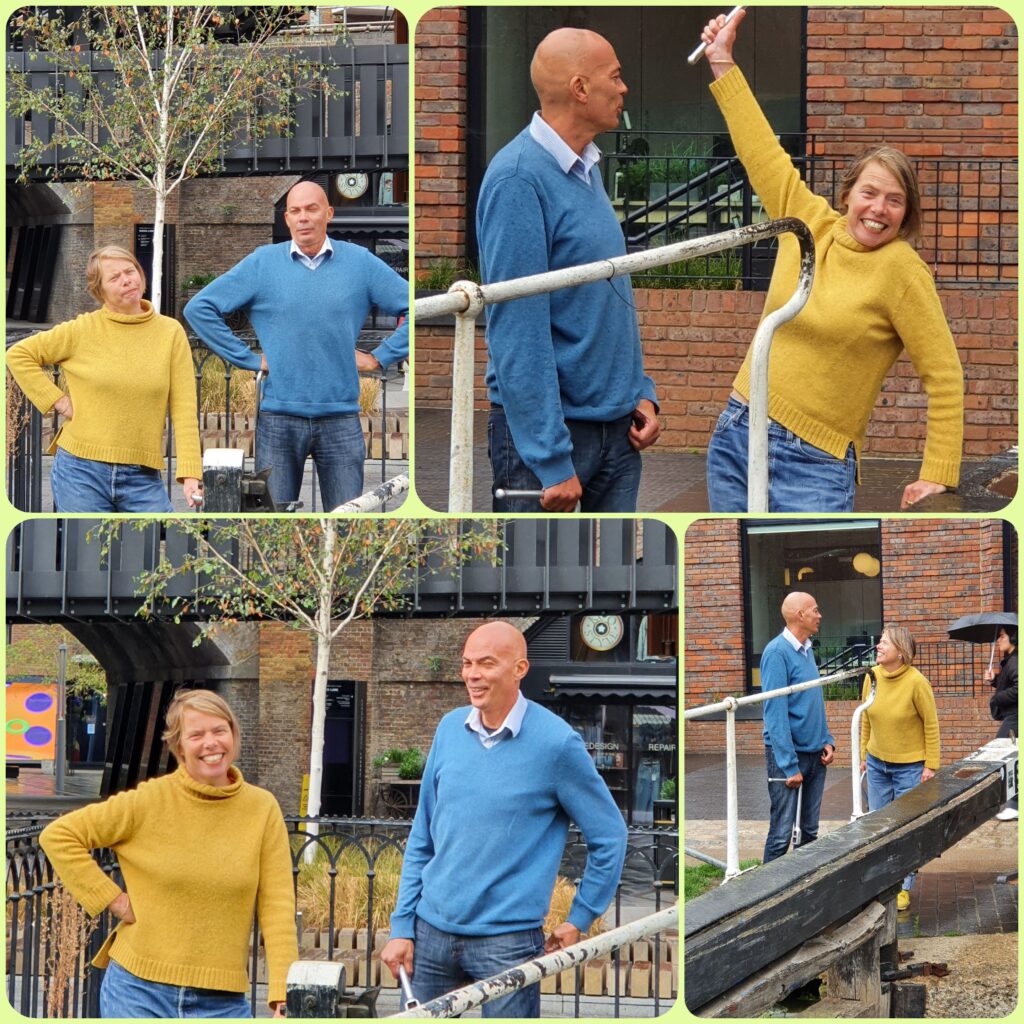
And I was very grateful to have a helping hand through the locks at Camden
I do like a willing crew
We had booked ourselves a night on the pontoons in Paddington Basin
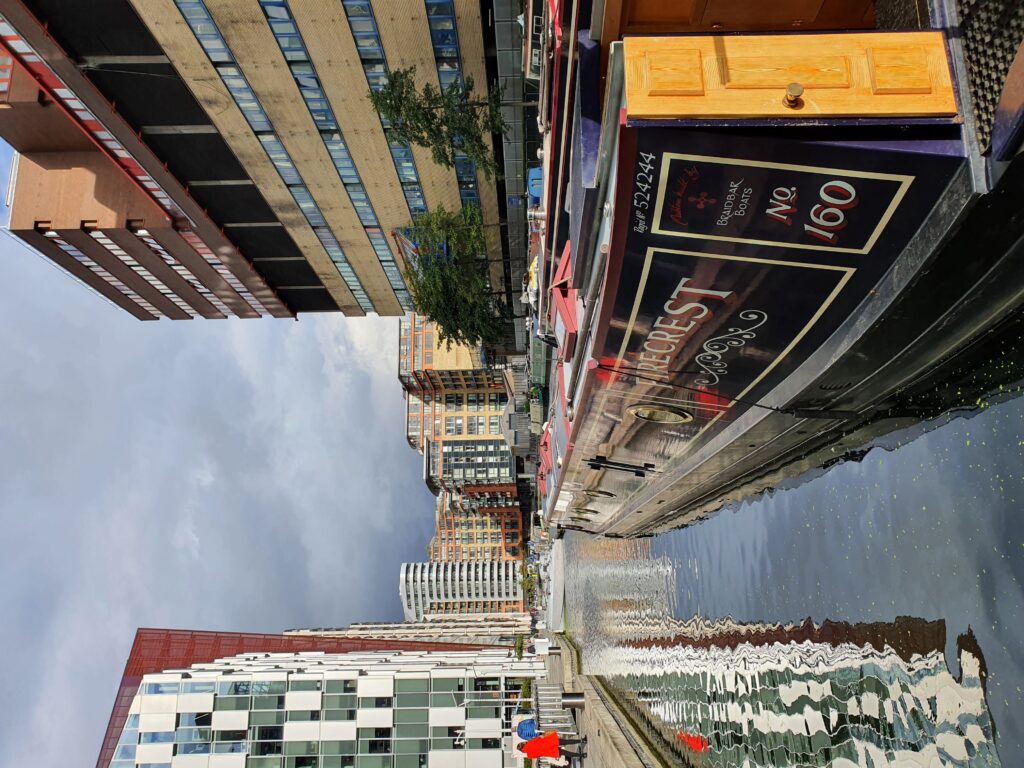
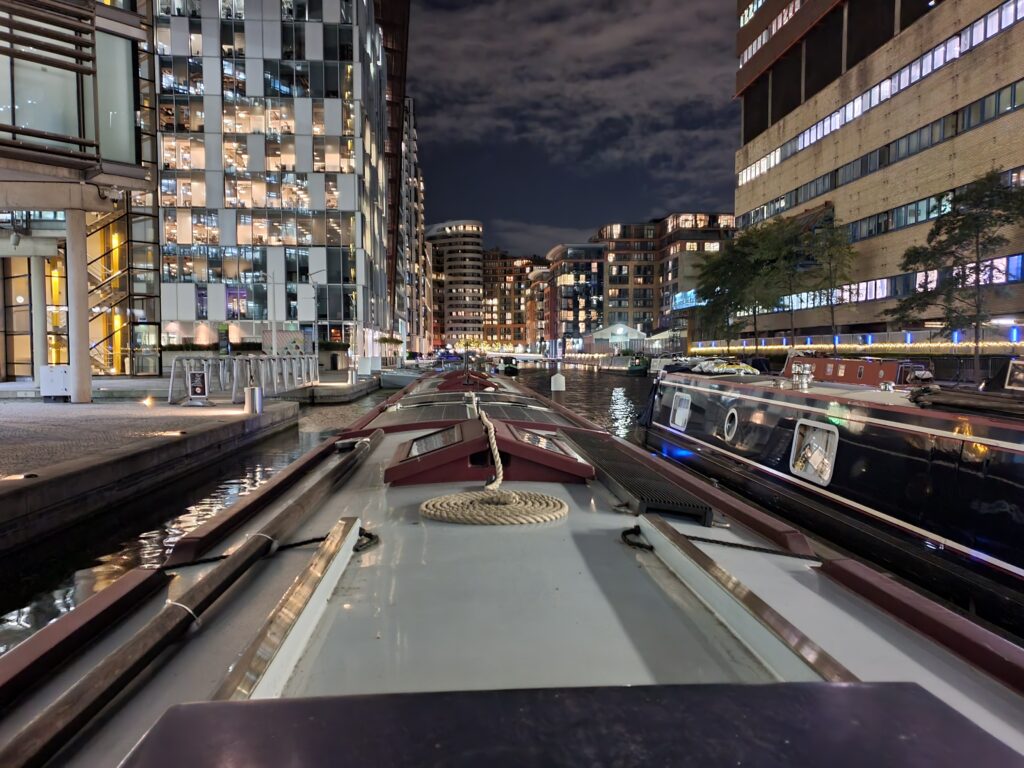
Paddington visitor moorings
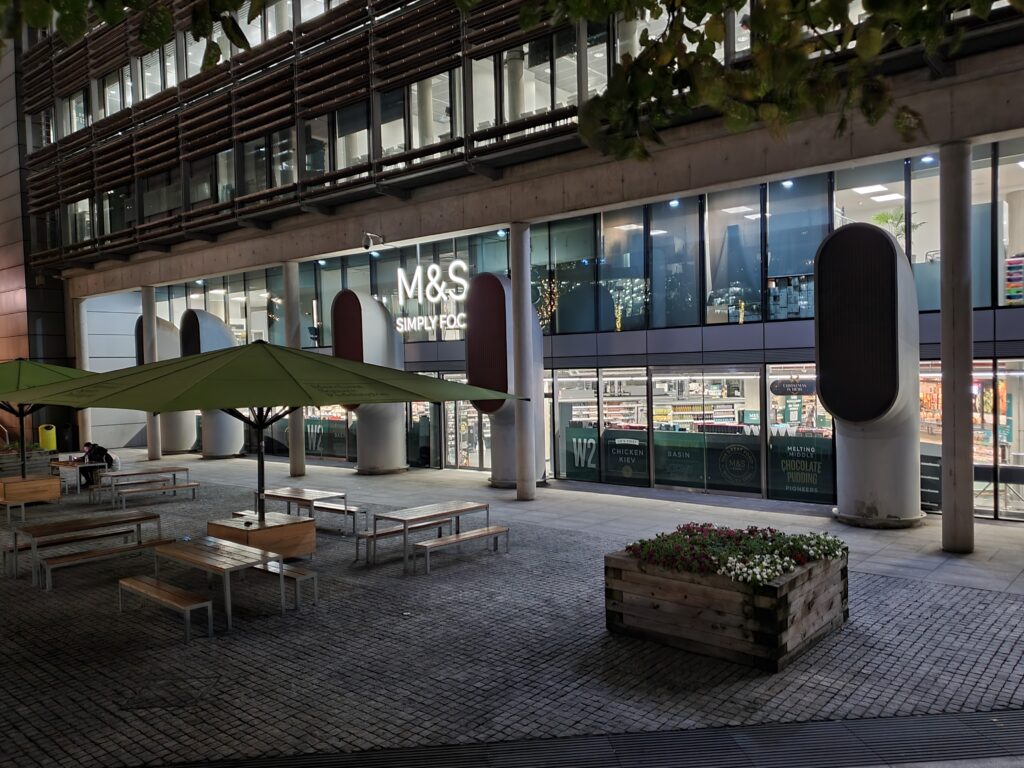
Which just so happens to be right next door to an M&S food hall
Now thats what I call a Convenient Store
So we enjoyed the evening together as well.
All that sparkle
I am sure next time we come into London, we will book ourselves a few more nights here, that view is surely worth £12 a night.
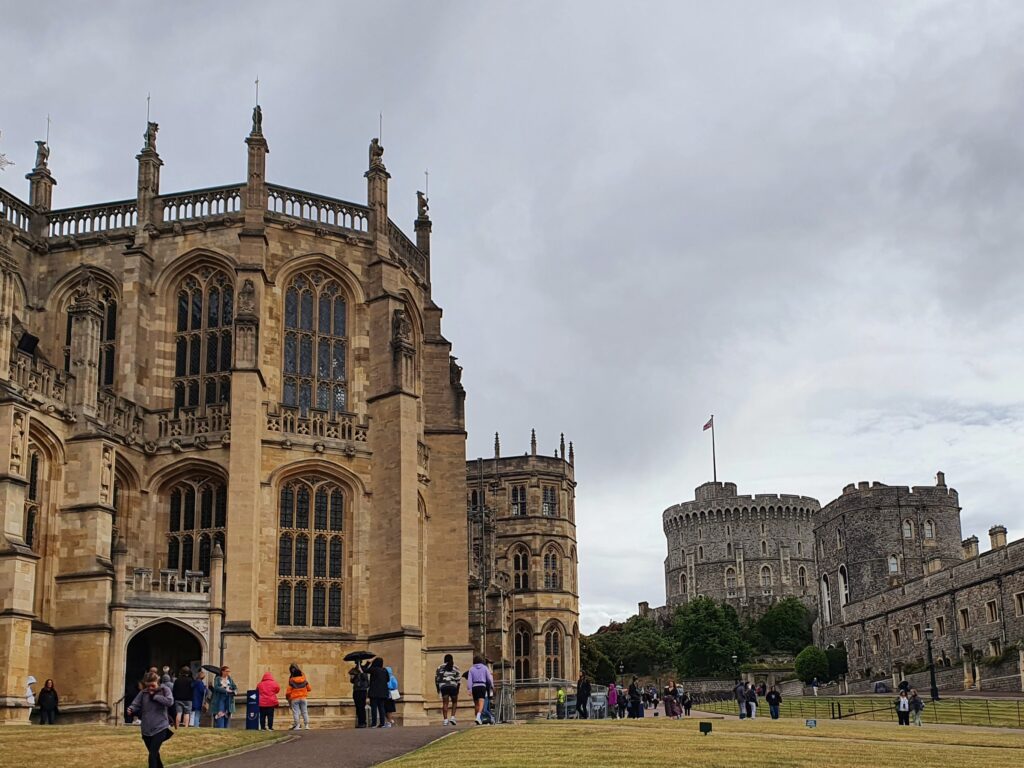
We arrived at our Islington Eco Mooring whilst Her Majesty was being driven to Windsor, her final place of rest, we were so glad that we had had the opportunity to visit St Georges chapel in July, and that we had enjoyed choral evensong there.
St Georges Chapel, Windsor Castle, in July
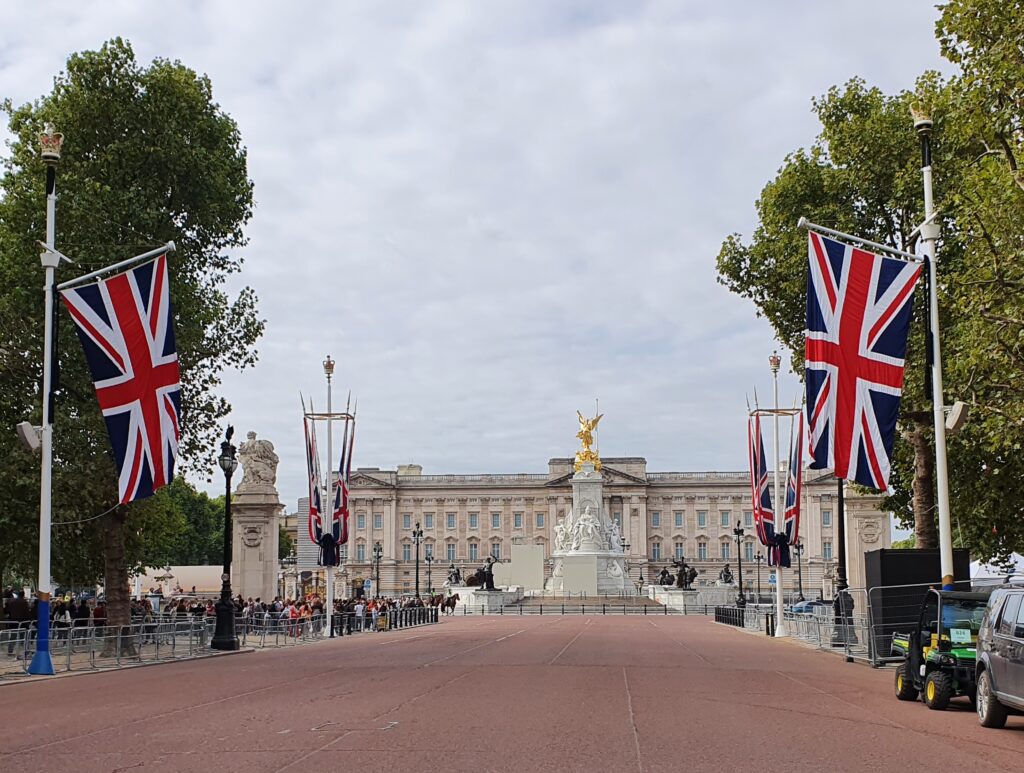
On the Tuesday we went to pay our respects outside Buckingham Palace, (which I shared at the time)
Buckingham Palace at the end of the Mall the day after Her Majesty’s funeral
And as we wandered around the royal parks, absorbing the sights we hope we wont be seeing again for many years, we saw something we really weren’t expecting,
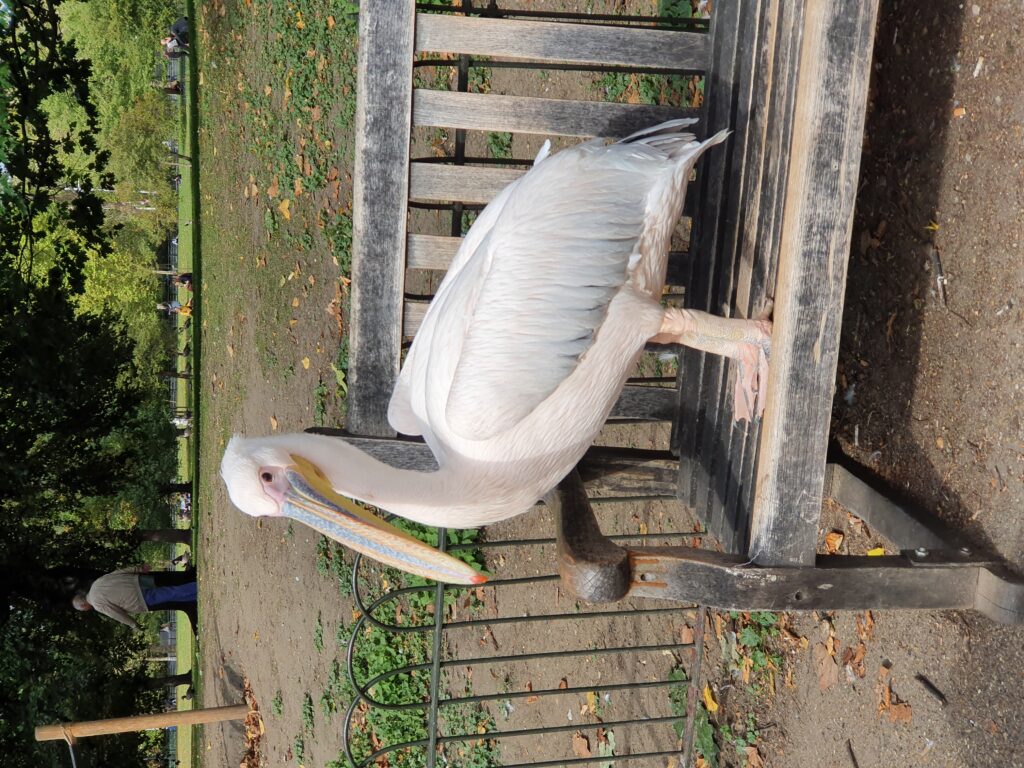
A pelican sitting not crossing
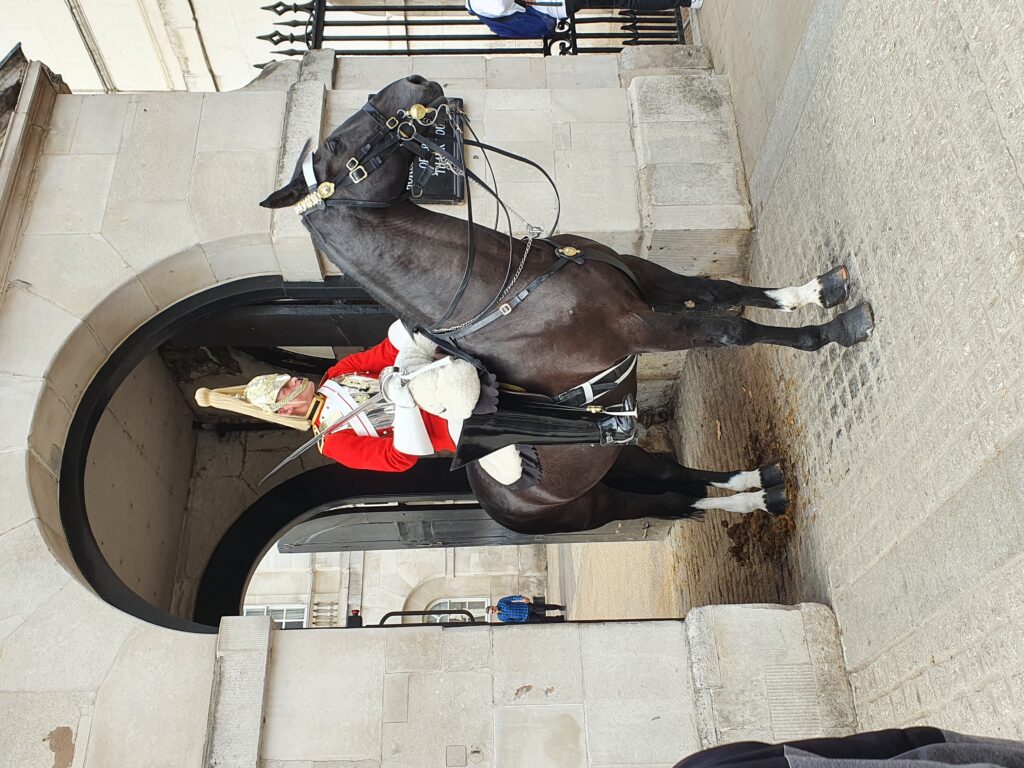
Apparently there are 6 pelicans currently making their home in St James Park. The original flock were a gift from a Russian ambassador in 1664. They are free to roam and fly (the pelicans not the russian ambassadors), but as they get fed fish every day (around 2:30) they are happy and sociable and choose to stay. Of course being in the royal parks I couldn’t resist adding to my men in uniform collection.
One of the Royal Cavalry
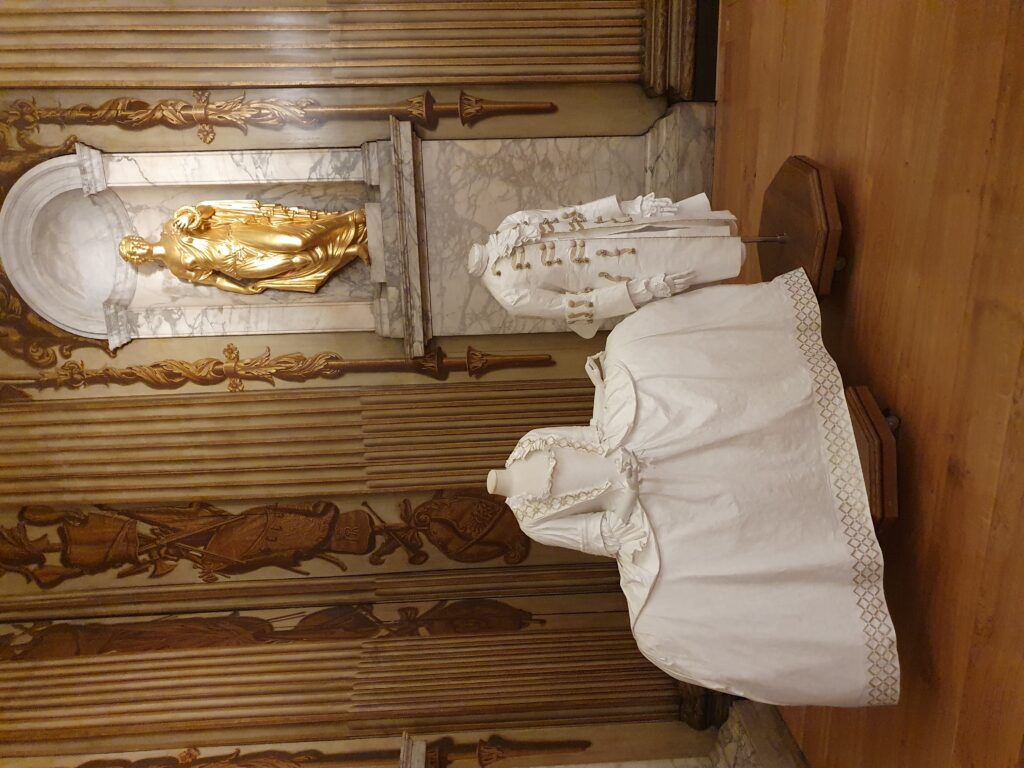
On Wednesday we visited Kensington Palace. William and Mary bought this Jacobean mansion in Kensington Village back in 1689 to escape from the damp London fogs.
Now thats one way to practice social distancing
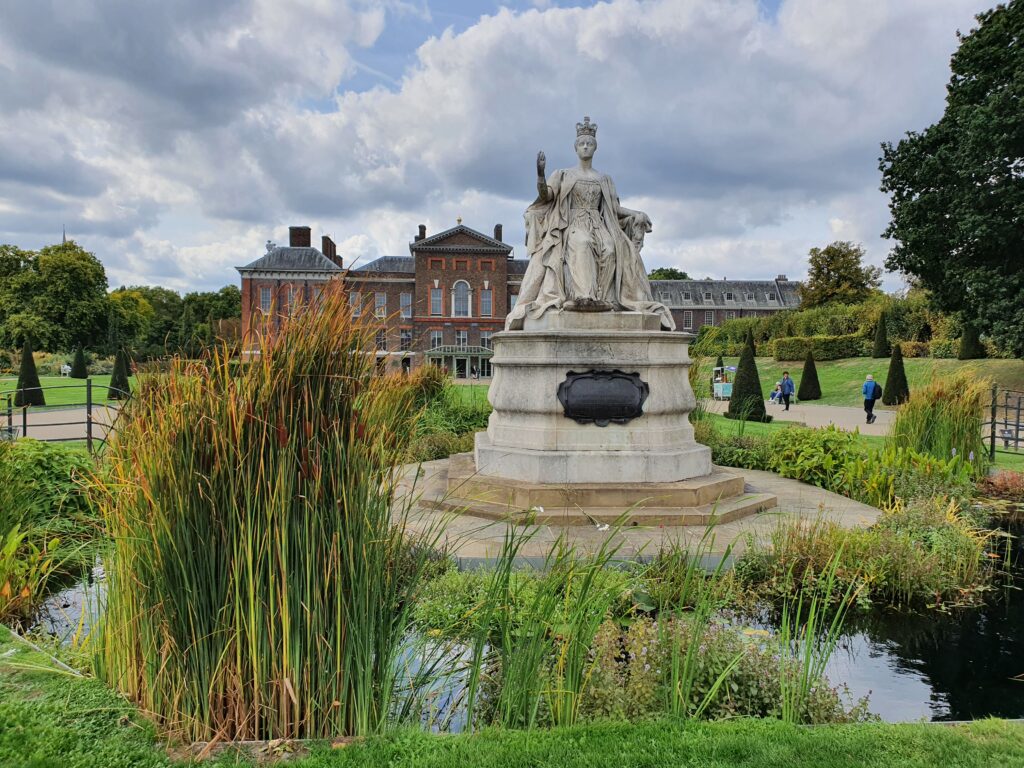
Its where Queen Victoria was born in 1819
The Queen Vic
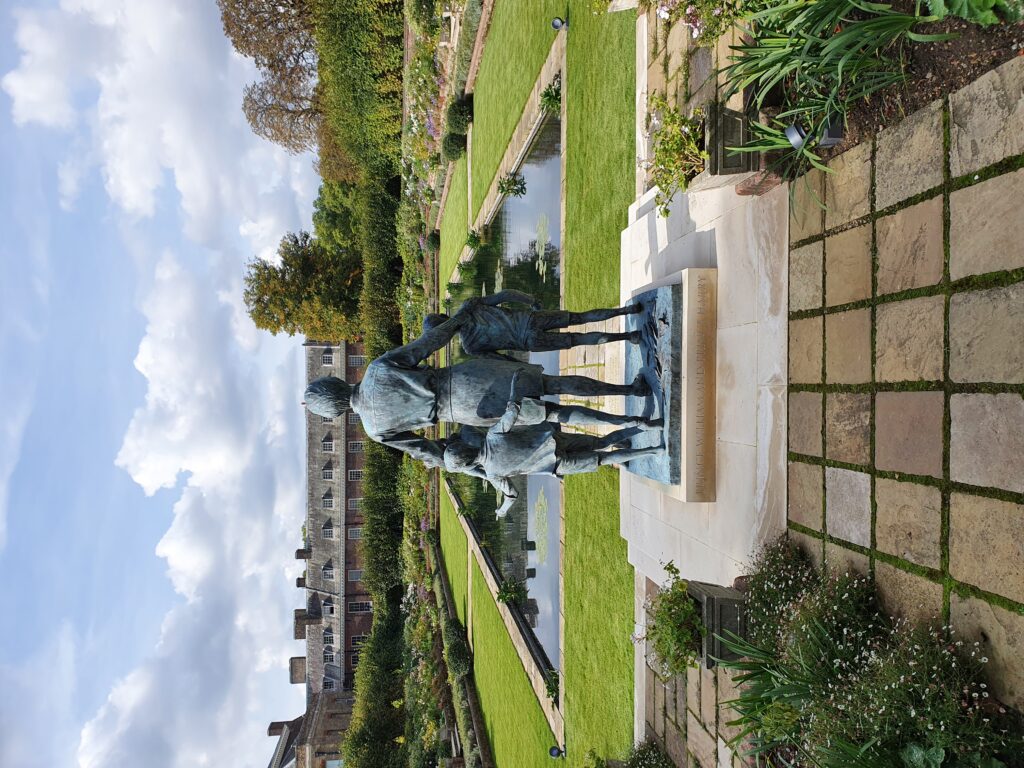
And it is famously where Diana, Princess of Wales lived.
Diana, with three children representing her ability to reach out compassionately and universally.
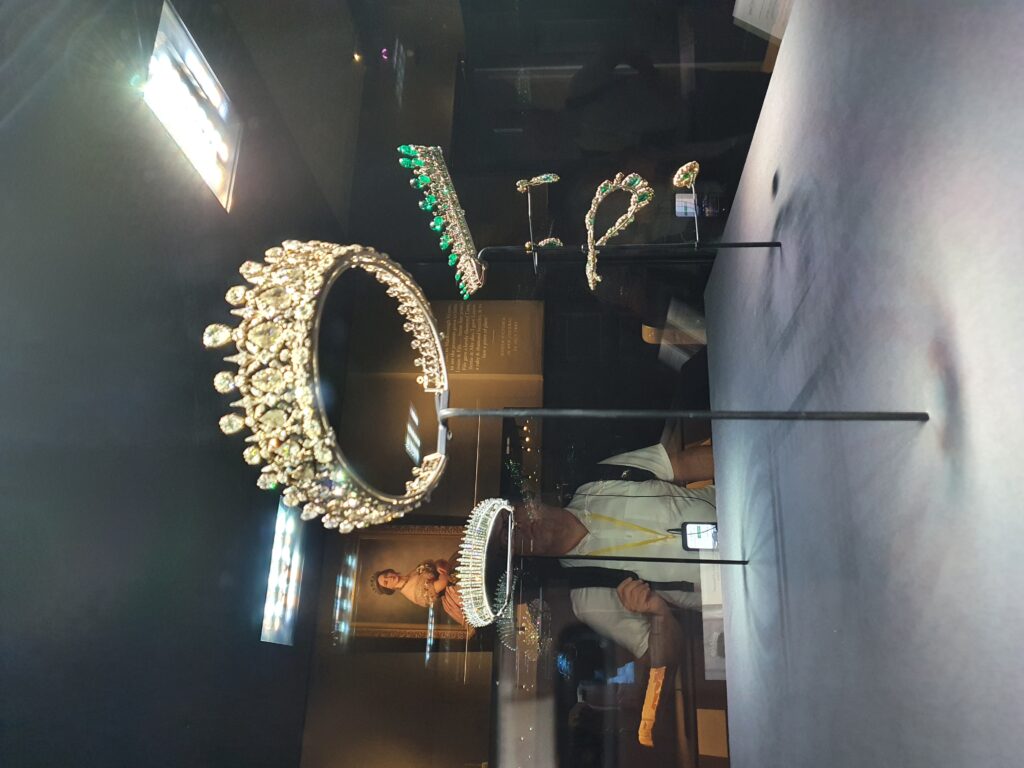
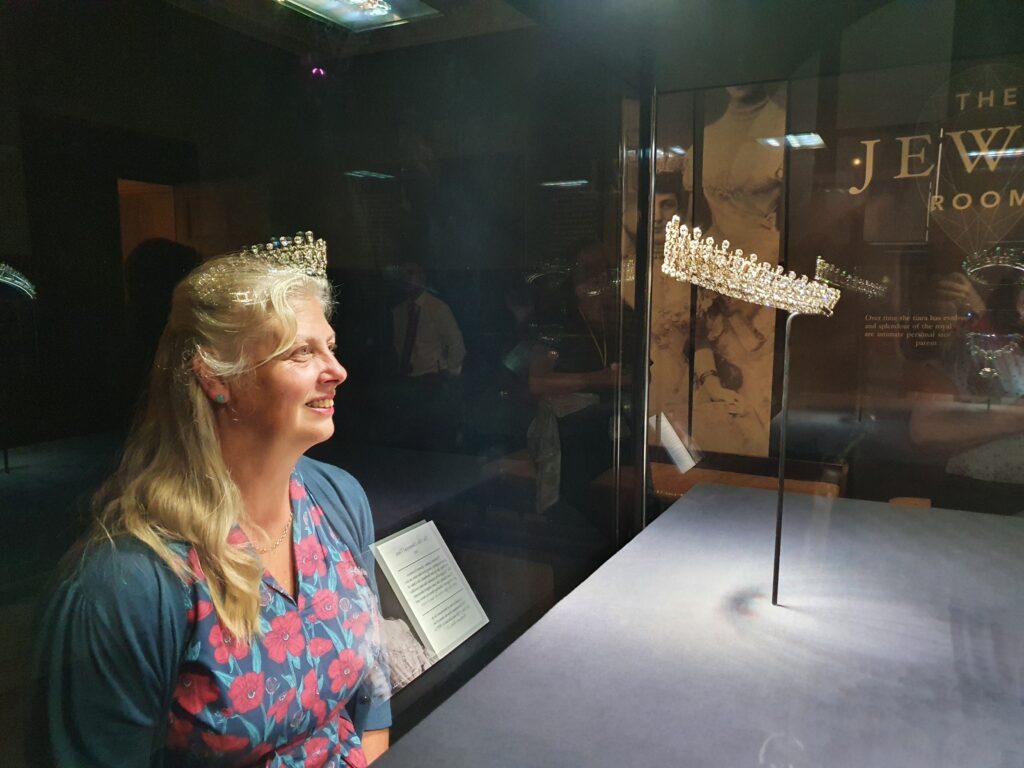
In 2012 Kensington palace was opened up to the public, with the Historic Royal Palaces trust overseeing various exhibitions and artefacts. Of course my favourite had to be the display of 3 Tiaras.
Unlike the Crown Jewels at the Tower of London I even got to try one on
If only…..
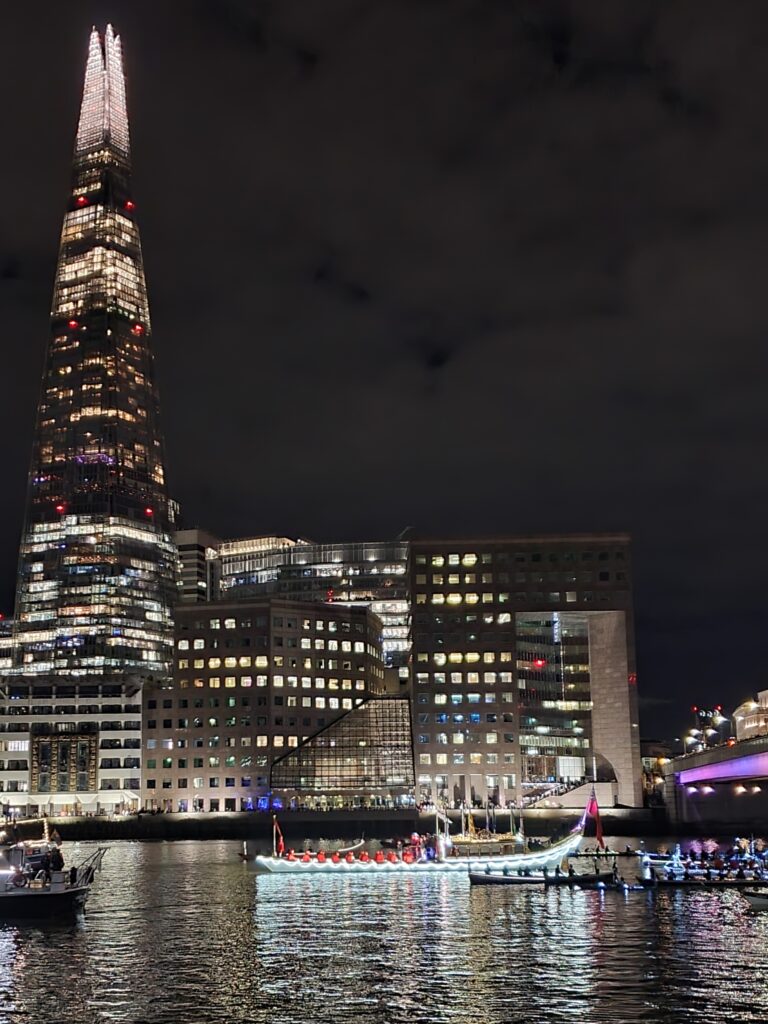
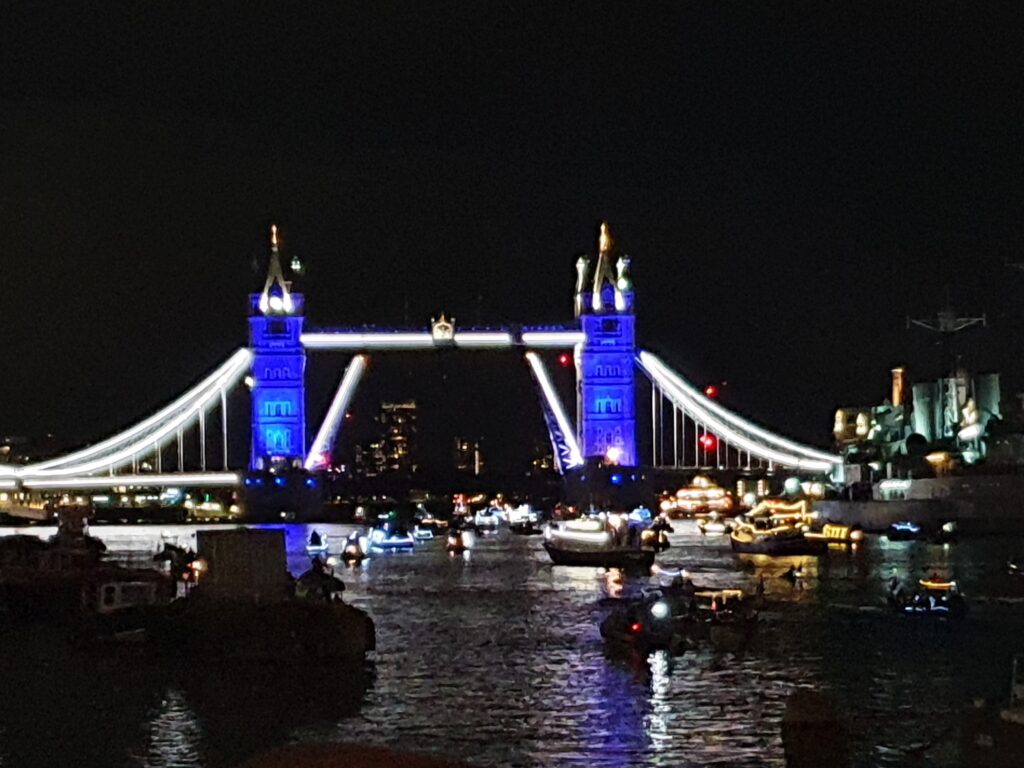
It was to be a week of reflections, culminating in the Reflections Flotilla. An event originally conceived as part of the Platinum Jubilee Celebration, but now a memorial celebration for our Queen. With 150 boats including the Royal Barge, lit up for a night cruising down the Thames from Chelsea to Tower Bridge
The Royal Barge in front of the Shard
Of course the boat we were really looking out for was Mick and Pip’s NB Oleanna as they had moored up at Islington, on their way to join the flotilla. Perhaps not the best photo of the night, but we waved as they passed.
Thats NB Oleanna
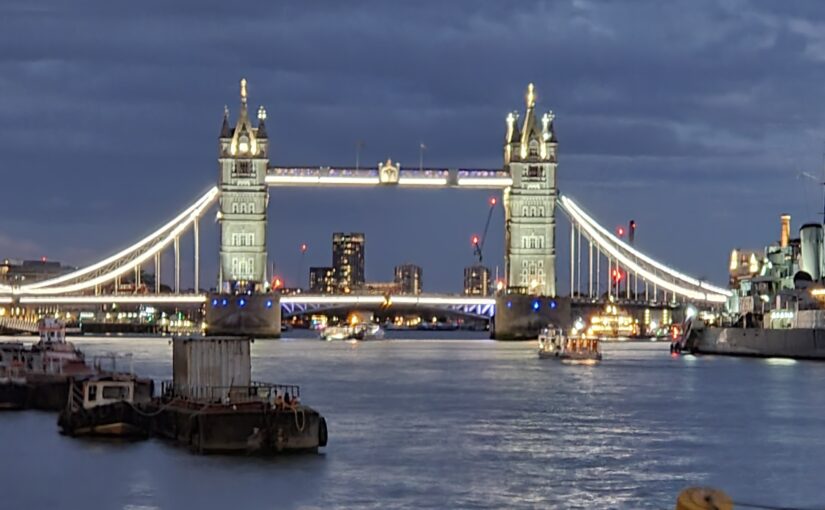
And then cheered loudly as Tower Bridge raised her arms in a full salute, something usually reserved as the highest mark of respect
Once we had made the decision not to venture onto the Tidal Thames at Limehouse, (mainly because the St Pancras Cruising Club tend to run their flotillas in the spring not the autumn) we booked ourselves another week at Islington. Little did we know our Queen was going to die and our mooring was to start the day of her funeral. (Yes, my blog diary is a bit behind the times) We would have preferred not to have cruised that day but, in the end it turned out ok. We set off from Limehouse braced for a long 4 hour cruise and 8 locks
We felt very small amongst these big boys
I walked around basin to set the first lock, and was greeted by a magnificent sight, a lock buddy,
Pea soup for lunch,
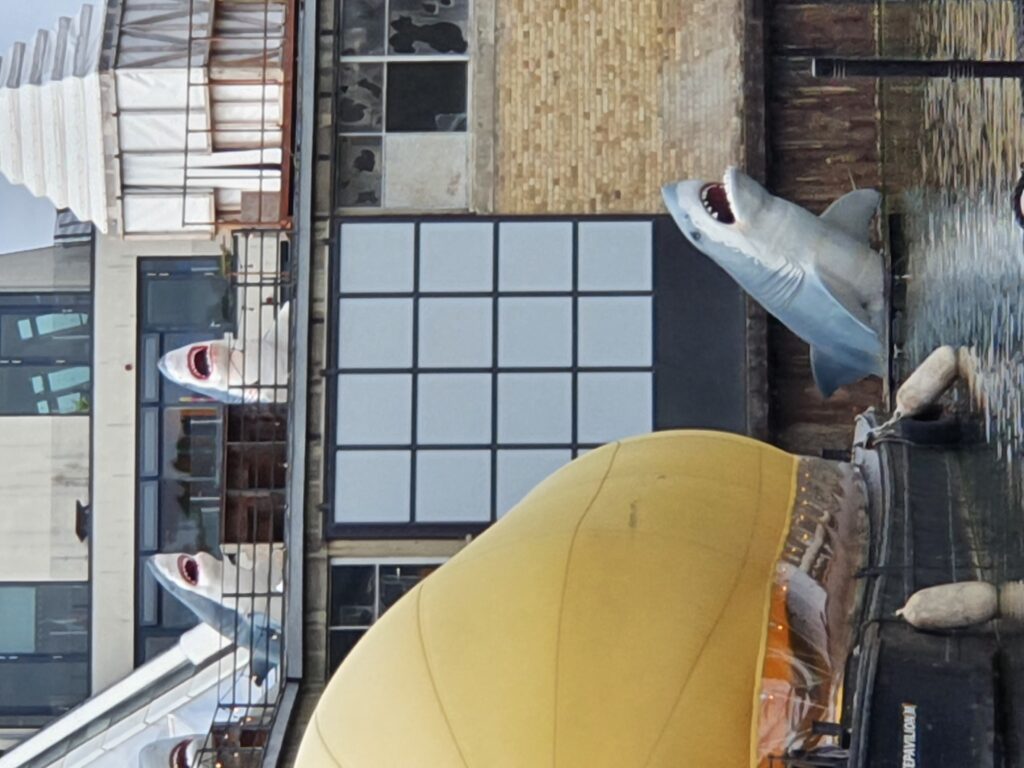
Our buddy was a professional boat mover, who could work through a lock single handed quicker that Eric and I working as a team. We quickly got into the swing of me walking ahead to set the next lock whilst the two men efficiently moved the boats. The journey took just over 4 hours. There were very few boats moving but the towpath was heaving in true bank holiday style. We wouldn’t have guessed that there was a state funeral taking place a few miles away. Even the Hackney sharks had come out to keep an eye on things.
Not sure why, but 3 sharks were now on the roof and one remained hiding in its yellow coccon
Thankfully we found ourselves a space on the eco mooring. It irks us that, despite us having booked, getting in isn’t a guarantee.
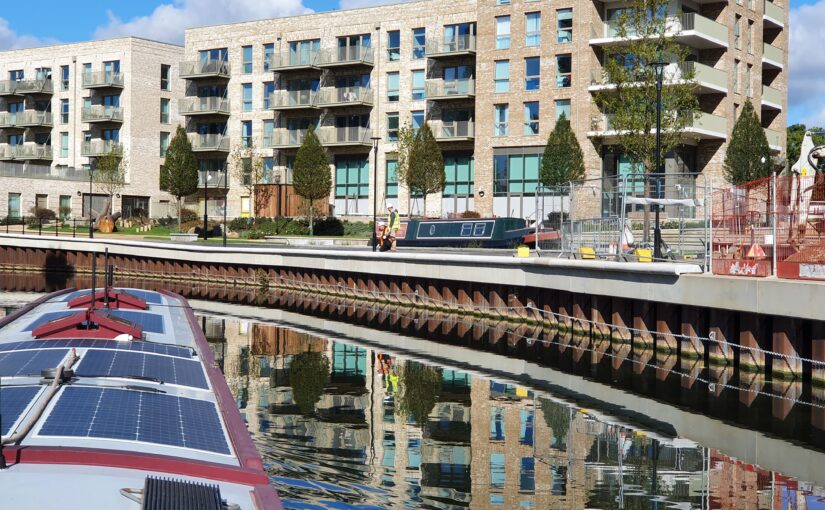
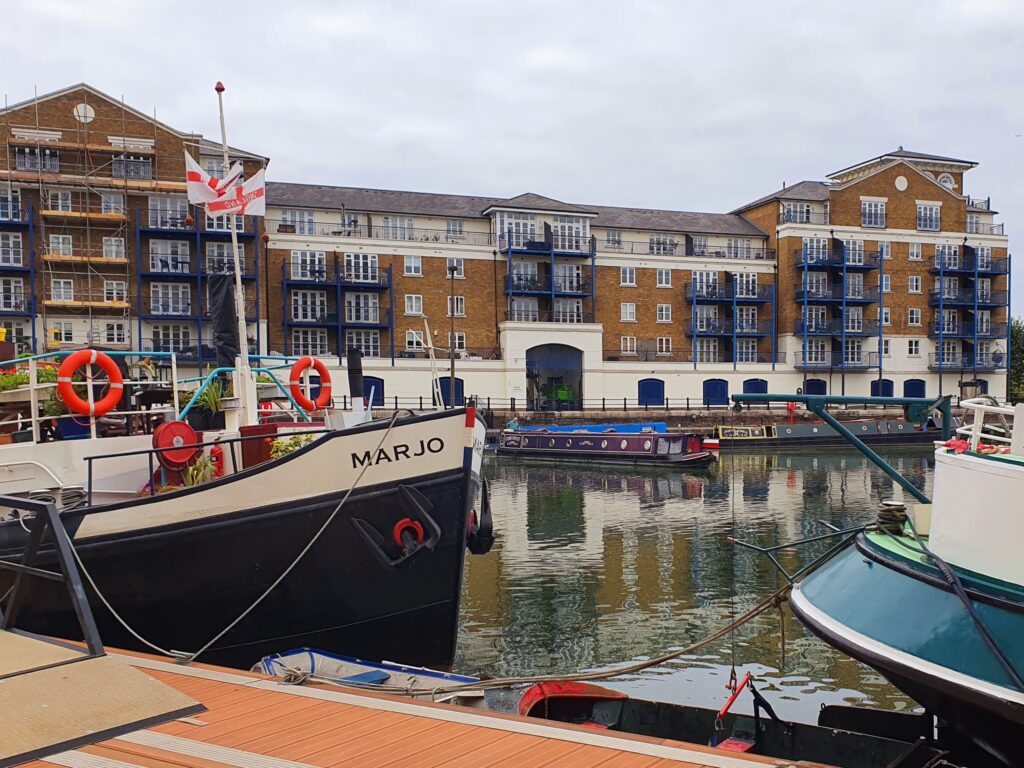
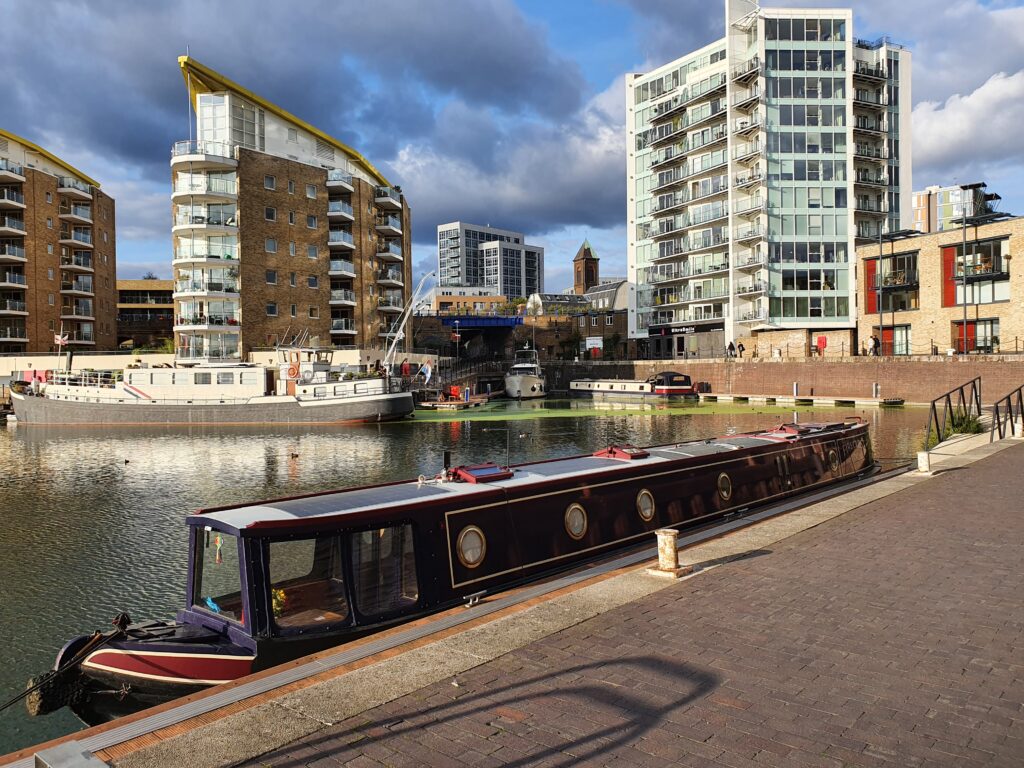
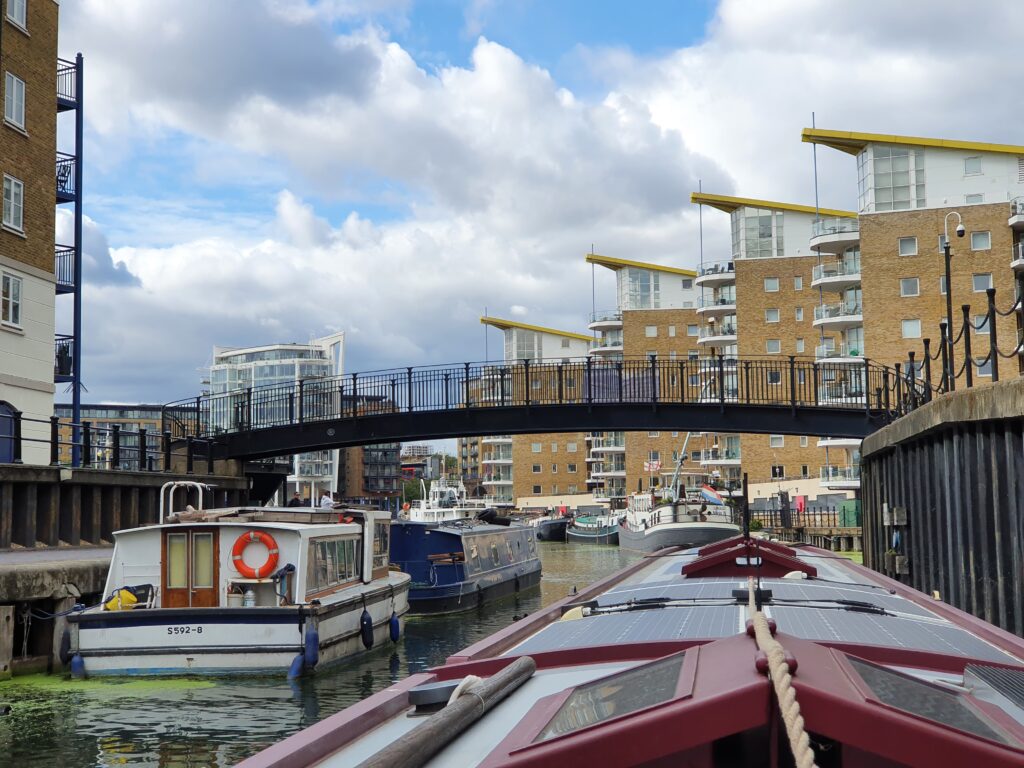
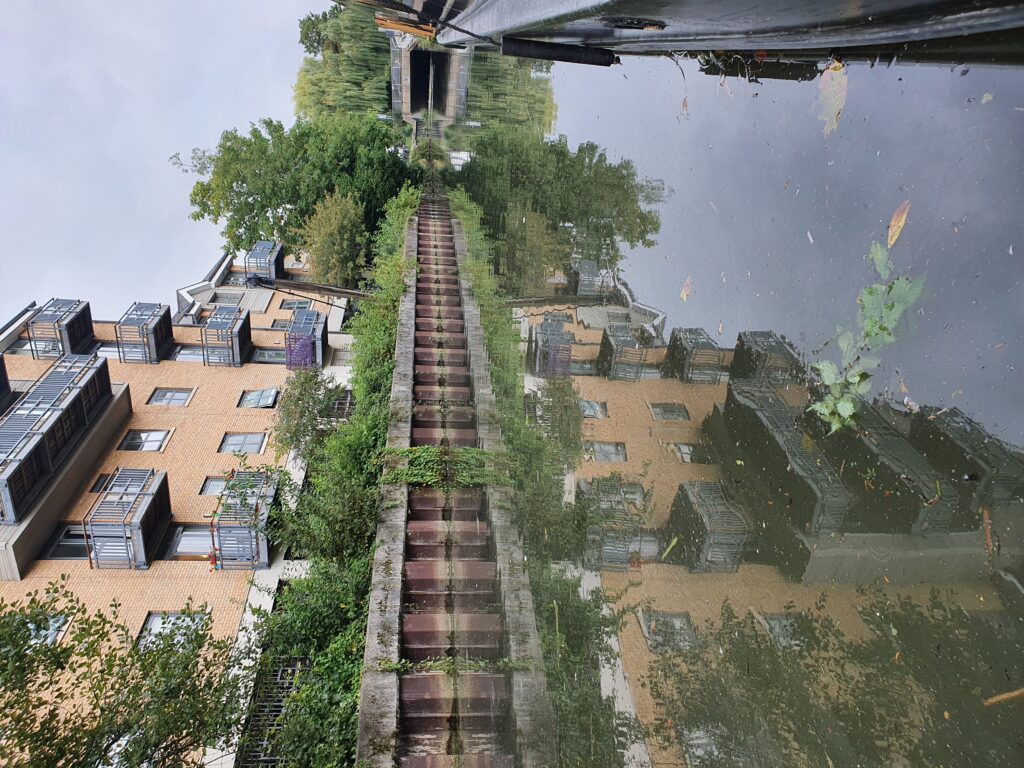
Limehouse basin is at the end of the Regent’s Canal. It used to be part of the historic Thames Docks, Nowadays, its a marina full of some mighty fine boats. Surrounded by some pretty impressive apartments. We wanted to be assured of an overnight stay so I enquired about paying for a marina berth…. £9/m per night… and we are 18.3m long….
Fortunately CRT retain the use of “the wall” with free 24 hour mooring, as its where the canal network is able to join the River Thames via a tidal lock. Originally we had hoped to join a flotilla of boats to do this and cruise with the tide, past the iconic sights, the Houses of Parliament, the London Eye, Tower Bridge etc, back towards Brentford and the Grand Union Canal However our forward planning left a little to be desired and this would become be a trip to look forward to another year. Instead we left Firecrest in the basin and went for a walk along the river, to see what we could see.
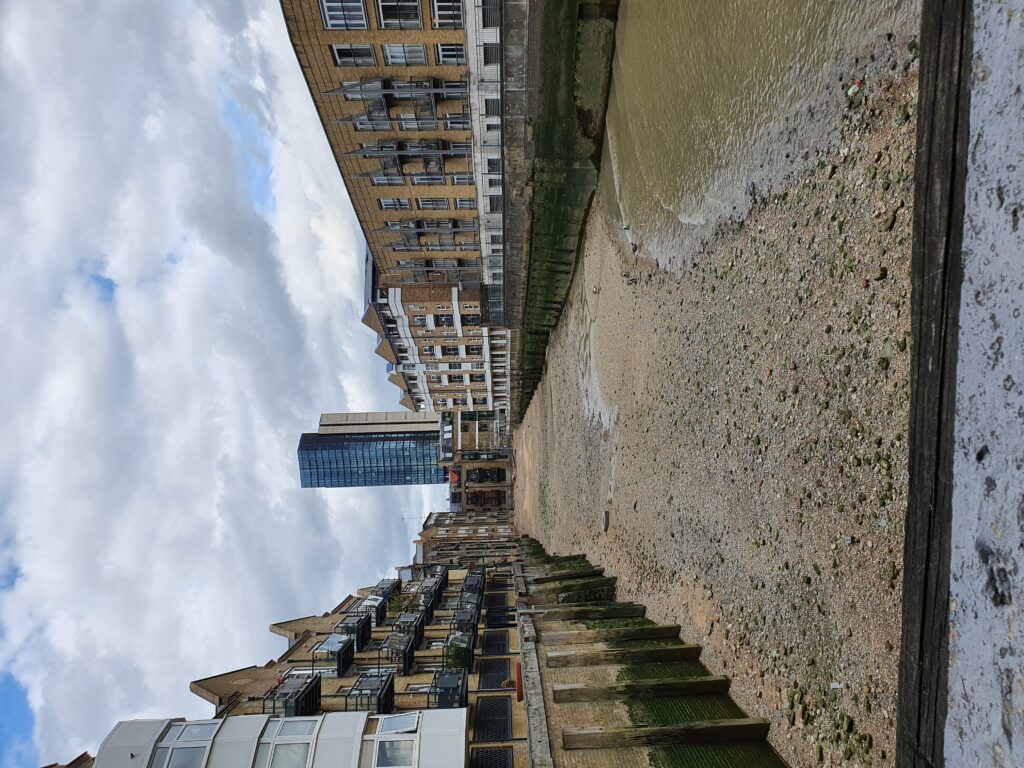
The Thames in London has quite a significant tidal drop, so the footpath is along dedicated walkways and interconnected bridges spanning the creeks. How it must have changed over the centuries,
Looking up the creek without a paddle
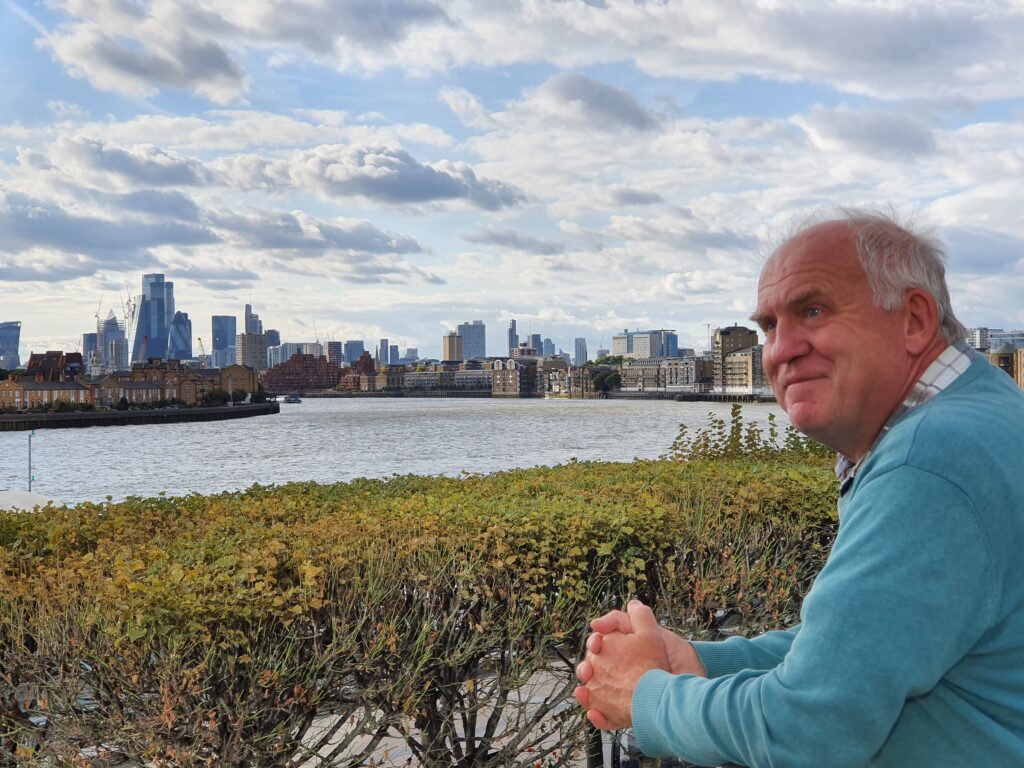
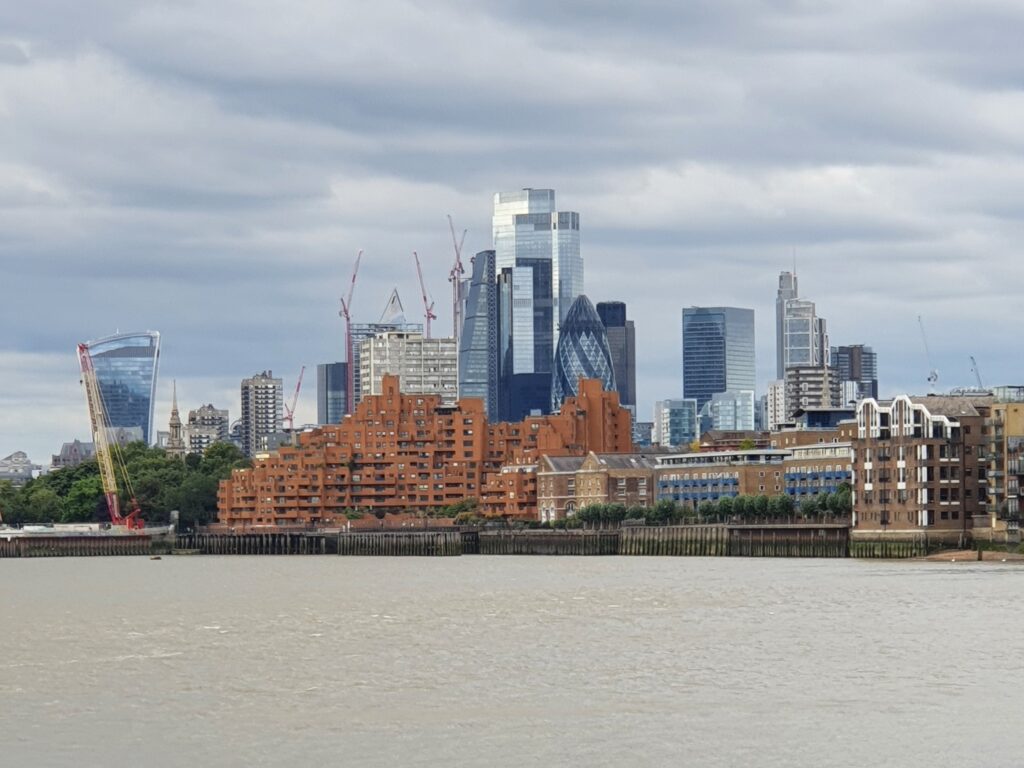
When we looked to the right, we were treated to a view of the city skyline
Looking towards City of London,
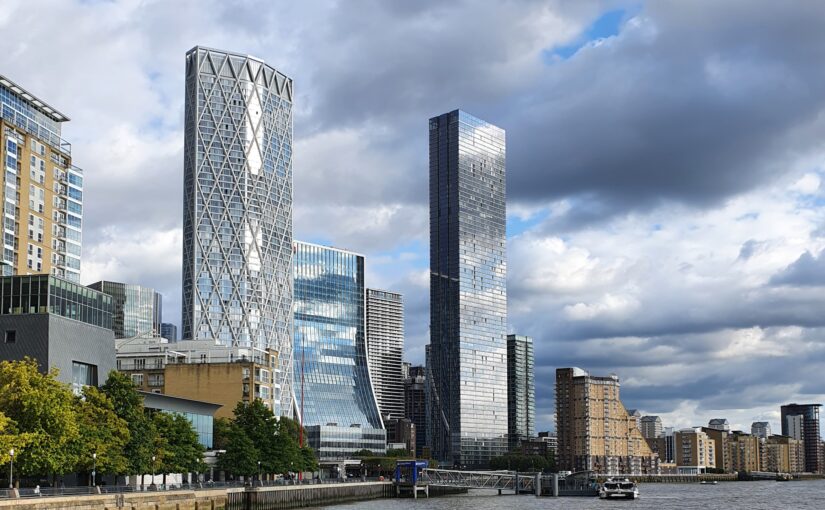
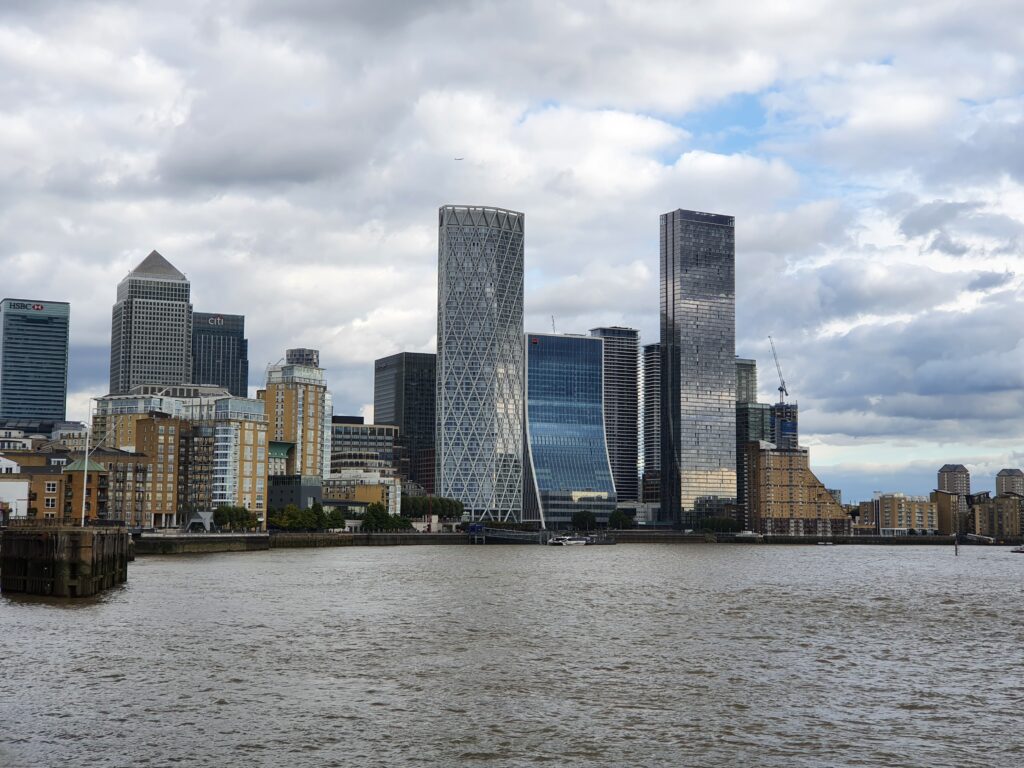
And towards the left we could see the financial district of Docklands and Canary Wharf
Canary wharf and Docklands
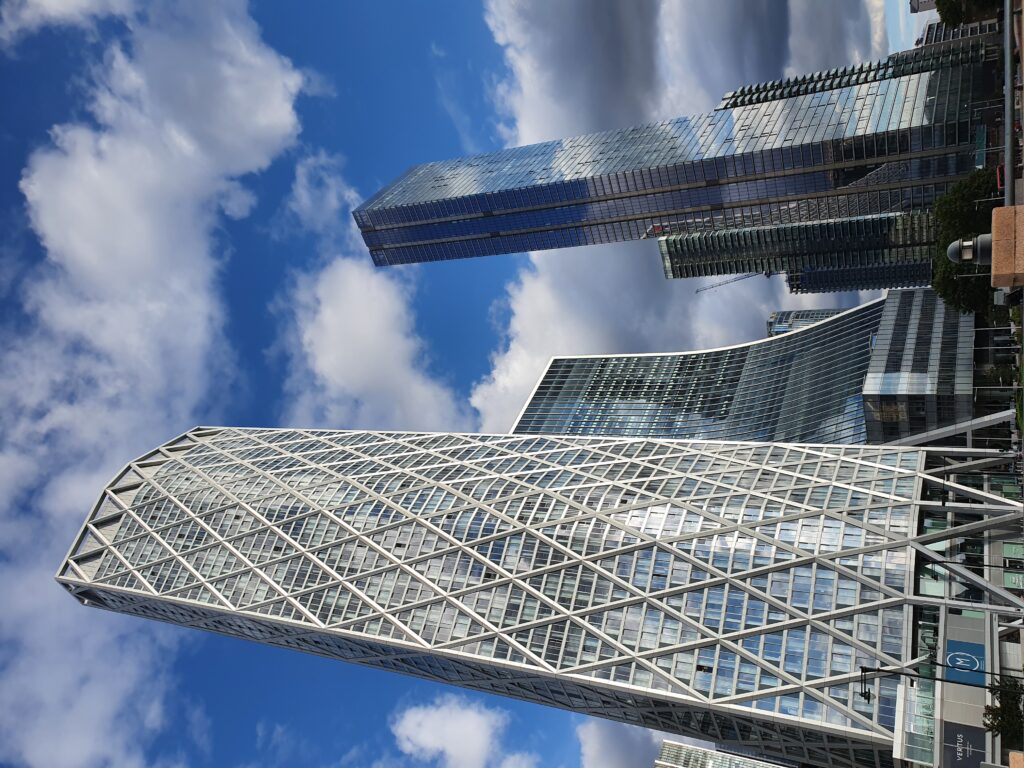
We decided to walk towards Docklands and in amongst the architectural megaliths
the landscapers saw fit to gentrify the navigation into a modern play pen,
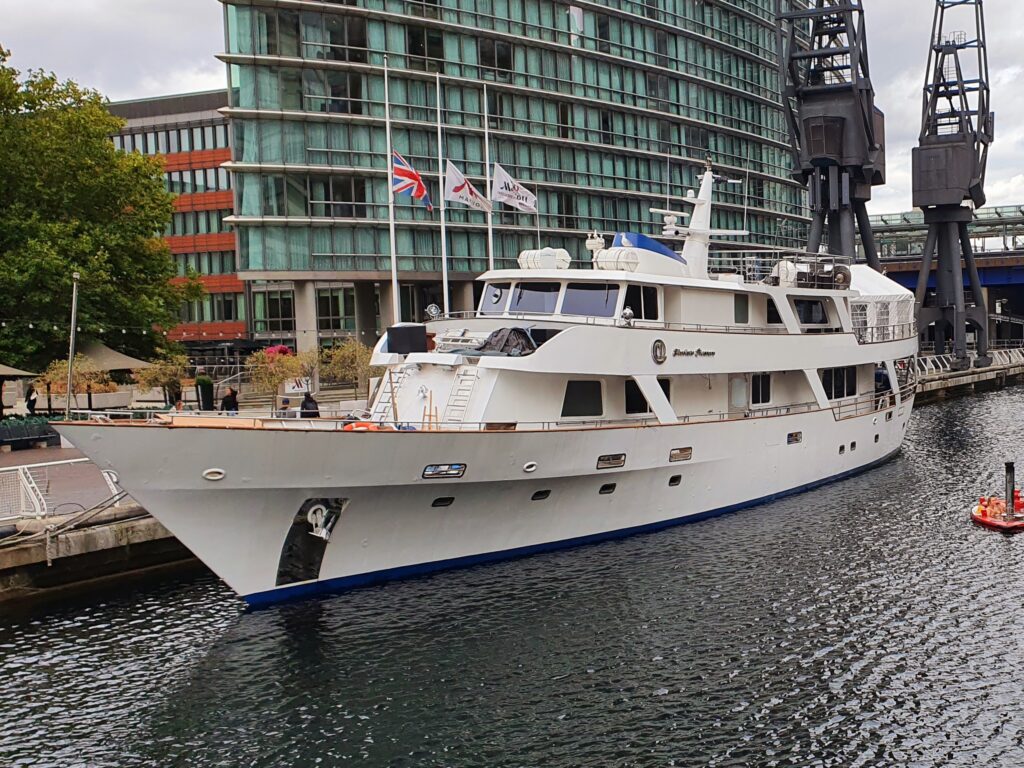
well don’t we all need somewhere to park a super yacht
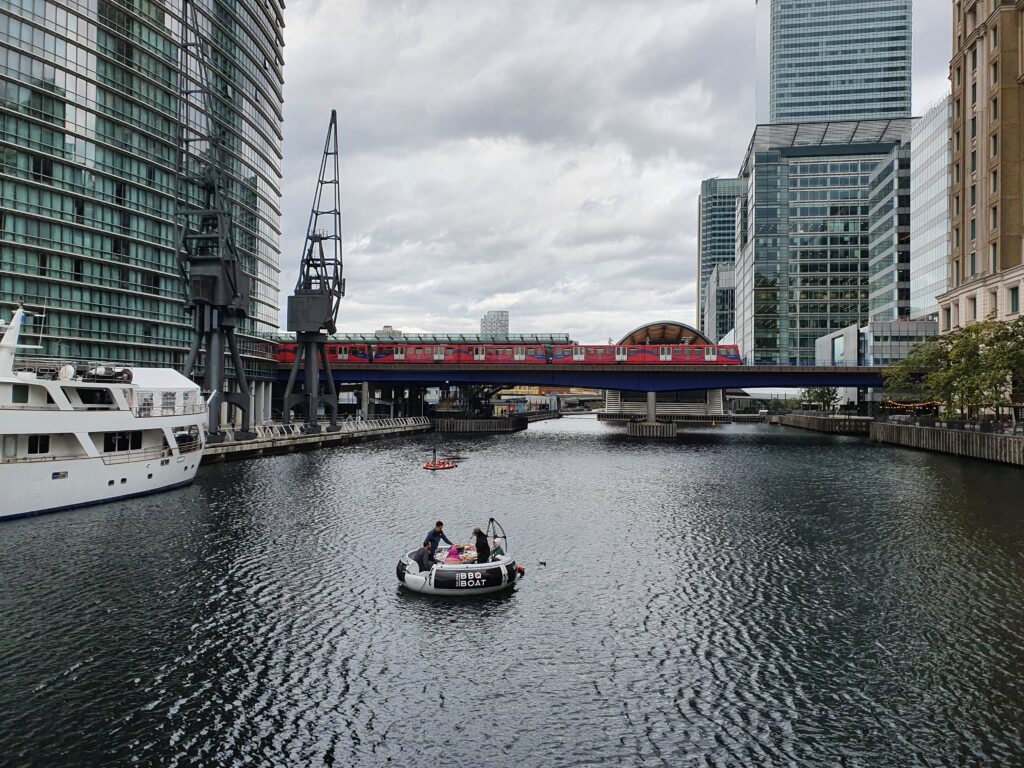
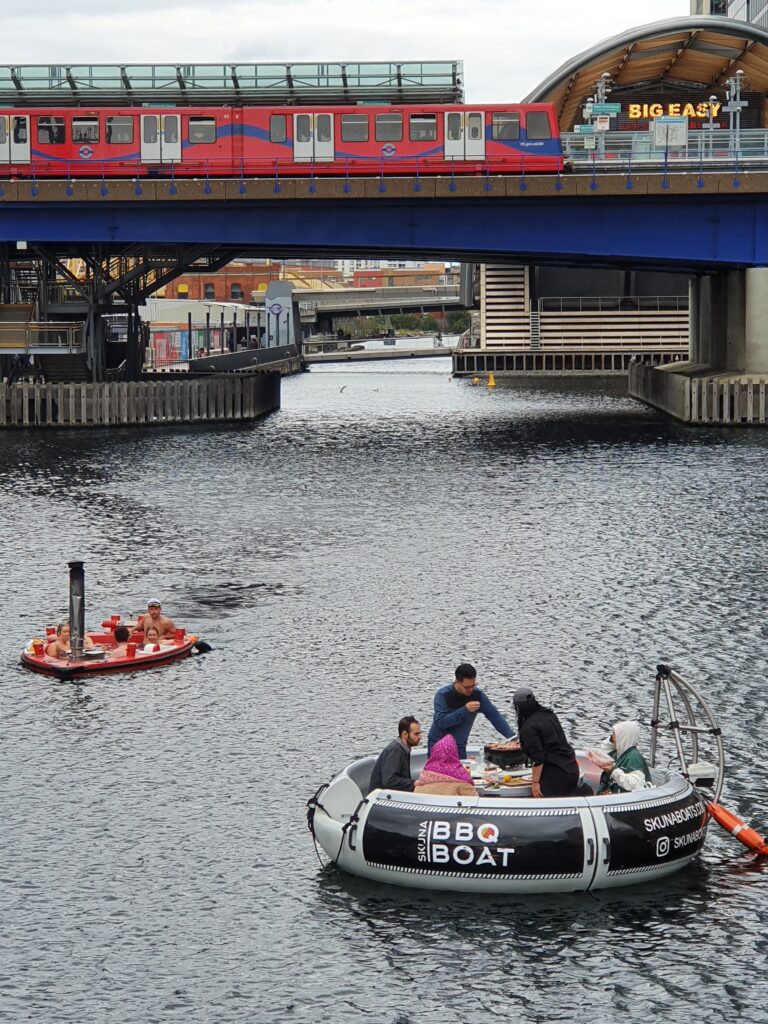
But it wasn’t just big boats, there were BBQ boats
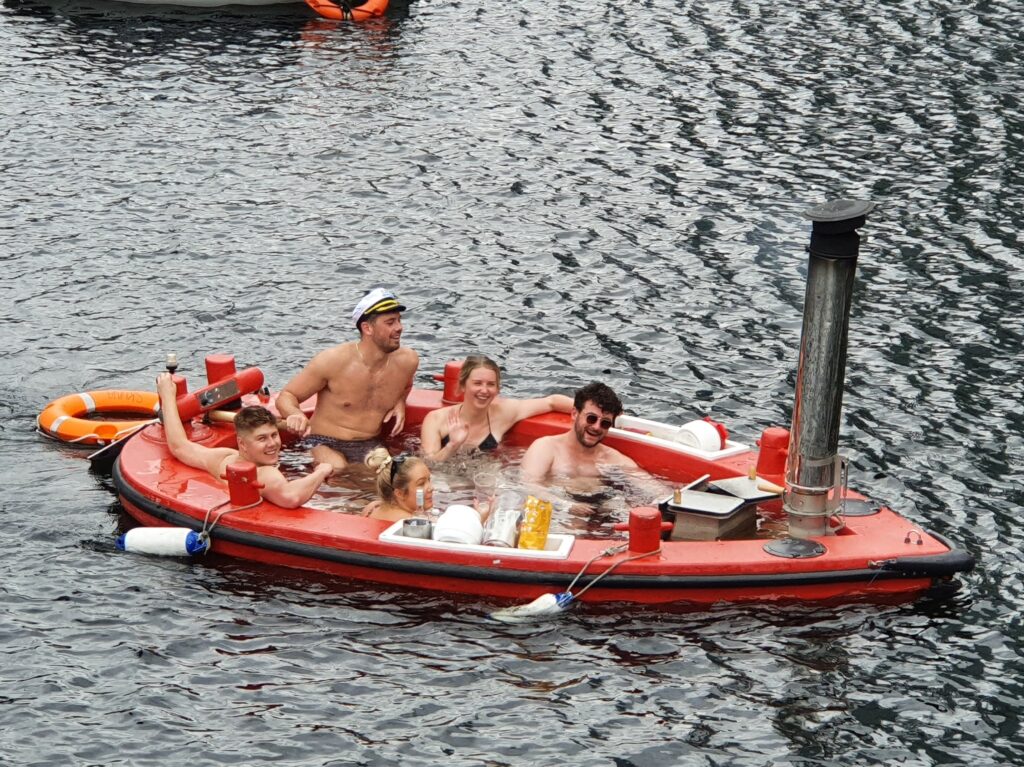
and weirdest of all a jacuzzi boat. For £225 up to 7 people can have the privilege of taking this electric bath tub full of warm water for a spin, whilst they sip prosecco.
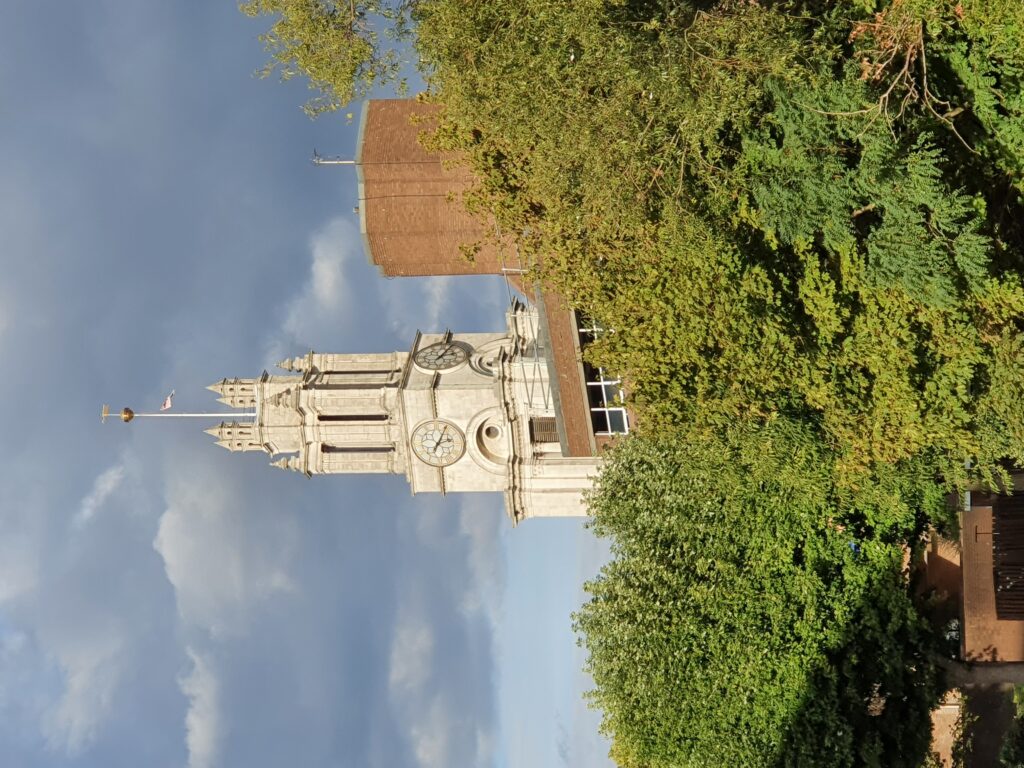
They certainly seemed to be enjoying themselves, so we left them to it, whilst we went into the Docklands Museum. Frustratingly we only had half an hour to take in the 3 floors of fascinating history charting the fortunes and failures of London’s East End, as it morphed from being a hub of imports and exports to becoming the financial capitol of our country. We wandered back to Limehouse basin via one of the local parks, where we were overshadowed by St Annes Church
St Annes Church, Limehouse
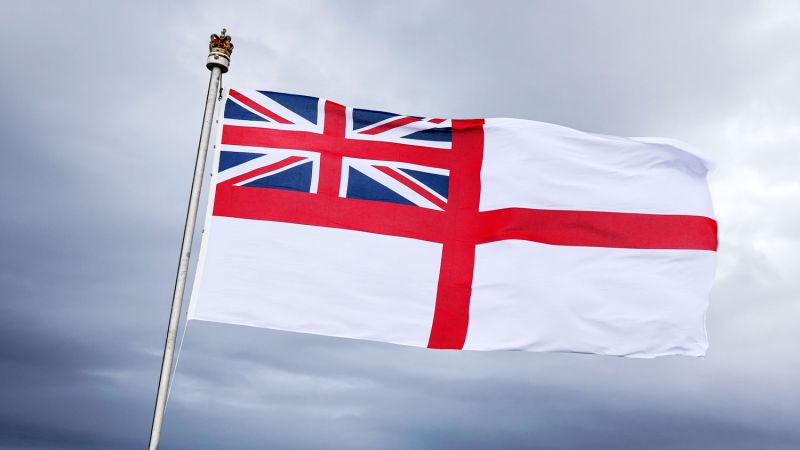
This is one of the 12 “Queen Anne’s” churches built in the 18th century. Its proximity to the river made it the ideal location for captains to record and register significant events encountered at sea. Queen Anne also granted permission for this church to fly the second most senior ensign of the Royal Navy, the White Ensign. And with its prominent tower and golden ball on the flagpole, it is still a visible “landmark” and became a Trinity House “sea mark” marked on navigational maps. It is still permitted under the Queen’s regulations to fly the white ensign 24 hours a day 365 days a year.
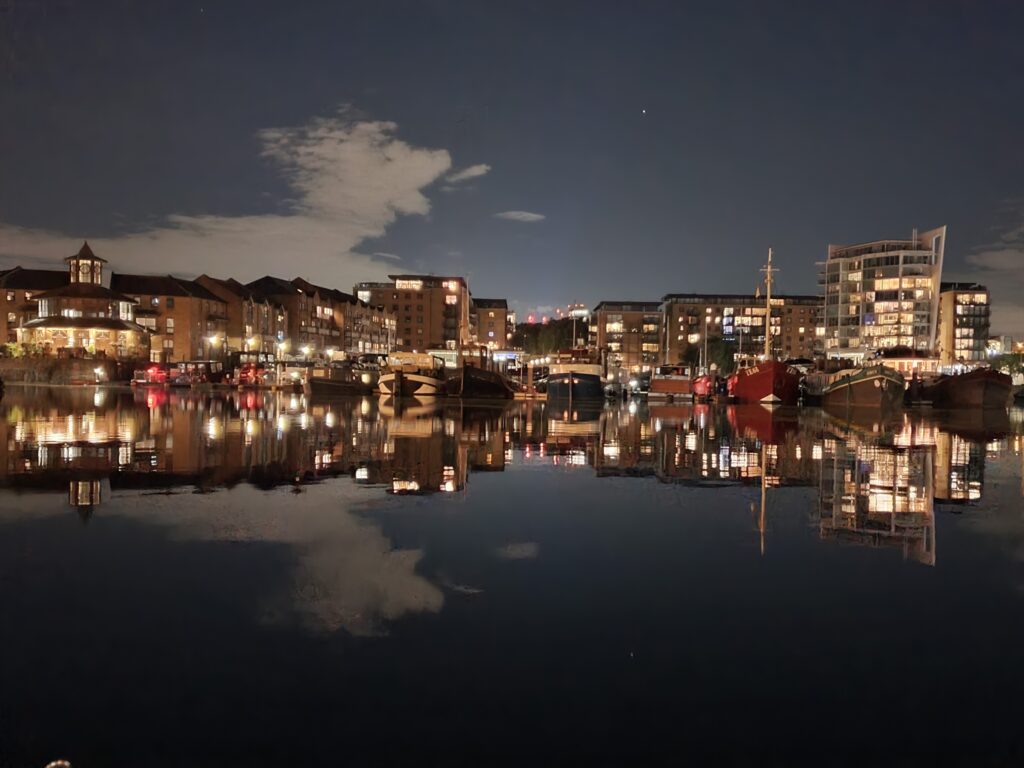
We made it back to Limehouse basin just before dark, but enjoyed our evening meal surrounded by big boats and twinkling lights. And determined to come here again and explore this historic area more. For anyone needing a calculator, our marina fees would have been £171.
Its 33 miles and 29 locks from Bishop’s Stortford to Limehouse Basin, so we took a week to build up some steam, enjoying the prettiness of the Stort, cruising at our leisure,
River Stort
Taking it carefully as instructed,
Roydon railway bridge
Making friends with the locals
Lucy the lock keeper
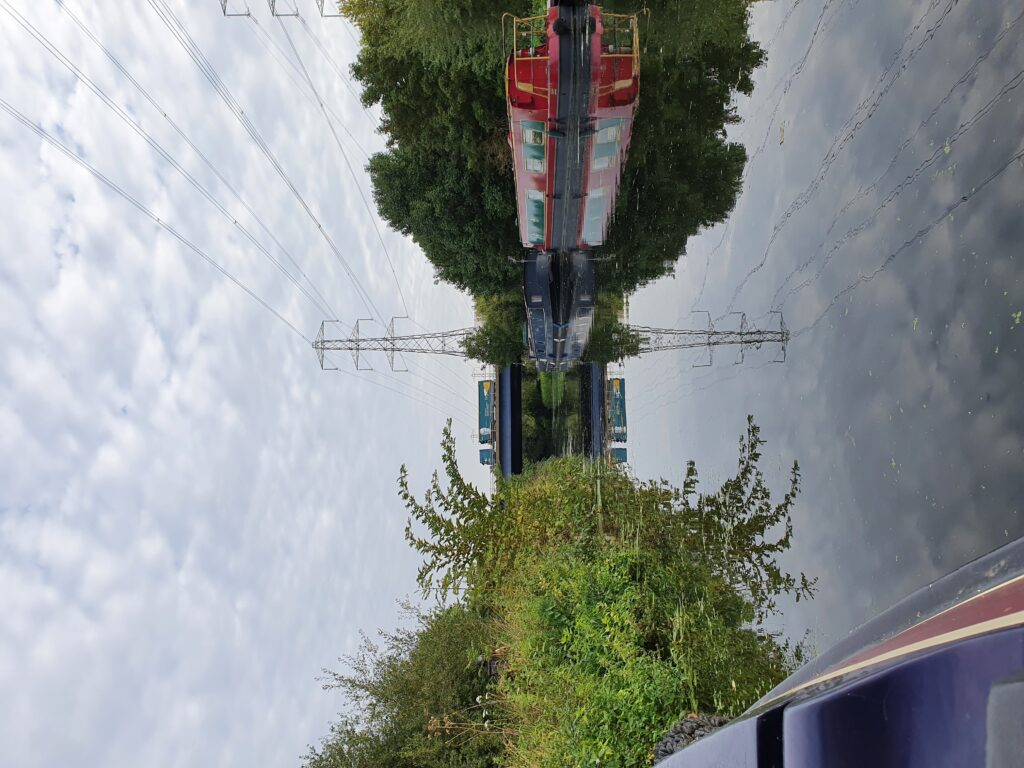
It was looking a bit congested around the M25
Rammy Marsh lock, with M25 behind us
With the daunting prospect of no mooring.
Around Tottenham
So someone thought they needed to check in early
But at Tottenham Marshes we struck gold. With a space that wasnt just big enough, it was in full sunshine
Tottenham Marshes
We now had 7 miles and only 3 more locks to complete our journey, thats roughly 3.5 hours travelling for us….. we could see the City looming ahead
City skyline in the distance
At this point we could have taken the option of turning right onto the Hertford union link canal to get us back onto the Regent’s Canal. But we thought it would be fun to take the half hour detour and cruise around the olympic park ring.
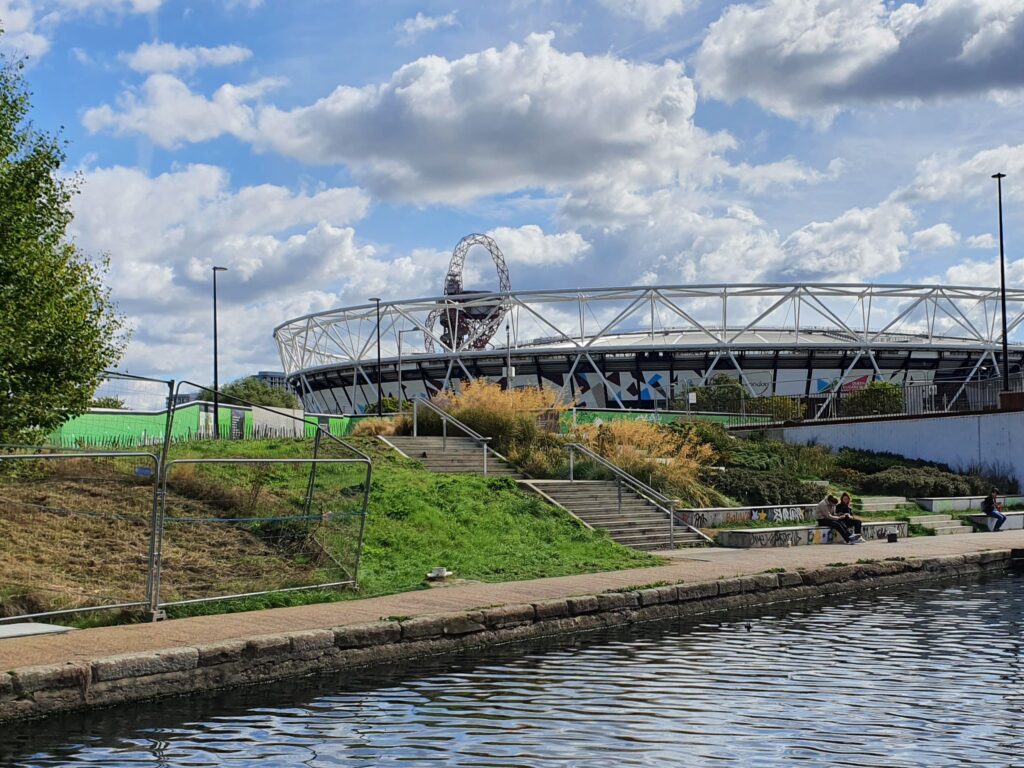
The Olympic stadium which is now home to West Ham
We had teamed up with another boat who had the same intention as us, we’d checked our maps and yes it was now permitted to cruise but not to moor. As I was on lock duty I had the advantage of looking around the corner, and saw a clump of branches at one side. I dutifully called out a warning. “Go very slowly, there’s a tree down and I can’t see how much navigation its blocking. …..” hummmmm turns out it was blocking the navigation completely. Luckily we were able to reverse in and pull them off, as they were well and truly stuck.
It could have been worse, but perhaps “tug of boat” ought to become an olympic sport
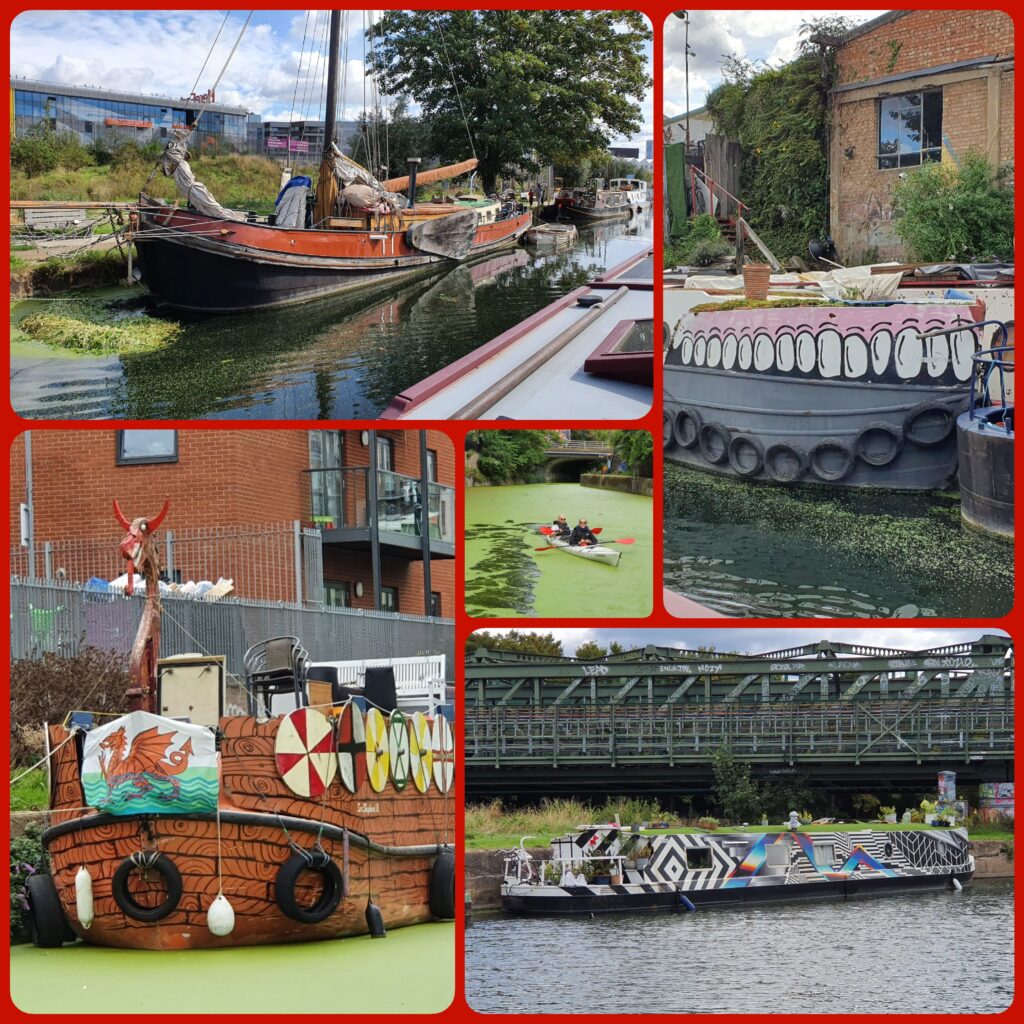
It was pity not to be able to do the ring, but we weren’t short of other interesting sights, with some creative boat design
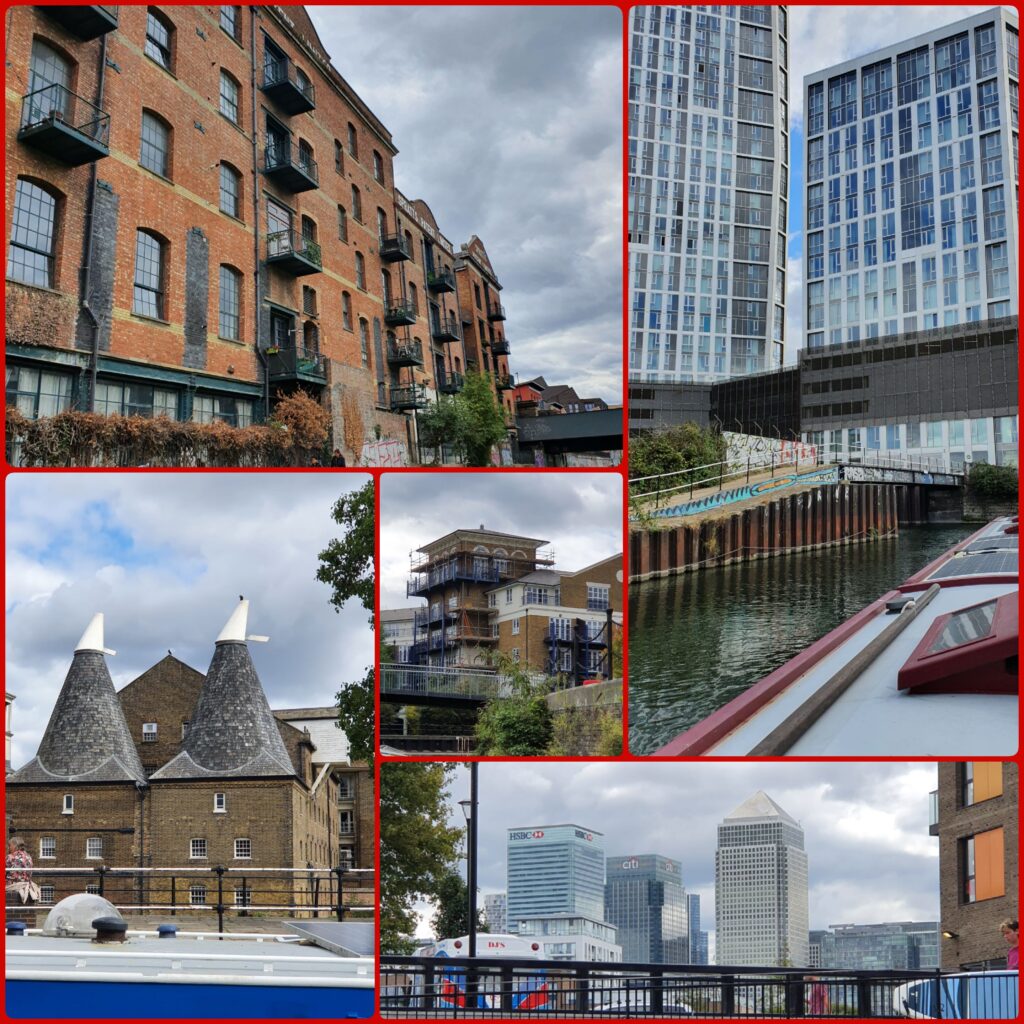
And most buildings reaching for the sky
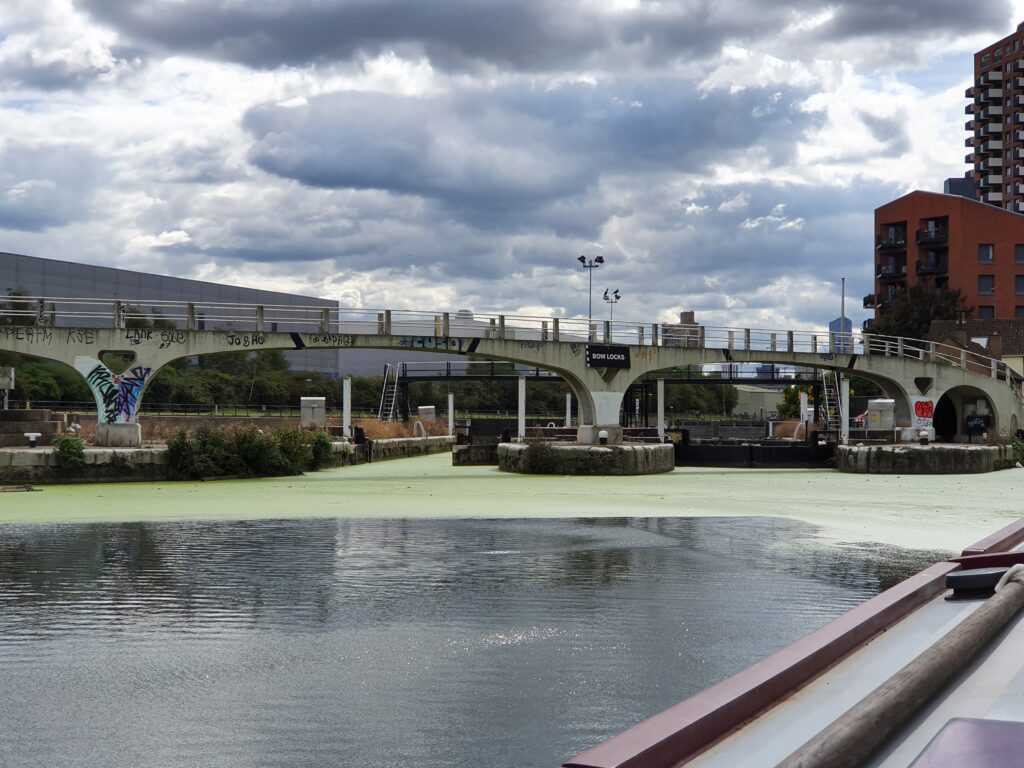
We cruised past the Bow Locks which we are not sure if they are still operational to allow cruising on Bow creek or if it is just for tidal management only now.
Bow Tidal locks
And after 5 long hours we reached the end of this section of our journey by entering Limehouse Basin
We managed to find the last available mooring in Hertford for 2 nights, so I could hop onto the train back into London to meet up with Amanda and a few friends. I’d have liked to explore Hertford a bit more but the need to run the generator, whilst being moored next to a block of flats isn’t neighbourly so we moved on.
Hertford
Back the 6 miles through Ware and Stanstead Abbot,
Stanstead Abbot
to Feildes lock, and the confluence of the river Stort which becomes the Stort Navigation. In a matter of minutes we felt like we were in a completely different environment. Although the Stort was canalized in the 1760s, it still retains the characteristics of a rural river.
The River Stort
Its 14 miles of very pleasant cruising, although the 15 locks are a frustrating dimension, only 13 foot/4m wide, which makes them just a bit too narrow to take 2 narrowboats side by side, yet still requiring a double locks worth of water, and effort, but at least they are very pretty. And a local boater informed us that it is customary not to close the gates on exiting a river lock, which did make them a bit easier to work.
Brick lock
We meandered happily along enjoying the buildings along our way
Roydon
Ducking under the overhanging willow trees, and infact narrowly escaping a potential catastrophe, as a large branch broke and fell into the canal seconds before we passed by. I was too shook up to take a photo, but we were lucky it had remained attached to the tree by a thin slither and blocked the towpath rather than the canal.
Duck!
We enjoyed a few nights moored at Sawbridgworth, which is where I believe Beckingham Palace is, although the Beckhams no longer live there. All this lovely countryside isn’t the usually the first image that you think of when you realise we were cruising through Essex
But after a week of tranquillity we were back in Hertfordshire and moored at the end of navigation in Bishop’s Stortford
End of Navigation, Bishop’s Stortford
Bishop’s Stortford has been voted one of Britain’s best places to live, although it seemed nice enough, its not the first town that springs to my mind to claim this title. We arrived on market day, and I was amused to see the same Cheese and Pie man that regularly visits our home town in Suffolk. We had quite a good chat reminiscing about people in common that we knew.
Once we passed under the M25 the navigation did get more pleasant.
The M25 bridge
We enjoyed a night moored in the pretty little village of Stanstead Abbot. there’s a useful marina and small chandlery although they were out of stock of mooring pins, which we urgently need . The Co-op was well stocked though.
We were lucky to get in here
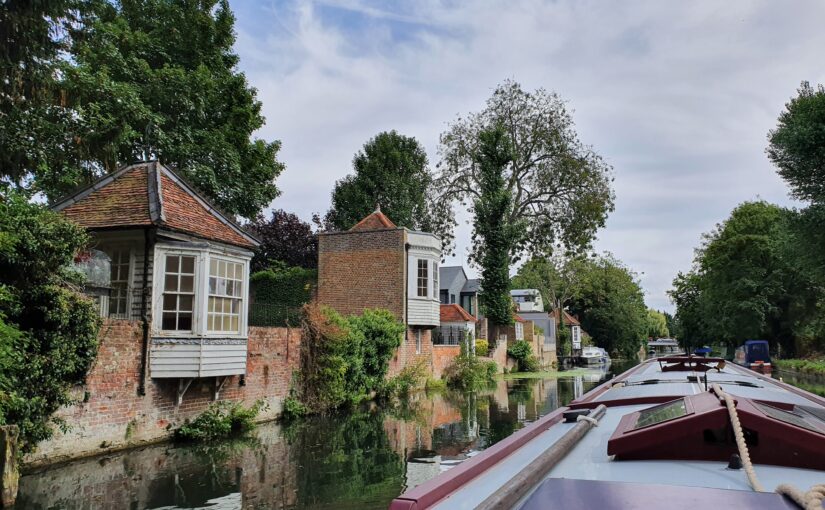
And the next night we were in Ware. A small town full of history, and rivalry with Hertford for being a significant staging post on the roads north. However Wares prosperity grew up quenching the thirst of Londoners, both with fresh water and beer. An artificial waterway was created in the early 17th century to channel water from the natural spring at Ware into London. Its still in use today carrying around 8% of londons drinking water, thats around 220million litres per day. Ware also played a significant role in the brewing industry supplying malt the London Brewers, and then brewing in the town itself. Several malt houses can still be seen from the river, but what marks Ware out is the Gazebos of Ware. In the 18th and 19th centuries the inkeepers and property owners needed a quiet place to retreat from the hectic highstreet and it became fashionable to build these overhanging summerhouses onto the river. Known as the Gazebos, they are are quaintly unique to this area.
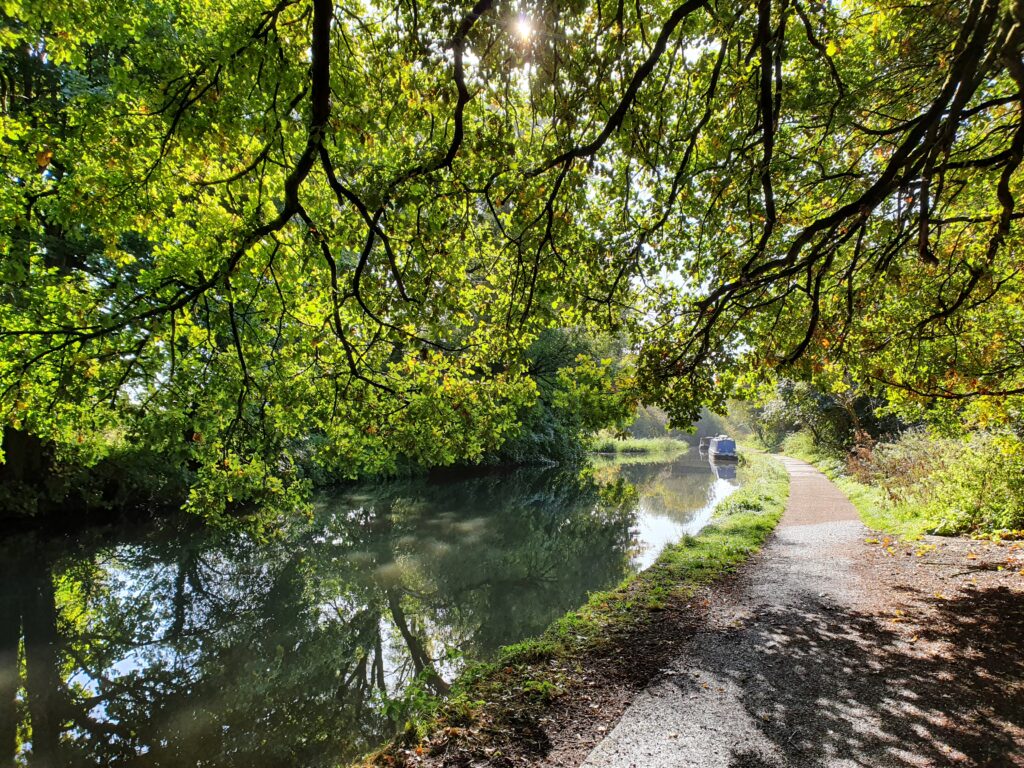
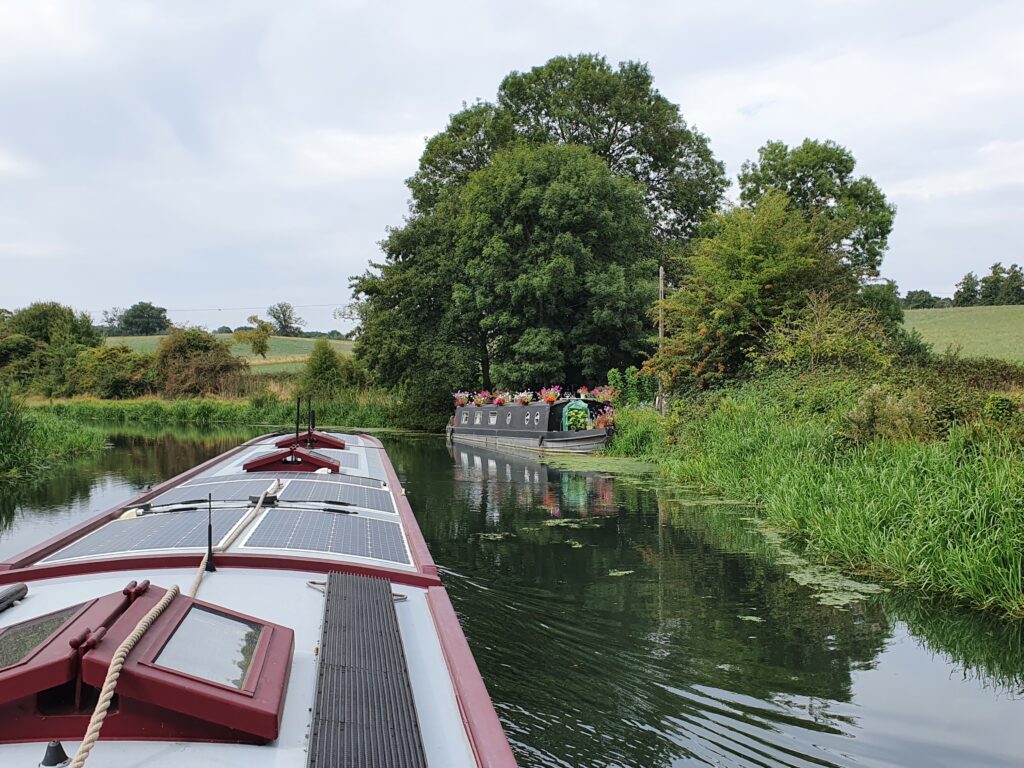
We continued our journey though some lovely rolling countryside
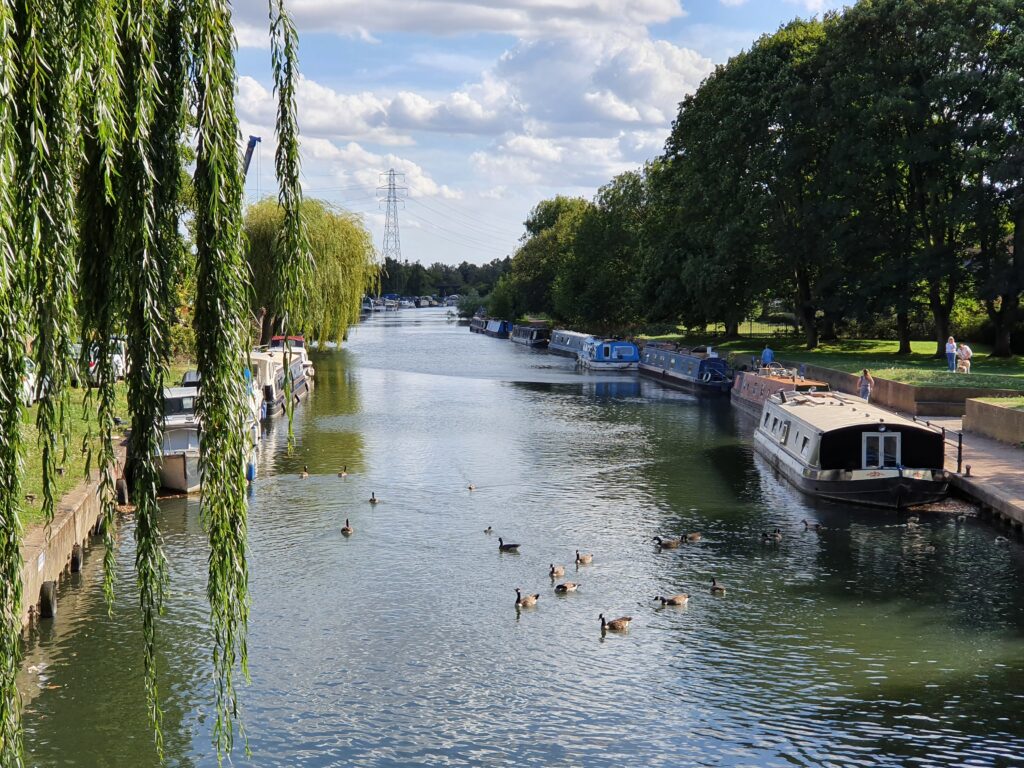
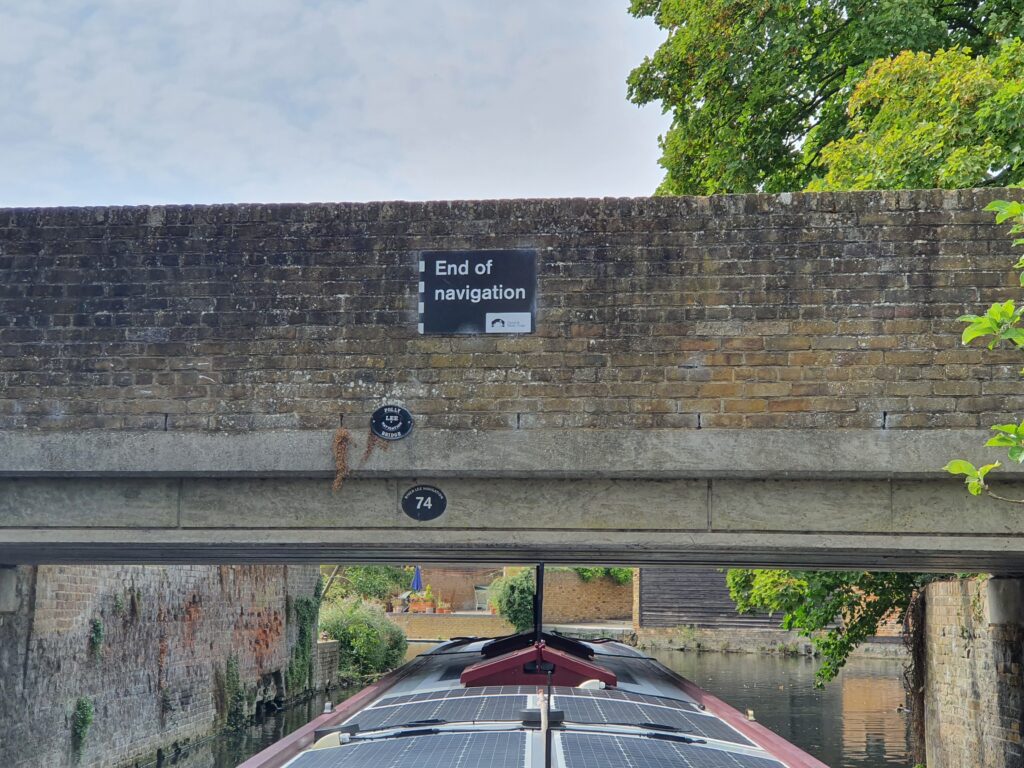
Until we could go no further
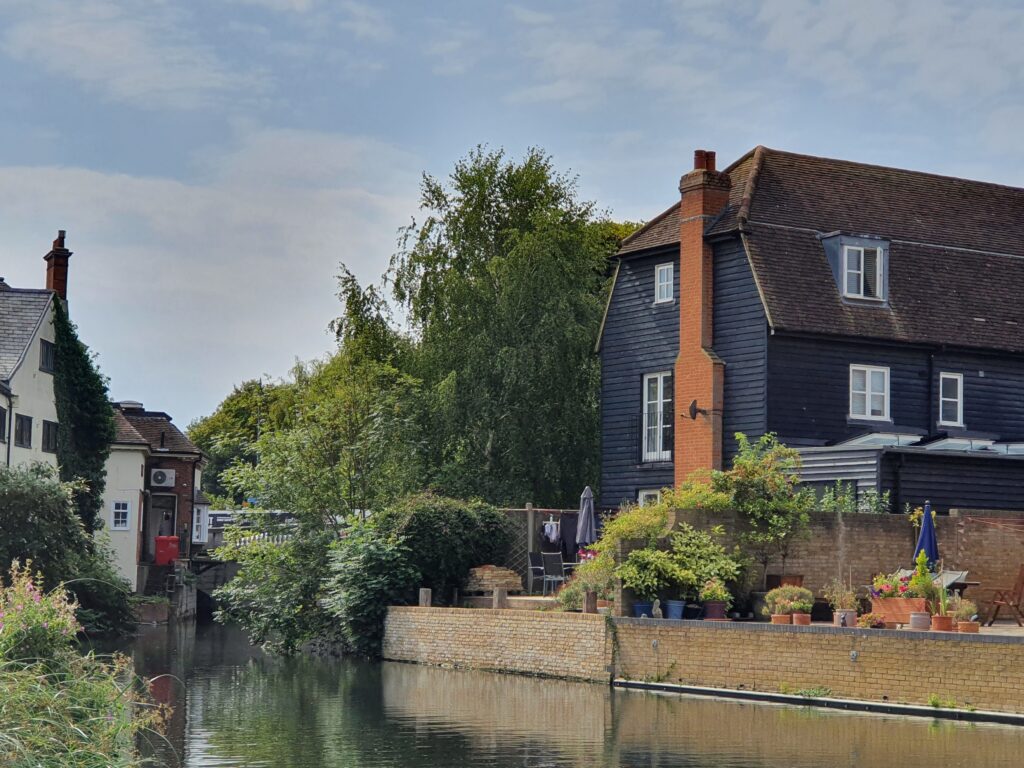
We struggled to get moored in Hertford, (the canal is quite narrow and overgrown here) which is a pity, because it looked an interesting place, albeit one that had become a significant commuter town for those wanting to get into London for work.