

We came across this lovely sight on Sunday. Someone’s found a true romantic. We wondered if there was a string quartet hiding behind the hedge.
Category: Boat Blog
Napton’s novelties
We’ve seen some memorable things on the south Oxford canal
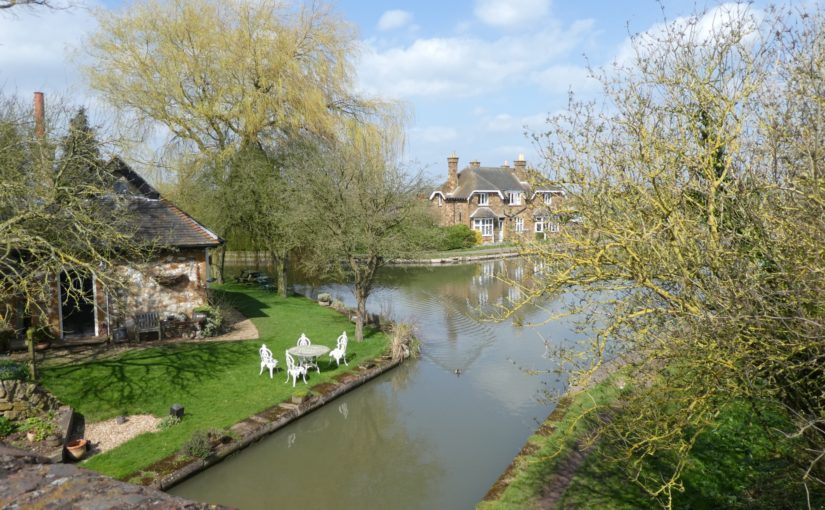
 We reckon this must be one of the most photographed narrowboats not on the network. How it got here we don’t know, but it is marooned all on its own, in a field.
  Eric and I have been debating whether or not marooned is the right adjective to use for a boat on its own personal canal.
Napton, being on a hill, was a significant lookout post during WWII, whereas the enemy used the canals as a significant navigation landmark. Consequently there are a number of concrete pill boxes along the bank, we hope they don’t topple into the canal.
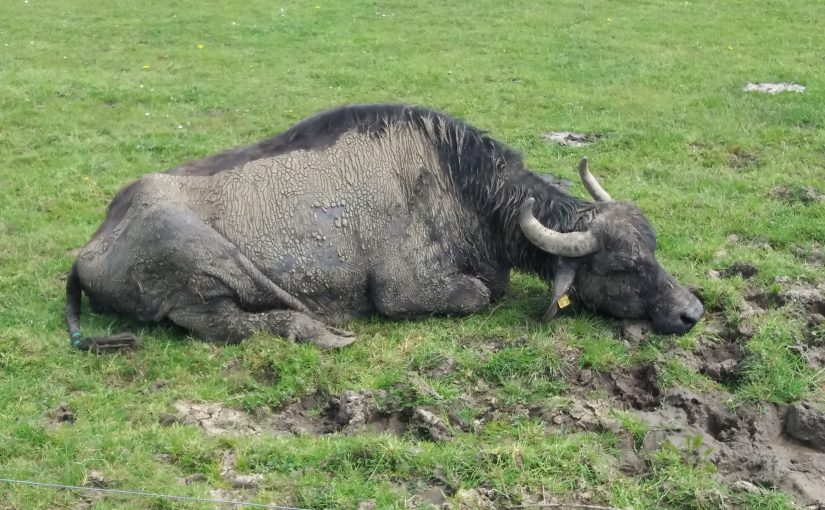
 Then we saw a field of cows. But when I looked over the wall I realised they weren’t cows but water buffalo grazing peacefully-also hoping that they don’t topple into the canal.
 We wondered what they were destined for until I walked up to the village shop, (one of the best little convenience stores we’ve seen)
 And we had the most delicious water buffalo burgers for our tea.
Just imagine a photo of an empty plate here…
On my way back from the shop, I discovered the Napton Cidery. A wonderful small brewery in one of the farm barns.
 I was generously plied with samples before I bought a few bottles, thankfully I didn’t topple into the canal.

As always with canal life, we’ve seen lots of things to make us smile, yet we didn’t really see them the first time we travelled this way a few weeks ago. Canal life is never dull.
Banbury’s beauties
Ride a cock horse to Banbury Cross, to see a fine lady upon a white horse, with rings on her fingers and bells on her toes, she shall have music wherever she goes.
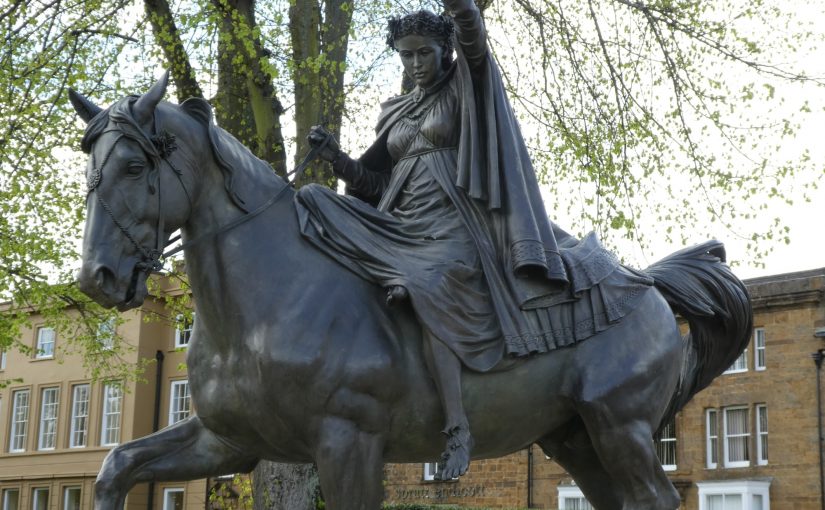
And so I set out to find this fine lady, who is now immortalized with a magnificent sculpture. And to check out the origins of the nursery rhyme. As I expected, there are several versions and interpretations to choose from.

In medieval times there was an annual celebration where children rode hobby horses through the town, they were known as cock horses. Although an adults knee is also known as a cock horse-I shall leave you to draw your own conclusions about that one. The fine lady could be Elizabeth I, Lady Godiva, (Although it was in Coventry that she bared all) or Celia Fiennes, one of the family from nearby Broughton Castle, as in “see a Fiennes Lady”.

Whoever she is, she is celebrating spring, new growth and creativity. As she wears a crown of 13 spring flowers on her head which was originally meant to have 2 butterflies and a moth sitting on it, however before the bronze was finally cast, they fell off and landed on her hair and cloak, the sculptors liked it so left them there. She has bluebells and musical bells on her toes. And her horse is a Welsh Cob

A frog was added to the base later and indont known if it was deliberate, but it sits in a puddle after it has rained.

It really is a stunning sculpture and I returned on several days and each time found a new aspect of it to enjoy.

Banbury’s cross however was overshadowed by it’s Victorian benefactors. There have been several crosses in Banbury as it grew from a Roman settlement, through to a thriving medieval market town and stronghold for Oliver Cromwell. Those crosses have all gone now but the Victorians took every opportunity to erect a memorial to their greatness, this one was to celebrate the marriage of Victoria’s eldest daughter, also Victoria to Prince Frederick of Prussia, in 1859

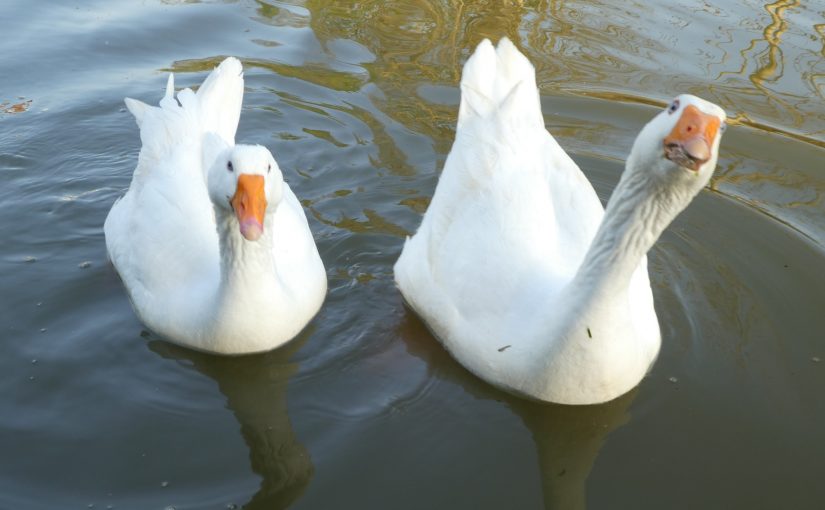
I didn’t find any spring lambs in Banbury but I did discover one of the parks had an aviary

Banbury Banter
I have to apologise for a very sparse blog over the past few weeks. We’ve had a mixture of some lovely cruising and several trips off the boat for various reasons. At this time of year we celebrate a “royal” birthday and eat as much cake as possible. There’s usually one of us that can legitimately blow out the candles. We even had a visit from Tim and Veve.

Anyway this is a boat blog and this week we are enjoying Banbury. The Oxford Canal runs straight through the centre of Banbury and the local authorities have taken advantage of this, creating a pleasant communal shared space.

However mooring is restricted to 48 hours so we stopped about a mile out of town.

We had the advantage of some noisy neighbours, 5 guard geese, who belonged to cottage opposite.

It was quite amusing watching people’s reaction to 5 hissing geese, made all the more hilarious because we had so much rain last week that the tow path had become a quagmire.

We’ll moor here again, 10 minutes walk to Tesco, and 30 minutes walk into town. And the neighbours kept us amused.

Company at Cropredy
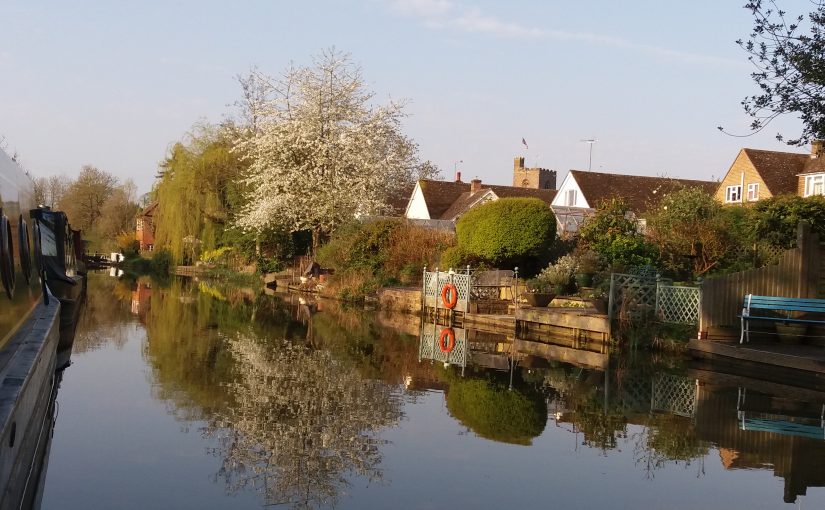
We only stayed one night in Cropredy but it was a pretty mooring and I think we’ll do a bit more exploring on our return journey.

But next time we’ll try not to be cruising through on a Saturday morning because the canal becomes a super highway when the canoe club takes to the water.

We’re not complaining, it’s great to see so many people enjoying the canal but we did feel like we were having a Jurassic park moment when we, the lumbering brontosaurus was being chased by a pack of high speed velocaraptors.

There were lots of lovely things to see on this journey, the May blossom was glorious

And some not quite so pretty but still made us smile

It was only after we’d cruised past that we realised this boater had his trousers down, probably a good job I didn’t zoom in for the photo.

And of course every spring post should have an obligatory lamb

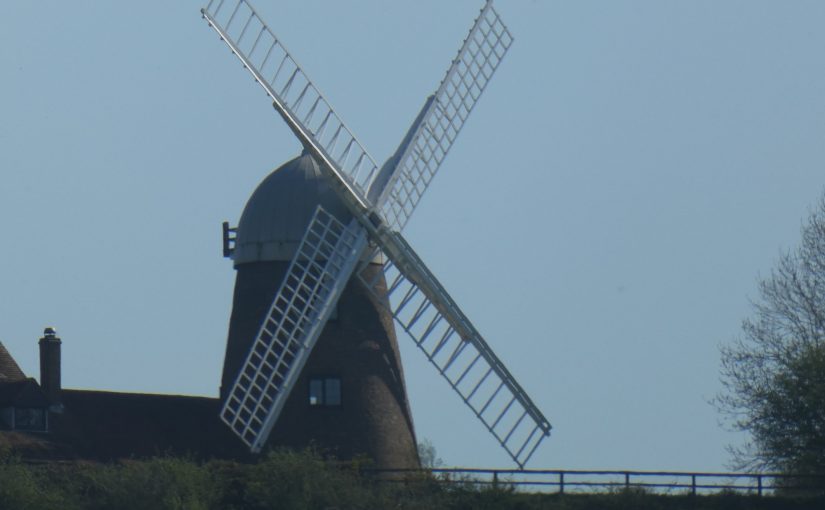
Round the bend at Napton
When Brindley was building the Oxford Canal back in late 1700’s he favoured following the contours of the land when planning it’s route. Its a very twisty canal and you never know if you’ll be facing north south east or west. Which is why the windmill on the skyline is such a landmark.

Even when we got to the locks it’s just about visible, if you know where to look.

We got a lovely surprise at the locks, there were 2 volunteer lockies waiting to help us along. Not only that, one of them greeted us by name, it turned out to be Bill from Beltaine Spirit, Braidbar 168. Bill came though all the locks with us and lots of chatting was done an route.

Unfortunately I’d gone ahead to set the last lock so didn’t get a chance to say Thank you to Bill before he turned to help the oncoming boat back down. So if you’re reading this, Thank you Bill.
We did the 7 Halton locks and the 2 at Marston Doles before we moored up to enjoy the sunshine.
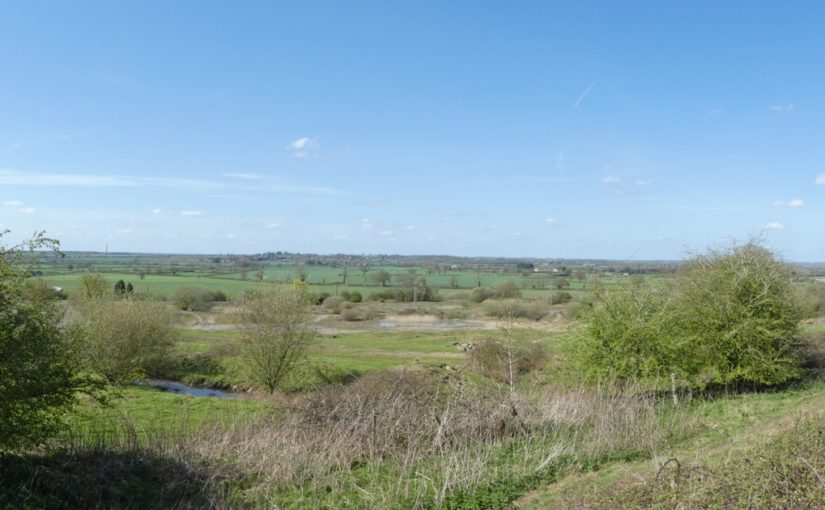
Napton on the Hill
The first place you arrive at going down the South Oxford, is Napton on the Hill, although the village itself is just over the hill. Not being deterred by the strange yellow object in the sky, I thought I’d go exploring in the hope of finding some refreshment.

This pub, imaginatively named “the Bridge” has sadly closed down but it is being renovated into a rather nice home. I left the tow path and followed the signs pointing towards the windmill. And as I climbed up and up and up I was able to sit on these fabulous rocks to look out over the vista.

It looked like I could see for miles and miles, although it was too hazy for the photo to pick up, I could see the Rugby cement works well over 10 miles away as the crow flies.

I eventually made it up to the windmill, which is also now part of a private home so not accessible to the public.

However there was a small commemorative garden, recognising the service from the village during the second world war as Naptons elevation made it a key observation post. The brow of the hill now has too many tall trees to see 360 degrees but I can imagine how terrifying it was to see the bombs being dropped on places like Coventry. 
I carried on walking down the lanes past the Norman church, saying hello to the sheep on the way
 The sensible ones where taking it easy in the shade.

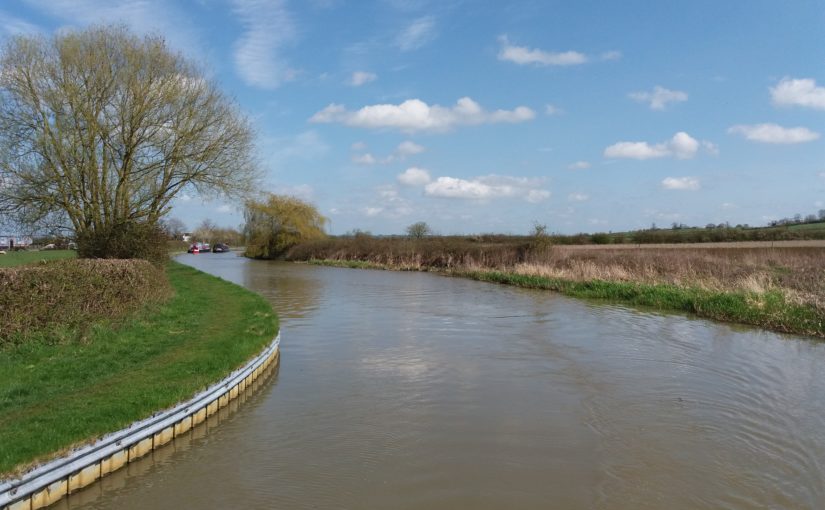
Onto the South Oxford
On Tuesday we woke to the what promised to be the first day of summer 
So we said goodbye to our Braunston moorings and set off under Butchers bridge (having first gone up to the butchers and stocked up on Braunston Bangers).
Under the twin iron bridges that so gracefully mark the entrance and exit to Braunston.

We’re never quite sure what this next stretch of canal is called, is it the South Oxford or the Grand Union. One day I’ll ask.

The weather really was glorious, too hot to be standing at the helm. So we moored up at Napton for a late lunch and to soak up the heat.
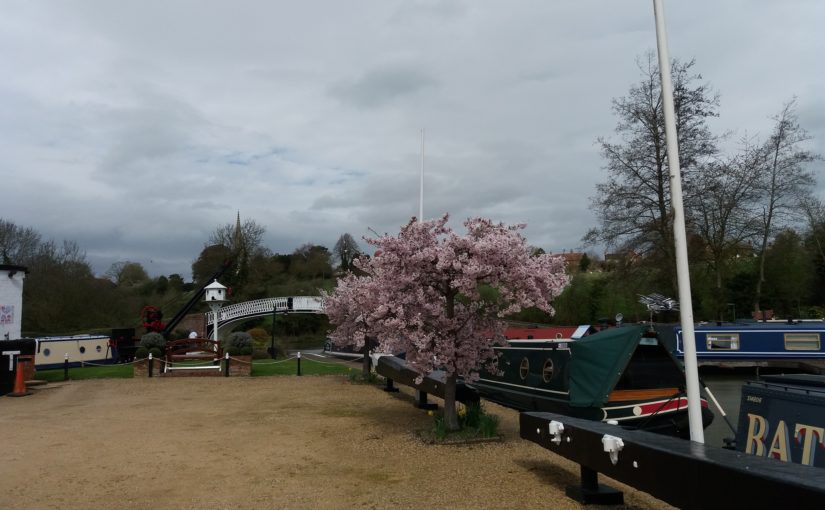
Braunston in bloom
You know how sometimes things just go well, Monday was one of those days. We woke refreshed and eager to get on. We got to the tunnel just before 9 and came through in 22 minutes without meeting any other boat. We dont like Braunston tunnel cause of its kinks. It makes it so much easier when you don’ have to tuck in close to the wall. Then we had the locks to do. No other boat to share the workload with but again we struck lucky. We kept meeting boats coming up, which not only meant all the locks were all set for us we were able to go through open gates and didn’ have to close them. No wonder I was still smiling at the bottom of the flight.

Beautiful daffodils by the admiral Nelson pub bridge.

And the cherry trees were in their full glory in the marina. Spring has sprung and we are very relieved.
While we were in Braunston had a visit from Jo-NB BluePearl, chatted so long a quick cuppa ended up in sending Eric up the hill for fish and chips from the Braunston Fryer.
Norton Junction and the Leicester line
With Amy’s help we did the Buckby locks easily. I then hitched a lift back to Suffolk leaving Eric to polish the floors while I attended to some essential maintenance back home. The trouble with the visitor moorings at the Norton junction is that they are restricted 48 hour stay. They’re fine for an overnight stay but otherwise mundane and functional. Not knowing how long I needed to be off the boat, Eric decided to cruise around the corner onto the Leicester line. Oh what a treat. Plenty of good 14 day official mooring and even more unrestricted mooring with pilings all within 5 minutes walk of the New Inn pub (that does good fish and chips) it’s even got a water point.

Once I was back on board we cruised up to the Watford Locks. I still find it amusing to find us travelling at 2 or 3 miles an hour right alongside a motorway. This time the M1 and the Watford gap service station. 
I know which side of the fence I prefer to be on. But this wasn’t the time for us to venture back into the ‘north’ so we winded Firecrest and returned to moor near the juntion ready to head to Braunston.

One of the downsides of this mooring is that it’s quite a hike to the convenience store at Long Buckby, so on Monday we pulled pins and turned right under the bridge at the toll house, in search of a pint of milk. I believe this gorgeous cottage is now a holiday let But it was once the home of Major Feilding and his wife Ivy, who were canal minister with the Salvation Army.

We stopped at the East end of the Braunston Tunnel to walk into Daventry to restock the larder. Lots of boats coming through the tunnel and we got a lovely surprise when we saw Mike off NB Mister E. Mike’s boat was just being completed at Braidbar when we were planning Firecrest. He’d made us very welcome so it was an ideal opportunity to repay the hospitality and show him around our boat.