
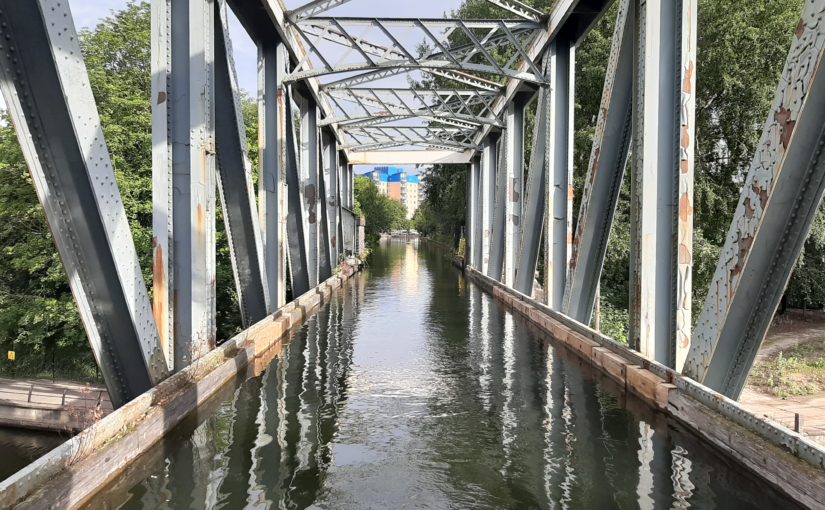
Reputed to be one of the 7 wonders of the canal navigation, the Barton Swing aqueduct deserves this accolade. It spans the Manchester ship canal and is still opened regularly. It is the only swing aqueduct in the world.

It was in 1761 when James Brindley built the first navigable aqueduct in England. He created a 3 span brick and stone structure to take the Bridgewater canal over the River Irwell.

Over a hundred years later 1885 the Manchester ship canal company, bought the Bridgewater canal and in order to facilitate the passage of larger vessels into Manchester, realised they would have to demolish this structure and replace it with something taller or something moveable. Edward Leader Williams designed the Barton Swing Aqueduct, which was built by Andrew Handyside and Co 11 years later. It was a huge feat of Victorian civil engineering. The river Irwell had to be diverted during construction and, because of its proximity to the old bridge, they were unable to test that the swing would work until after it’s completion, when they were able to demolish it.

Fortunately it all went to plan and on 1st January 1894 the new aqueduct was opened and is still in operation today.

It is approximately 100m long 2m deep and 5.5m wide, weighs 1500 ton and carries 800 tons of water. It pivots 90°over a purpose built central island.

The views up and down the ship canal are amazing, looking East to central manchester’s city skyline

And west towards Mersyside and the M60, although this view is dominated in the foreground by the sister, swing road bridge and the central control tower.
Oh boy am I glad I am not responsible for opening and closing this particular swing, it’s a bit heavier than I’m used to. I enjoyed the crossing from the safety of the boat.

It was originally swung by steam operated hydraulics until 1940 when that system was replaced by electric pumps. The central pivot system consists of a 8.2 m race plate embedded in granite blocks. Sixty-four tapered cast iron rollers sat on top of the race plate, held in position by a spider ring. On top of that an upper race plate supports the aqueduct and its circular gear rack. But its collosal weight caused these rollers to deform.
a hydraulic press was installed in the pivot to help reduce the pressure. When water was admitted it took up to half the weight, but it was still pushing the structure to its limits and by 1927 it had dropped by nearly 10cm
In 1928 the hollow iron rollers were replaced with steel and since then the bridge has dropped by only 2.4mm and the hydraulic press wasn’t needed any more. Sadly the current custodians aren’t paying much attention to the aesthetics and although it is in working order, it’s in need of more than a lick of paint.

The crossing only took us 5 minutes and I wanted to turn round and do it again.

The original swing aqueduct was built with an elevated suspended towpath 2.5m above the water level. I wonder what the horses thought as they pulled their narrowboat cargo. I don’t think I’d have been brave enough to use it.

I would have liked to have seen it being swung and although I believe it is opened twice a day, I couldn’t see any information about when.