King Charle’s Chester

We took a few more days to cruise up into Chester, stopping under the Egg bridge at Waverly and outside the Cheshire Cat, but eventually found ourselves the perfect mooring in King Charles’s garden.

King Charles’s tower

The early morning golden sunshine lit up his tower on the Roman wall filling us with a sense of adventure as we explored the city. It is suggested that during the first English Civil war (1642-1646) this is where Charles I stood and watched his soldiers being defeated at the Battle of Rowton Heath. Personally I think he was enjoying looking at the narrowboats moored below, until Eric pointed out that he might have been plotting the route but the canal wasn’t actually built until the 1770’s.

Looking down into “our” garden

Chester has a fascinating history, far too complex for me to do justice to. However it’s proximity to the River Dee made it ideal for the Romans to establish it as a major fortress between England and Wales. They named it Deva Vitrix , and built the original wall. The Anglo-Saxons maintained, repaired and strengthened the wall to help defend against the marauding Danes. And it continued to protect its residents until the disastrous 16 month siege in 1645 when the Royalists fell to the parliamentarians. Chester then realised it was more profitable to welcome visitors, both traders and tourists, and the wall became a 2 mile circular pedestrian thoroughfare.

Eric the gladiator

Until the 1800’s Chester had thrived as an inland port, and although hard to imagine now, taking some quite big ships on the River Dee.

The River Dee

Sadly or fortuitously -I would say the latter, the combination of the River Dee silting up and Liverpool being able to take the bigger ships on the Mersey, the port faded away. But the local entrepreneurs realised that a canal could help maintain trade links both onto the Dee and the Mersey.

Is it a most or a canal?

Beside the canal, one of the highlights of the city, is the stunning architecture. Many of the original Tudor buildings remain, but the spectacular city centre is predominantly Victorian. We shouldn’t complain because we fall into this catergory but they are a significant draw for the tourists making it a strangely busy place to be. Both Eric and I were content just to wander around looking up and all the intricate wooden carvings, and the unique balcony walkways,

Waltons jewellers and the Chester cross

and at the same time looking down to the Roman ruins

What remains of the Roman bath houses

Luckily for us the mooring below the wall is 14 day so we had plenty of time to explore.

The Eastgate clock tower

Climbing the castles

Although we have descended a few locks, with the exception of one or two comical rocky outcrops this part of the Cheshire plain is fairly flat. But if you’re going to build a defensive castle where better to put it than the local view point. And where there’s a hill, we’re not the only ones take advantage to climb it.
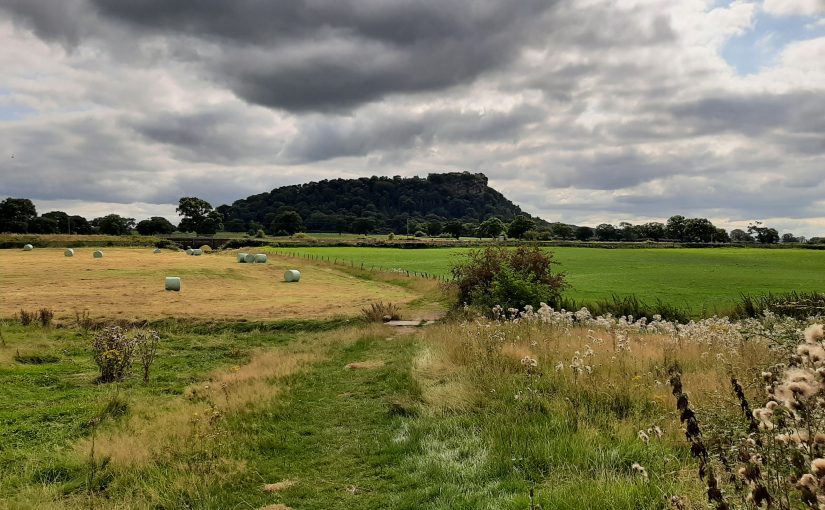
Beeston castle dominates the skyline along this section of the canal and its an easy walk from the Shady Oak moorings. So after an enjoyable afternoon with our new friends, when we woke the next morning to a day promising to be a lot cooler we decided to stay put and explore on foot.

A promising morning

Beeston castle is now owned by English Heritage and today it was over run with marauding children attired in printed chain mail tabards, brandishing wooden swords. But back in the day, in the 1220s, Ranulf de Blondeville, the 6th Earl of Chester, returned from the real crusades to built this castle. It was never a royal residence but Henry III used it to keep Welsh prisoner of war, when the English and Welsh weren’t quite so amicable.
In 1394, it was rumoured that rumoured that Richard II hid his royal wealth in the grounds of Beeston castle, but did so rather too well for it still hasn’t been found. We kept our eyes open, but we couldn’t find it either.

Beeston castle


Whilst we were searching for the treasure, we realised we were also within walking distance of Peckforton castle on the neighbouring big rock. So we continued exploring and enjoying the views. I’m fairly sure we could see Mow Cop, that we climbed several weeks ago from the Macclesfield canal, and we definitely could see Liverpool’s cathedrals and the Welsh hills. The cloud cover made photographs pointless.

Peckforton castle

Peckforton castle looks medieval but was actually built in Victorian times, by the eccentric Tollemarsh family. Nowadays it is a fancy hotel and wedding venue. We weren’t invited to stay but never the less it was a good walk.

The straight path home

And the following morning we woke to blue skies and another perfect cruising day.

A perfect day to cruise

Tossing the coin, to the left or right?

To the right, we both agreed, lets go to Chester.

Onto the main line, Shropshire union canal

So off we set, travelling northwestish, along the Shropshire Union main line. We weren’t planning to travel far on this first section, because we had heard good things about the “cheese factory” at Calverly. And we were lucky to get a mooring right next to it.

It would have been easy to miss and although there was a short stay 2 hour mooring, it was occupied. Some of the gardens backing onto the towpath, immediately before had boat names and lengths attached to their fences, yet there wasn’t any official CRT signage and not a single boat in sight. We chose an unreserved length, the owners saw us arrive and didn’t say anything so we weighed up the pros and cons and decided that the home owners were probably just trying to deter potential noise at the bottom of their gardens by laying claim to “their bit”. We’d have moved if asked. We stocked up on some Firey Dragon Cheddar and enjoyed a peaceful night there, but the cheese and cafe weren’t quite as “artisan” as I’d hoped.

Calverly Mill cheese factory


Continuing our journey, we had to start working our way through double locks, but the canal is a hive of activity right now and it didn’t take us long to team up and share the load.

Tilstone lock

It didn’t take me long to spot the little round building alongside Tilstone lock. I’ve not yet been able to uncover a confirmed correct purpose of these buildings but the general opinion is that they were a boaters/lock keepers shelter. And one explanation that I like is that the boats carrying explosives for the mining were not allowed any flame on board, so their boats would be cold and dark. These little round houses had a fire so would be a place to warm up, make a hot meal. Fortunately the end of August We were more in need of a cool pint than a warm hot pot. Another unusual feature on this stretch of canal is the Beeston Iron Lock.

Beeston Iron Lock

Most locks are lined with stone but ground structure made it unstable so this one is lined with iron, but even now it is need if constant care, the sides have bowed inwards meaning you can no longer share, for fear of getting stuck when it’s emptied. We caught up with our new friends at the Shady Oak and settled in for an afternoon in the pub and an evening enjoying the sunset.

Looking towards the Shady Oak

Branching out, waters new

We love taking Firecrest onto waters new, and we had no idea what a lovely stretch we were joining.

Starting on the Middlewood branch


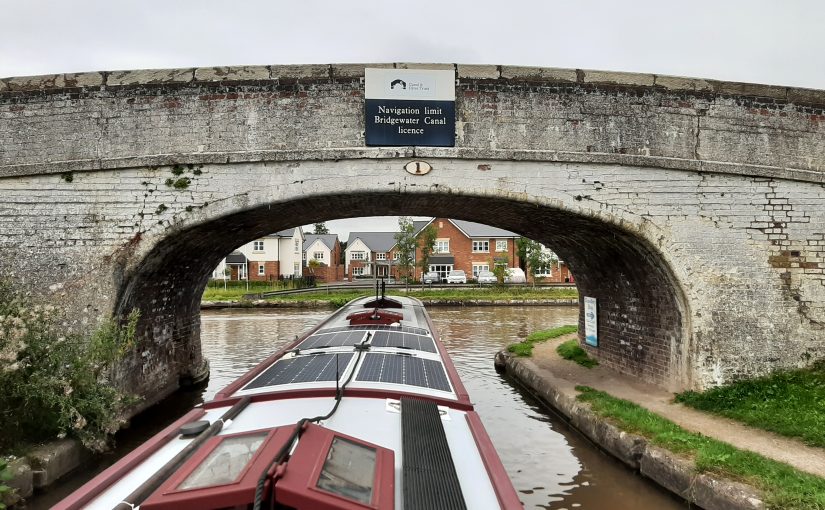
The Middlewich branch is a 10 mile route that joins the Shropshire Union canal to the Trent and Mersey Canal. We started to look for an overnight mooring half way along but got caught by infamous “Shroppie shelf”. This is concrete ledge about a foot below the surface, which makes mooring difficult. The small tyres that we use as fenders aren’t quite big enough to stop us being bashed against the edge if (when) boats cruise past too fast. However, there’s some beautiful scenery and we managed to get in near to Stanley s bridge below Minshul lock.

A perfect cruise

One of the things that makes me happy on the canals is looking at the worn stone steps at the locks and imagining the history. How many feet have trudged up and down.

Well worn steps

But I doubt the working boats would have had to queue like we did at Minshul Lock. When we arrived, we were number 8 waiting to ascend,

Eric, making good use of the long wait to polish the brass port holes, (we have to maintain Braidbar’s reputation )


An hour and a half later, when our turn finally arrived, we had one side of very well polished brass port holes, and there were at least 10 more boats behind us. I don’t know how many more were beyond the bridge, I couldn’t see that far. Yet very few boats waiting to descend.

Now that’s what I call queuing for a lock

I was surprised at how few boaters joined in to help working each other through. Ok I don’t expect boat number 10 to leap into action, but you would think that by the time you are 2 or 3 from the from of the queue, it would be to your advantage to help. So I wasn’t very impressed having assisted several boats myself, by the time our turn came I had to set the lock and open both gates myself. My ladylike decorum was put to one side and I yelled down for some assistance, which to be fair did come running. Many hands make light work, and its far more fun chatting and encouraging each other. Less than a mile and a half on, the following lock was at above Venitian marina, which had the benefit of 2 volockies. But even so we had had enough by then and took advantage of the pleasant visitor moorings.

Venetian visitor moorings

And woke the following morning ready to move onto the Shroppie

Blink and you’ll miss it

Blink and you’ll miss it, The Wardle canal is shortest canal on the system. In the time it took for me to walk the whole length of this canal, Eric exited Kings Lock on the Trent and Mersey, waited for the oncoming boat to emerge from under bridge 168 at Middlewich junction, before arriving in Wardle lock, ready for me to lock up. And that was it. All 154 feet /47m of it.

And that’s it. The Wardle canal

Wardle canal was built in 1829 by the Trent and Mersey Canal authority in order to exercise that authority over the middlewich branch, and Shropshire union. Wardle lock is affectionately know as Maureen’s lock because a boatwoman called Maureen lived in the lock keepers cottage and took great pleasure in helping boats up and down. But we had no time to dwardle through Wardle, we were travelling at the height of holiday hire season, there were so many boats about I forgot to take a snap of her commemorative plaque.


Next stop the middlewich branch.

Leaving Wardle lock and the Wardle canal

Meanwhile in Middlewich

After a day off, we completed 4 more of the heartbreak hill locks to moor up on the wides above Kings Lock in Middlewich.

Kings Lock visitor mooring

A convenient but noisy mooring as the busy A533 runs right alongside, but the neighbours were friendly, and liked to pop in for breakfast, elevenses, lunch, afternoon tea dinner and supper and snacks inbetween.

Please feed us

And the early mornings were idylically peaceful, especially if you’re travelling by hot air balloon

What a glorious morning to take a balloon flight

Middlewich itself is a busy little place, convenient for boaters as it has supermarkets and services, and a very interesting looking Italian restaurant, that used to be a cinema.

The middlewich Alhambra

Historically, the Roman’s valued it for its salt pan, (as most towns ending in a “wich” have a salt based heritage.) And it is the middle of the 3 Cheshire salt towns of Northwich, Middlewich and Nantwich. Nowadays its busy canal junction is the main attraction. We sat out the weekend’s heavy rain and set off on Monday morning, Kings Lock being the last in our descent of Heartbreak Hill.

The last lock of Heartbreak hill

A lot more locks, descending Heartbreak Hill


11 months ago, (September 2020) we huffed and puffed our way up Heartbreak Hill, which is the affectionate nickname for the 31 locks on the Trent and Mersey canal between Middlewich junction and Kidsgrove.

September 2020

It’s only a 12 mile stretch, the enthusiastic hire boaters can do it in a day and still call it a holiday. We took three days. Since then we travelled down to Northamptonshire, where we overwintered and locked down around Market Harborough whilst we had our hull zinced and blacked, then made our way back up north via Leicester, the start of the Trent and Mersey, with a pleasant detour onto the Caldon, up the Macclesfield, to Whaley Bridge on the Peak Forest and back down onto the Trent and Mersey. Which is approximately 360 miles and 240 locks and according to ACC canal planner can be done in 26 days……

Screenshot of our travels from ACcanal planner

This time we are descending the flight, and not having a deadline, have taken our time. We started at Kidsgrove by refilling the larder at the newly opened and very convenient canal side Lidl.

Ready to empty the trolly in the lock

Although for the first mile we thought we could feast upon tomato soup directly from the canal, perhaps not, who knows what other contaminants are lurking in that iron stained water.

A lock full of tomato soup

Traffic seemed quite heavy on our first day, and we were lucky enough to benefit from some convenient crossovers.

Practicing for Strictly, dancing between locks

We felt quite sorry for the enthusiastic hire boaters, negotiating the queues and etiquette of these locks on a very damp day. Although it was mainly mild drizzle, I got caught out in proper rain shower whilst Eric sheltered below a bridge waiting for me to set the next lock.

Hmmm not our idea of fun

We had had enough after 3 miles and moored up in Rode Heath. Our next day was drier, but this time Eric was suffering from wind…..

Practicing the “Suez manouver”

So after 2 miles we tied up at Hassal Green and enjoyed a pleasant evening accompanied by the constant hum of the nearby M6.

Hassal Green mooring

It might make for a noisy pair of locks but once we were under the bridge the noise quickly settled and we were back in the countryside.

Under the M6

The section to the next obvious mooring (for fickle snails like ourselves) actually feels like the end of the flight, despite there being another 5 to go. Wheelock bottom lock, lock 66 is the last/first of the twinned locks.

Leaving wheelock bottom lock

Over the past 3 days we might not be heart broken, but we had broken the backbone and had completed 26 locks over 7 miles. That called for a treat, aka a fish and chip supper under a pretty sunset.

Wheelock mooring


I had wanted to walk into Sandbach, but the footpath was so overgrown I gave up as not being entirely safe with the wet ground. Instead I walked south to the Wheelock farm shop and stocked up on some local produce, and a Cheshire farm ice cream.

Moving on from the Macc


The last few miles of the Macclesfield Canal take us through Congleton. We used to get tantalising glimpses of the town when we drove up to visit Firecrest in build, but we’ve never actually walked around this little town. The signage from the canal was also intriguing.

Very cosmopolitan


We moored to the north of the town near Stanley’s bridge and walked the mile and a half into the centre.

Congleton town garden


Despite some old timber framed buildings and an attractive town garden, the day was damp and miserable and I wasn’t inspired to spend long exploring. I suspect the town has suffered economically.

But this isn’t a new thing, in 1620 the town was struggling to attract visitors to it’s bear baiting contests. As legend has it, when the town couldn’t find the money to buy a bigger more aggressive beast, they used the funds raised to buy a town bible to buy a bear instead to keep the bear baiting entertainment going. Thankfully they have more respect for their animals nowadays.

Treo

We continued cruising south, under the last of the gorgeous snake bridges so familiar on the Macclesfield Canal. These ingeniously simple designs allows the old horse drawn barges to continue seamlessly when the Towpath changed sides because the horses didn’t need to be unclipped and refastened.

A Macclesfield snake bridge

And one last lock to be tackled at Hall Green. This was originally the end of the Macclesfield Canal, as the mile long Hall Green Branch was built by the Trent and Mersey Canal company in order for them to charge tolls and to retain the water flowing down the Macclesfield Canal. Originally it had two chambers that enabled either side to be the higher or lower level. Many stop locks have been removed from the system, but due to the draft of the Harecastle tunnel and the shallow depth of the Macc the 12 inch drop at Hall Green is one of the nicer locks to work.

Hall Green stop lock

With only a mile to go, we crossed the aqueduct and looked down onto the rusty Trent and Mersey, under bridge 97,

Bridge 96


and onto the Trent and Mersey Canal

And onto the Trent and Mersey Canal

Lots of locks, the Bosley flight

Shortly after leaving Macclesfield we cruised south across Gurnett Aqueduct, looking over you can see the house where James Brindley had served his apprenticeship (and Bryons Lane is a pretty circular walk around to Sutton with a well stocked village shop and tea room worth noting )

Paying Homage to James Brindley

But we weren’t stopping, the clouds were grey and heavy and we wanted to reach the top of the Bosley Flight before they offloaded, which luckily we did, and they did. Thankfully we woke to reasonable sunshine and set off down the flight.

Number 2 of 12

The flight is 12 rural locks, nicely spaced out over a mile, so it usually is a pleasant experience even if it’s hard work. All but the last three were set against us.

10 of 12

And we exited number 12 just 2 hours later.

Made it, 12/12

There’s plenty of mooring at the bottom on the embankment that overlooks the River Dane Valley and the magnificent rail viaduct to the east.

River Dane Valley

And the local lamdmark “The Cloud” to the south, this is the peak that Eric and Tim climbed 2 months ago. I decreed that the Cloud’s cloud would obliterate the view so I would leave it until “next time” before I considered the climb.

The cloudy Cloud

And of course when we woke to a perfect day, we needed to continue cruising.

A cloudless Cloud

Paradise

Paradise…
Or Paradise Mill to be more specific, is home to the Macclesfield Silk Museum, and we managed to be moored up on days that it was open so I booked myself onto a guided tour and I consider anything to do with textiles paradise. Lucky me, I was the only one booked in so as soon as I told my guide I was a spinner, I got the royal treatment. That being said I am not (yet) a weaver so although the concept is familiar, I am no expert. But never the less it was a fascinating tour of the weaving shed and the museum.

Paradise Mill, home to the Macclesfield Silk Museum

Locally, the medieval economy was boosted by an abundance of holly trees which were ideal for making buttons. In Tudor times the aristocracy demanded their buttons be covered in silk rather traditional linen or mohair. Louis XIV is said to have spent $600,000 on silk buttons.

Spoilt for choice

It didn’t take long for entrepreneurs to realise that the moist climate in Macclesfield was ideal for processing silk so it was cost effective to import raw silk rather than the heavily regulated silk thread. Silk is spun by the larvae of a silkworm moth when it makes its cocoon. The silk is then drawn from the cocoon in one long fine thread, and then “thrown” to add twist which strengthens it. Thrown silk threads are then doubled to correspondingly to make thicker more usable thread. Hence the term a “twist of silk.” The French Huguenots, who were fleeing from religious persecution, were master weavers and progressed the Macclesfield silk industry. And in 1743, local man Charles Roe utilised the river Bollin to build the first water mill powering machinery to throw the silk and wind bobbins and pirns for the weaving shuttles, although as the industry grew most mills were driven by steam engines.

Paradise Mill was one of the few mills to still be weaving into the 1980s until it went into liquidation. But although production was abandoned, a farsighted group realised it’s place in our history and was able to preserve it as a heritage museum. Many of the floor looms are still carrying the fabric and threads which were being worked on when the mill closed.

Although grants have been made available to pay to have some of the looms re-warped so they can continue to be worked on. In its hey day, took a team of two women a week to warp one loom, last year it took the heritage team over 4 weeks. Originally there were 32 floor looms in this shed, however some have been replaced by other contraptions from the lower floors for our benefit.

Weaving looms are usually housed on the top floor of a mill so that sky light could aid the vision of the weavers. Often children were employed as the throwers, women were responsible threading up the looms and the men did the weaving. One of the great advances in the machinery used for weaving was the Jacquard machine that allowed for some automation of colour manipulation used to create the elaborate designs. In very basic terms it incorporates an punched card that allows the correct thread to be utilised, some would say a forerunner to the modern computer.

The jacquard machine

The silk from Paradise Mill was primarily used to make ties, but the museum also showcased some dresses. The one on the right was made of a woven silk known as the Macclesfield Strip, popular in the 1920s. After WWII fabric remained in short supply but cunning housewives knew they could buy silk “escape maps” without coupons. This “housecoat” came from A pattern printed in women’s weekly and needed 12 maps to complete it.

“Vintage” 20th century dresses

I would love to be able tp make myself a silk dress, but I can’t imagine it would be practical on a boat, so I contented myself with a Macclesfield button kit

Who doesn’t love playing with buttons

Macclesfield isn’t just a silk town, it also housed the Hovis flour mill right next to the canal. Although nowadays it has been converted into flats.

The Hovis building with high rise flats for those with dough they don’t kneed