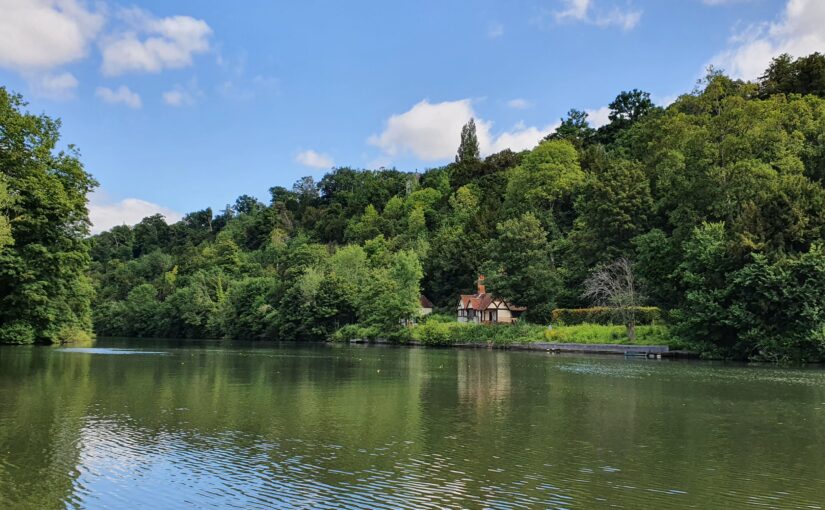
No wonder the tourists love visiting Windsor, everywhere you look there is history, pageantry and Britishness, which includes lots and lots of people and touts cashing in. But we were lucky enough to find a spot of unrestricted wild mooring, opposite the race course, just a 15 minute walk into town.
Wild mooring, opposite the Windsor racecourse.
At the weekends, Eton College opens it’s museums to the public, so as it was Sunday we walked up to the hallowed halls and enjoyed wondering what it would have been to have been educated in a place like this,
The back entrance
but as the Victorian Educator, William Johnson Cory who was an Eton Master expressed, its not so much about being educated, as being taught how to learn, and that was the vibe we picked up. It might seem like a privilege to be educated here, but oh boy we also got the impression that those boys work very very hard.
That’s a lot to live up to
Eton, itself is not just a school but an entire town. Eton being derived from the old English word, meaning “river town”, was a hamlet in 1066, built up by people maintaining the road and bridge from London to Windsor. It wasn’t until 1440 when Henry VI chose to build his new college here that the name Eton became synonymous with an elite education.
One of the main entrances
Nowadays most of the town’s businesses, are dedicated to supporting the schools infrastructure.
Tom Browns tailors
Eton was the first place in England to have a post office and this early Victorian post box shows why in the style of a doric column helps explain why they are called pillar boxes.
A proper pillar box, with a vertical letter slot
Whilst we were there, we saw the Queens Baton relay arrive, which has toured the commonwealth in anticipation of the commonwealth games being held in Birmingham later this summer.
Not quite as exciting as an olympic flame, but still a great honour and I’m sure Birmingham will do us proud
The baton was carried over the Windsor bridge which has been pedestrianised to link Windsor and Eton. We also crossed the river and continued to expore….
As with a lot of places on the Thames, settlements grew because of a river crossing, and Maidenhead is no different. There’s evidence that the Romans set up camp with a ferry, then the Anglo Saxon’s built a “new wharf” aka “the maiden hythe”, that then became a landing stage for the marauding Danes in 870. The Danes moored their longboats here to continue fighting overland towards Reading, (not sure why they didn’t just cruise a bit further, maybe there was a water shortage). But by 1280 a wooden bridge had been built which helped to establish Maidenhythe as a thriving medieval market town. But wooden bridges and rivers prone to flooding are a recipe for disaster. Despite the royal “grant for pontage” ( the right to charge tolls for upkeep and repair) a chapel and hermitage had to be built so travellers could stop and pray for a safe passage or to give thanks that they had made it over and could continue their journey. The wooden bridge battled on through more political, military and civil wrangling, collapsess and rebuilds until the new 13 arch stone bridge was built in 1777.
Maidenhead bridge and the Thames Riviera hotel
In 1903 the toll for crossing the bridge in a horse drawn coach was an eyewatering shilling, roughly equivalent to £14 today. And if you took 20 sheep across, it would have been 10 old pence-roughly £11 today. Eric hoped they didn’t charge for going under the bridge as he’s convinced I have 20 sheeps worth of wool on board with all the spinning and knitting I do. But in 1903 the charity commission deemed the tolls illegal as Maidenhead corporation were using the funds for purposes other than bridge maintenance.
The Maidenhead bridge isn’t the only bridge with a story. In 1839 Isambard Kingdom Brunel completed the Great Western Railway bridge.
The rail bridge
It was an innovative design intended to maintain the shallow gradient needed for the age of steam and at 39m x7m (129’x24′) the low rise arches were the widest flattest ever constructed at the time. However, the commissioners were worried that the bridge wouldn’t be strong enough, so Kingdom Brunel reluctantly agreed to leave the centering wooden formwork in place. But unbeknown to them, he had lowered it slightly so it was no longer of structural consequence. During the next strong flood the wooden “support” was washed away but the brick bridge held fast proving his superior engineering skills.
It might not be the most aesthetically beautiful bridge, but it is indeed a very clever and innovative one. The width and size of the central arch is such that acts as an echo chamber so the bridge is known locally as the Sounding Bridge. Though I’m not sure the local residents appreciate very passing boat tooting its horn, or the local teenagers sharing their greetings.
Not the quietest of bridges
Maidenhead has yet another bridge within its bounds, the M4, but neither the road or the bridge give us any cause for excitement. But its always fun to see things from a different perspective.
Under the M4
We moored at Bray, the exclusive suburb of Maidenhead
Looking back to Bray
next to Eton’s Dorney lakes (where the 2012 Olympic rowing took place), but thanks to a few disrespectful individuals, who used the site as their personal playground during the covid lock down, Eton have now closed it off to the non feepaying public. But we did walk the meadow and saw this flower that we haven’t come across before
Any ideas?….
and the damsel flies were very obliging when it came to being photographed.
I took this snap on my phone
Whilst Eric was lining up the perfect shot
Smile you’re on camera
And the mystery flower is Chicory. Apparently it’s quite common but i don’t recall seeing one before or since
Having cruised past some sumptuous houses over the past few weeks, we dropped by to say hello at Cliveden House. Only to find that the nice little cottage on the bank, was the summerhouse where Queen Victoria used to take afternoon tea. Undeterred we duly paid our £10 mooring fee to the National Trust, (not sure why, when as members we can park for free) and climbed up the hill to the big house,
only to find one or two other guests had arrived first, not being our usual choice of holiday destination, we hadn’t realised not only is Cliveden a NT property but a 5 star hotel as well.
Arriving in style
Not wanting to spark further scandal, political or otherwise, photography wasn’t permitted (Cliveden is where the Profumo affair took place) and the tour of the house was very limited. (Which I suppose if you are paying a starting price of £450 for a room is fair enough) but it is worth having a look on the hotel website for some impressive internal features. Whilst we enjoyed the view from the terrace. ( remember this view for later)
I guess this is technically a house with a river view at the end of the garden
To be truthful I was a bit disappointed that we couldn’t see more of the house, but at £90, we didn’t think we were suitably dressed to enjoy afternoon tea, even if Victoria was no longer around. (£124 for the champagne tea). It was time to see the gardens.
If you need a clock in the garden, it might as well be a smart one
especially the rose garden
Just a few
and the fabulous borders
Borders
The mooring was wild and we struggled to get a rope around a tree to secure the bow,
Very wild mooring
but in the intense heat, we were quite glad of the shade and it made an excellent location for me to swim safely, it was cool clean and shallow, so much so that Eric handed me the scraper and I was able to clean off some of the growth under the waterline. But you’ll have to take my word for that.
Low cost spa
Whilst I was enjoying my natural spa day, Eric set to washing the side of the boat
Its a myth that Braidbar are self cleaning
Refreshing though this mooring was, it was also quite shallow and everytime a fast boat went past we could hear us scraping on a rock underneath us, so said goodbye to the Mandarin ducks
Mandarin duck
and only stayed one night. As we continued our cruise downstream I chanced to look and oh boy did we get a treat. Remember the river view from the terrace? I guess this is what you’d call a terrace view.
During June and July the river really belongs to the rowers, or at least they act as if it does. But thankfully we left Henley before the Regatta officially started. But we we still had to follow the course.
Half way down the sacred 1.25miles
And although we followed the arrowed signage the way ahead looked clear. What we hadn’t realised was the imminent attack approaching from behind. Traveling fast at 4mph (which is a rare occurance for Firecrest) we felt like we were taking our elephant for a stroll around the Ascot race track as the rowers had to slow down from their charge to avoid hitting us. Apparently a men’s 8 averages 14mph. Things weren’t helped by a single non competative rower, (eg the donkey) had ignored the signs and was travelling the wrong way. For us it turned what should have been a dignified dwardle into a fraught furlong.
Being overtaken by the womens 8
But we survived to reach Temple Island which is where the Regatta races officially start.
We’ve reached the start
The eyot with it’s temple, (a folly orignially built as a fishing lodge in 1771), now belongs to the Henley Royal Regatta who forbid anyone to moor or step foot on the island unless the committee gives written permission, can be hired for the day for £1750 plus the hiring of boats to transport your guests.
We decided not to linger, and to be honest breathed a sigh of relief to be off the course. We enjoyed a few nights wild mooring before we reached Marlow, home to the worlds most revered rower Sir Steve Redgrave.
Sir Steve Redgrave, 5 times olympian rower
There was plenty to see in Marlow, a pleasant stroll along the river path takes you to All Saints church, part of historic Bisham Abbey
All Saints, Bisham
But as we have found all along this river some views are tantalising close… if you can swim, but bridges are few and far between. But then again when you do find a bridge, its usually quite special. The current Marlow bridge was built circa 1830 by William Tierney Clark who went on to build the larger Hungarian Széchenyi Chain Bridge that crosses the Danube
Marlow bridge with All Saints Marlow (not to be confused with all saints bisham)
We enjoyed Marlow, although its the first place we have been “disturbed” by several noisy groups who had drunk a little too much champagne (is there such a thing as too much champagne?)
The tree that sheltered us from the heatwave
We’ve become used to seeing some impressive forms of transport on this part of the Thames but this mini caught my eye and made me chuckle
Flower power
And whilst a lot of the enticing looking restaurants were out of our price bracket, the farmers market made up a bit of variety.
A good few days, Sir Steve is wondering about the emerging talent.
But we dont think the doggy paddle will win any golds
After a few days watching the world go by at Lower Shiplake, we were ready to cruise the 2 miles downstream to what is probably one of the most prestigious places to be seen on the Thames, Henley. First we had to cruise past a house featured on Grand Designs,
Definitely a des res
Then after we had passed through Marsh lock, we passed the Henley Rowing club, just one of many multi story carparks for rowing boats, no wonder the river is so busy, and this is just a tiny fraction of what we saw. We’re convinced they deliberately all go out for spin at exactly the same time of the day just to confuse the nervous narrowboats
Henley rowing club
We cruised around the Rod Eyot, (an Eyot being a small river island, commonly seen on (in?) the Thames.) Rod Eyot is populated with about 10 chalets, fancy living somewhere surrounded by water.
Rod Eyot and friends
And for £10 a night (£55 a week) we finally moored up on Marsh Meadows. One of the necessary flood planes, a few minutes walk into the town.
Marsh meadow mooring
Of course what Henley is world famous for now is the annual 5 day Henley Royal Regatta, HRR, which takes place at the end of June/beginning of July, but the race course is set up and used for several other regattas during June and July. We were able to stand on the bridge and see the end of the course and the start of the hospitality.
The fun starts here
Not only is the rowing highly competitive, but I think the social scene is too. And looking back upstream we could see boats and people as far as the eye could see. (We were moored beyond the treeline)
We thought it was time to do some entertaining of our own and Eric’s brother and his wife came to see us. We had a lovely lunch on board, sipping something chilled, as one does in this part of the world,
before we went for a stroll around the town.
The market place
And to see the bridge
Henley bridge
The river and rowing museum was closed the 2 days we stayed in Henley, but one of the riverside info boards showed this painting, an 17thC version of street view looking towards Henley Bridge, when the river was just as much a focal point for the towns economy, albeit in a much more laborious way. It shows the “Flash Lock” designed stem the flow of water downstream whilst the cargo barges queued up behind it, the resulting whoosh of water as it was opened sent the barges hurtling downstream ‘riding the wave’. It sounds quite fun, but it was physically a very hard and dangerous job, and many lost their lives working on the river. Jan Siberechts (1627–c.1703), 1698
Henley on Thames from Wargrave Road
Nowadays the river is just as essential to the towns economy, just in a more gentle fashion
Ok, the knowledgeable will know they’re boats not ships, but oh boy, or oh buoy, we have certainly seen a wide variety of craft floating past Firecrest whilst moored at Lower Shiplake. The most impressive was The New Orleans, a replica paddle steamer, flagship of the Hobbs of Henley fleet.
Now thats the way to go for a paddle
But perhaps one of the most prestigious was the Alaska, another steamer, but this time genuinely part of the national historic fleet, built in 1883, and has been used for the Queen’s Royal Barge.
The steam boat Alaska
Of course not all the boats are quite so elegant but on a sunny sunday afternoon the occupants are still having just as much fun
Some are having to work harder than others
I havent quite worked out the pleasure of travelling backwards yet
Some boats seem very high tech, these rowers were too serious to stop for a chat, we wondered if they are training for some sort of ocean rowing challenge as it had a stabilizer, its the only boat of this style that we’ve seen.
This is some high tec kit
This one seems like its cheating, but I suppose if you can have an E-bike, why not an an E-canoe, it certainly looked a lovely boat.
Youve gotta love an electric boat
Of course we’ve lost count of the cruisers whizzing up and down,
Noisy and fast. Not for me.
but its the Dutch barge style boats that prompt the “… our next boat ….” conversations
I think the biggest argument would be the colour, I love it….
That’s when were not suffering from house envy
Our mooring with a view
Of course for some life on the water is a breeze
But I’m afraid we had a bit of a chuckle here, its not much of a breeze when your boat breaks down and you have to be towed home
The boat that one aspires to is a beautiful Gentleman’s launch.
but for those that don’t have a property with a boat house in which to keep such luxury we saw this concept boat whose owner and inventor stopped to chat
Stopping for a chat
We were seeing it on its launch day, so much so that it doesn’t even have an advertising website yet. But the name on the side is Pubboat. Its a collapsible inflatable design using the modern paddleboard materials that hold the sides rigid like this unlike traditional inflatable dinghies. It folds up small enough to put into the boot of his VW golf. And I think he said it would retail for around £1500. I’m sure this is one for the Dragons Den
Good luck guys
And I haven’t even begun to mention the rowers, paddleboarders, kayaks, swimmers or dogs that we saw in the water. It certainly makes a change from the canals
After a week at Beale Park watching the jubilee celebrations, we took the opportunity for a night on Pangbourne Meadow (so I could restock the fridge without having to carry the shopping down the towpath). I would have called a water taxi but the standard of boat building in these parts leaves a lot to be desired.
Lessons on how not to build a raft
Despite the dodgy rafts, the prestigious Pangbourne college, has historic naval links, but in 1939 it was the Royal engineers took advantage of the meadow and used the area to train in bridge building. However the Whitchurch bridge is still standing (Whitchurch being on the Oxfordshire side, Pangbourne is in Berkshire) has stood on the site since 1792. When it was first built the ferryman received £350 in compensation for loss of trade. Its one of only 2 remaining private toll bridges over the Thames. (Swinford being the other)
Whithurch Bridge
But with the sun shining we set off -our destination, Shiplake lock charging point.
Sometimes its well worth waking up at 6am
Our first chuckle of the day came when we saw two heads popping up out of the water, we realised they were divers, I duly called out what are you looking for?…. “Bodies” came the reply. It turns out they were filming for Midsomer Murders. I suspect Firecrest’s photobombing shot will end up on the cutting room floor.
Hope they didnt find any bodies
Filming was obviously the order of the day, because we saw these two capturing the moment
They were probably estate agents
and this swimmer who was either being chased by a submarine, or was well prepared to sue any boat that cut the corner too close for comfort.
Swim cam
Or perhaps just keeping a look out for anyone going the wrong way.
Sentry duty
but the two things that puzzled us the most, was seeing a letter box built into the railway embankment wall below Mapledurham. Who was going to use it to post letters and who was going to collect them.
Thats an odd place for a letter box
Then we saw another built into the Sonning bridge arch which caused me to ask Mr Google for some answers. The Sonning post box was is an art installation, just the front of a box, put up by the artist, Impro, in 2013, the Mapledurham post box appeared in 2016 but is probably a copycat prank with no one claiming responsibility.
Sonning Bridge
but as I’m posting about bridges, we couldnt pass through this area without mentioning Christchurch footbridge in Reading.
Christchurch bridge
Completed in 2015 linking Reading and Caversham, and if like us you like a few facts and figures, it is 123 metres long, the mast is 39m tall. Is made up from more than 455 tonnes of steel, A 68 m river span weighing approximately 200 tonnes and supported by 14 pairs of cables, 1,100 metres of reinforced cable attached to the main bridge mast, supporting eight separate steel sections A 50 tonne mast sitting 39m above river level, supported on nine piles 750mm in diameter and 19 metres in length. On a hot day, a mast that expands 3cm as it warms up. A bridge deck which expands up approximately 6cm at the middle of its river span on a hot day. A bridge deck is only 380mm deep – about the size of a car steering wheel 234 LED lights – 39 of which are colour changing – alongside its white LED walkway illuminating lighting.
I wonder if it will last as long and look as good as the brick bridges in a few hundred years. We had been warned that there was absolutely no mooring to be had in Reading, however we spotted this gap, which leads directly to the entrance of tesco. I took advantage and restocked the ballast, eg, if theres a shortage of tinned tomatoes or other heavy bulky goods, we’ll be ok
Reading continual moorers
Weve got used to seeing some pretty prestigeous boats but obviously not all boats in Reading wanted to be seen
Spot the boat
We made it to Shiplake Lock to recharge our batteries. And our final mystery of the day….
It was a treat to find ourselves within walking distance of a NT property, so after the forecast rain turned into a beautiful sunny day we walked the 1.5 miles up the hill to discover Basildon Park. What a gem, but at the grand entrance gate we were advised to take the back route up to the house, huh we know our place, but so glad we did, the formal gardens were magnificent, I could have spent a whole hour just inhaling the heady scent of the roses, if Eric’s sneezes hadn’t disturbed the peace.
As is often the case with NT properties the volunteer guides were welcoming and rushed to share information about great house,
The octagon room
We’re not that fussed about knowing it was built circa 1776 by Sir Francis Sykes in the Palladian style, but suffice to say that even wealthy Georgians, fall prey to the odd financial crisis and and social scandal. In the 1830’s it is said that Charles Dickens based his character Bill Sykes on Sir Francis’ grandson. The resulting humiliation and lack of funds meant the family pad had to be sold for £97000.
If you have to contemplate your mistakes you might as well sit in style
Skipping on to the 20th century the house was requisitioned during the war years and sadly fell into a terrible state of repairs, made worse when its owner attempted to transport and relocate the entire house stone by stone to America. Fortunately that venture failed, but by then the house was deemed fit only for demolition. In the 1950s it was bought and lovingly renovated and restored by the Iliffe family. Lady Iliffe had a knack of finding appropriate items at auction, including the bamboo bedroom, which she got for just £1,
The bamboo bedroom
She was both practical and very creative and did a lot of the decorating herself including creating a shell room
Just a small piece of a very ornate room
But not all the rooms were quite so fancy.
I like that kitchen
Inheritance tax demands would have made it impractical for the house to remain in the family so it was bequeathed to the NT in 1978 for everyone to enjoy. I thought id return the following day to take advantage but the forecast sunshine was overshadowed by some big black clouds so ill save that treat for another year.
One of the things we’re enjoying about being on the Thames is the excitement of wild mooring. Can we find a bank where we can get the stern in close enough for me to clamber off with my dignity intact, and long enough that we can get the bow tied off securely?
We’ve mastered the art of tying up now
And preferably one that we wont be charged for. One of the things we’re not so keen on is the uncertainty of not being sure we will be able to moor roughly where we want.
Yes, that’ll do nicely
Beale Park hit the spot, and with a 4 day weekend approaching the river was suddenly coming alive with craft of all shapes and sizes, so we happily tied off to the convenient overhanging trees and settled down to watch the world go by, even if the weather was a bit dodgy, we even had a kingfisher family living directly opposite which provided a lot of entertainment
Thankfully Thursday dawned with clear sky and mist rising.
But alas although it remained clear over Buckingham Palace by the time the fly past was dispersing over Oxfordshire it had clouded over, we’d also got a few storm clouds above. But we still got to see quite a few of the planes that had saluted Her Majesty.
Some formations were better than others
We were able to take a very pleasant walk along the river and down Shooters Hill into Pangbourne village. We couldn’t help but notice a series of very interesting looking houses. It turns out they are known locally as “the seven deadly sins” of Pangbourne. They were built in 1896 to house the seven “lady friends” of the then Prince of Wales, who became King Edward VII
4 of the seven deadly sins
Pangbourne has a regal past with Bertwulf, King of Mercia being granted lands here in AD 844, Athough nowadays his allotted spot is on the village sign, underneath a Viking longboat, (frequently referred to as narrowboats by saxon gongoozlers)
The sign also pays homage to local resident, Kenneth Graeme, who wrote Wind in the Willows (although the book had already been written before he moved here) but its thought that E H Shepard based his drawings for the book from sketches done around this section of the river. It is a very pretty village.
St James church
Theres a brilliant butchers Greens of Pangbourne who boast having the best pies. I think we have been spoilt with good butchers recently, because we both agreed it was excellent so much so that we bought a second for our onward journey
Sadly prices are no longer in shillings and pence
On Saturday, whilst we watched Rod Stewart massacring Sweet Caroline at the platinum concert, I kept noticing the sky over London, and sure enough that same sky was all aglow over Firecrest.
But despite the red sky at night Sundays weather wasn’t condusive to us sitting outside for a “river party” so we ended our jubilee celebrations with a hint of a rainbow.
now, how long can I keep my bunting flapping for. Will we be celebrating Her Majesty’s century in 2026 or even her 75th Jubilee in 2027. Part of me hopes so, but by then I will try to devise a way to stop the pennants flapping onto the roof.
Talk about spring showers, we’ve had some really dodgy weather recently. So we have only been travelling in short hops, taking in pretty moorings when we see them.
Somewhere between n North and South Stoke
It’s the not all overgrown wild mooring, some people have some rather nice spots with manicured homes and gardens below Wallingford.
This one surpasses all my previous awards for most sumptuous boat house
Having heard that the footpath at Goring was being resurfaced meant the visitor moorings were closed, we set out for Pangbourne. But just as we landed on the lock, the biggest raindrops ever started to land on us. I had the foresight to ask the lockie if there was anywhere close to shelter, there was, we got tucked in around the corner by the weir.
Look at that raging torrent
not that we could see the weir initially, but it didn’t take too long for the clouds to run dry and we could see the weir and a little hydro electric generator
Looking down on from the bridge
and for the Egyptian geese to come and say hello
Not the prettiest goose but a nice change from the canada geese
Goring-on-Thames is another chocolate box village, pop phenomenon George Michael sadly died here at his home, Mill Cottage. Its also where Oscar Wilde lived when he wrote his play “An Ideal Husband” however I dont think his character Lord Goring was ideal. But we shall choose to remember that Goring Village Butchers sells the best Cumberland sausages we’ve had in a long time.
That’s Mill cottage and St Thomas of Canterbury church
I took an opportunity to walk across the bridge,
A bit of oak mellowed to blend with the concrete structure
into Streatley on the southbank. I was about to start walking up the onto the North Wessex downs ( why are hills called downs not ups?), but the storm clouds put in an appearance so I only made it into the meadow.
Streatley meadow
Goring and Streatley are also known as the Goring Gap, where the Chilterns on the north of the river come close the the North Wessex Downs on the south of the river. (Although at this point as the river is running north to south, the hills are on the east and the west)
Whilst we were moored at Goring lock, I realised the cover picture on our paper Heron map is Goring Lock.
That looks familiar
The weather dictated we stayed 2 nights in Goring
These locks make us feel quite small
before we continued our journey towards Pangbourne.